
-
Your next favorite book
is waiting.
Summary | Excerpt | Reviews | Beyond the Book | Readalikes | Genres & Themes | Author Bio
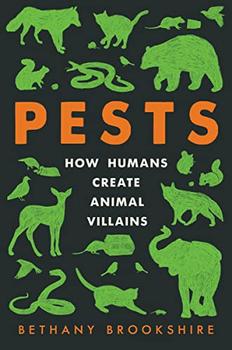
How Humans Create Animal Villains
by Bethany Brookshire Book Reviewed by:
Archaeologists have found ceramic mousetraps that are more than four thousand years old in the cities of Bampur, Mohenjo-Daro, and Mundigak, ancient cities in what are now Iran, Pakistan, and Afghanistan, respectively. The residents of the ancient cities molded clay mousetraps with strings that controlled a sliding door. They looked a bit like tiny mailboxes (with air holes).
Stories of pests have been passed down from antiquity. Anyone who has read the Old Testament book of Exodus will remember the ten plagues that God sent to Egypt. The rivers turning to blood and the dreaded killing of firstborn children were the most dramatic, but other bizarre weather events included rains of flies, gnats, and frogs. In the book of Samuel, when the Philistines take the Ark of the Covenant, they are afflicted with a plague of mice and "tumors" (whether these were bubonic plague lumps or hemorrhoids is up for debate). When they returned the Ark, they had to send with it five golden "images of your tumors and images of your mice that ravage the land." An extra payment to go with the pain. In Aesop's fables, stories allegedly told around the sixth century BCE, a farmer sets out a net to catch the cranes dining on his grain. Instead, the net catches a hapless stork. The bird pleads for his life, insisting he's not a crane, he just hung around with the wrong birds. The farmer has no pity. If the stork associated with those nasty cranes, well, he deserved the same fate.
As time went on, the divide between animals we loved and animals we loathed sharpened, especially in Western culture. A house or town wasn't just about shelter from the cold and wet, says Harriet Ritvo, a historian of science at the Massachusetts Institute of Technology. It was about people "defending themselves from all the things that nature could do to them." Nature was out there, cold, wet, very muddy, and full of sharp rocks. It wasn't a place you escaped to, it was somewhere you tried to escape from. Ritvo has studied how people have viewed the environment around them over time. "It's an artifact of [Western, often white] modernity that people feel really able to appreciate the natural world as a source of beauty and inspiration and something you go in pursuit of, instead of something that you hide from."
Up until about the Industrial Revolution in Europe, she explains, pests were a fact of life. Most barns had rats, houses had mice, fields had crows, and henhouses had foxes as a matter of course. People devoted a lot of time and money to keeping them out. But they were used to feeling vulnerable, used to feeling that true control could never be had. After all, no one could keep out every pest.
But as human technology improved, Ritvo explains, "the obstacles to all kinds of things presented by the natural world diminished." Bogs were drained, wild forests were cleared. The tops of the tallest mountains felt the imprint of our intrepid boots. In the process, we became better and better at keeping nature, in all its hairy and feathered glory, out. Our sense of control increased. Humans—white European humans in particular—were masters of all we surveyed.
Unless, of course, we weren't.
The concept of "pest" has a lot to do with our sense of our own power, Ritvo explains. As our sense of control increases, an animal may go from nasty pest to revered icon of nature. Like the red squirrel. Or the wolf.
WOLVES (CANIS LUPUS) are predators. They get top billing as the Little Red Riding Hood–munching hairy nightmares of our childhoods. They have certainly killed their fair share of humans, but, far more often, the gleaming white teeth of storybook fame aren't coming for us. Instead, they are coming for the sheep we guard or the deer we want to hunt for our supper. In many areas, wolves still go after sheep and cattle. Why hunt a fast-running deer, when the slow, stupid, fluffy sheep aren't going anywhere?
Excerpted from Pests by Bethany Brookshire. Copyright © 2022 by Bethany Brookshire. Excerpted by permission of Ecco. All rights reserved. No part of this excerpt may be reproduced or reprinted without permission in writing from the publisher.

L.A. Women by Ella Berman
Two ambitious writers in 1960s LA face betrayal when one writes a novel based on the other's life.






Your guide toexceptional books
BookBrowse seeks out and recommends the best in contemporary fiction and nonfiction—books that not only engage and entertain but also deepen our understanding of ourselves and the world around us.


