
-
Your next favorite book
is waiting.
Summary | Excerpt | Reviews | Beyond the Book | Readalikes | Genres & Themes | Author Bio
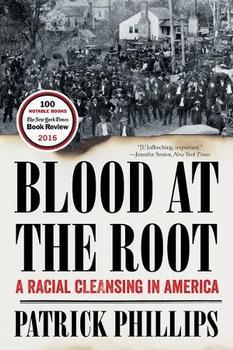
A Racial Cleansing in America
by Patrick Phillips Book Reviewed by:
I'd thought of the story of Mae Crow's murder as a kind of tall tale all my life and had even questioned whether African Americans ever really lived in Forsyth. But now I was suddenly confronted with the truth—or at least something closer to it than I ever thought I'd get: three white soldiers in front of a train car, standing guard over six black prisoners. These were the first faces of black Forsyth I had
ever seen, and while there was no way to know if they were really guilty of the "revolting assault," when I zoomed in and panned across the photograph, I could hardly believe my eyes. Young, fearful, as alive as you and I, the prisoners stared back at me from the very twilight of that old world, and at the dawning of the all-white place I knew. As they peered across the century, frozen there beside the train tracks, I couldn't shake the feeling that the image came to me bearing not just a secret but an obligation.
As I read more about the accused, I realized that the picture raised more questions than it answered. If two of those faces belonged to the "Knox and Daniel" who were doomed to "swing for their crime," which two? And if they were the ones who stood accused of raping and killing Mae Crow, who were the others? That teenager in the middle wearing a porkpie hat, his limbs growing so fast that his white shirt was already a size too small? What about the
Atlanta Constitution, October 4th, 1912
young boy on the right in overalls, resting an elbow on the thigh of an older, visibly worried man? And who was the lone woman, petite and fine-boned, who seems to be—maybe I am imagining this—almost smiling? Was it really true, as the headlines claimed, that she had helped "fasten the noose" around the neck of her own brother? And who was that big man in front: legs spread, arms gripping his knees, as if to shield the group?
This book began with my first glimpse of that photograph, and my realization that while the stories I'd heard were riddled with lies and distorted by bigotry, at their heart lay a terrible, almost unbearable reality. These were real people being led to real deaths, at the start of a season of violence that would send a ripple of fear out across the twentieth century. In the glow of that computer screen, I also began to see how the tale, stripped of names and dates and places, made the expulsion of the county's black community seem like only a legend—like something too far back in the mists of time to ever truly understand—rather than a deliberate and sustained campaign of terror.
Having lived my entire life in the wake of Forsyth's racial cleansing, I wanted to begin reversing its communal act of erasure by learning as much as I could about the lost people and places of black Forsyth. I was determined to document more than just that the expulsions occurred: I wanted to know where, when, how, and to whom.
It was then I set myself the task of finding out what really happened—not because the truth is an adequate remedy for the past, and not because it can undo what was done. Instead, I wanted to honor the dead by leaving a fuller account of what they endured and all that they and their descendants lost.
Excerpted from Blood at the Root by Patrick Phillips. Copyright © 2016 by Patrick Phillips. Excerpted by permission of W.W. Norton & Company. All rights reserved. No part of this excerpt may be reproduced or reprinted without permission in writing from the publisher.
Theo of Golden by Allen Levi
One spring morning, a stranger arrives in the small southern city of Golden. No one knows where he has come from…or why…






Your guide toexceptional books
BookBrowse seeks out and recommends the best in contemporary fiction and nonfiction—books that not only engage and entertain but also deepen our understanding of ourselves and the world around us.


