
-
Your next favorite book
is waiting.
Summary | Excerpt | Reviews | Beyond the Book | Readalikes | Genres & Themes | Author Bio
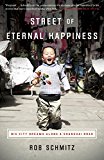
Big City Dreams Along a Shanghai Road
by Rob Schmitz Book Reviewed by:
Modern times hadn't been much better for the people of Hengyang. On a freight rail map of China, the north-south and east-west lines crisscross at Hengyang, creating an X in the heart of the country. It's one of the region's most important centers of heavy industry. Chemical factories abound, as do coal, lead, and zinc mines. The air was polluted and rancid, but there were jobs: CK's grandmother worked at the railway bureau, his mother at a phosphate fertilizer factory, and his father at the Hengyang City Number Two Construction Company.
CK's parents were born in the early 1950s alongside the birth of Communist China. Their generation grew up with the Party's schizophrenic campaigns, revolutions, and counterrevolutions that left tens of millions dead, persecuted, and imprisoned. There was rarely a moment of calm. Survival depended on a keen ability to adapt to an ever-changing political environment, understanding that, like a swimmer caught in a riptide, you must resist the urge to swim against a much stronger force. There was always the possibility of patiently maneuvering your way to safety, but you first had to cede control to the system.
As teenagers, CK's parents were sent to the countryside to farm for several years, a typical fate for city kids under the policies of Chinese leader Mao Zedong. Mao dreamed of a China where urbanites worked alongside farmers in a proletariat utopia; when he died in 1976, his dreams went with him. Most "sent-down youth" promptly dropped their hoes and returned home to their families. Upon their arrival, the Party stepped in again, assigning them jobs at local state-owned enterprises. By the time they turned thirty, CK's parents hadn't yet made a single career decision for themselves.
"Would you like to draw or play the violin?" CK's parents asked him one day in 1985. The three sat at the dinner table, the adults searching the boy's face for an answer. His father had always aspired to be a writer or a musician. He was convinced that had he mastered an artistic skill as a boy, he might have been able to wrest some control from the system that had robbed him of his choice in how he made a living. Pushing his son into the arts would serve as a safety net in case China's economy took another treacherous turn someday, he reasoned.
CK's parents had whittled the boy's choices down to skills other family members had shown talent for. The boy's grandmother was a gifted illustrator. His father had happened upon an erhu – a two-stringed traditional Chinese instrument vaguely similar to the violin – in the garbage one day, and had taught himself how to play. The two choices were clear.
"Draw or play the violin," his father demanded as he stared at his son. The boy thought for a moment.
"Draw," he replied.
His parents turned away from him, whispering to each other, before turning back to him. "You will play the violin," announced his father.
CK had just turned four.
CK's lessons started when his family shelled out half a year's salary for a new violin. They ended a couple of years later when the government launched a series of reforms that privatized parts of China's economy. This put employees at the most inefficient state-owned enterprises, such as Hengyang City Number Two Construction Company, on the chopping block. CK's father lost his job, and with that went money for the violin teacher. The family scrambled for an alternative, and someone remembered that an uncle owned an accordion. A new instrument was chosen. CK's uncle taught the boy the basics for half a year until one night when an electrical fire burned down the government-owned shop where the man worked. CK's uncle was the manager, so the government held him responsible and sent him to prison.
"It wasn't his fault," CK's father said about the incident, "It was the system's fault."
Excerpted from Street of Eternal Happiness by Rob Schmitz. All rights reserved. No part of this excerpt may be reproduced or reprinted without permission in writing from the publisher.
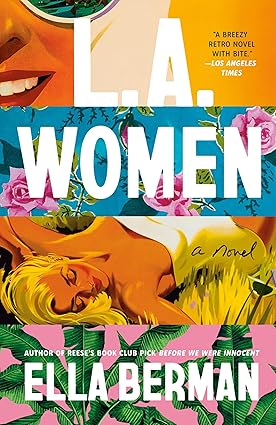
L.A. Women by Ella Berman
Two ambitious writers in 1960s LA face betrayal when one writes a novel based on the other's life.






Your guide toexceptional books
BookBrowse seeks out and recommends the best in contemporary fiction and nonfiction—books that not only engage and entertain but also deepen our understanding of ourselves and the world around us.


