
-
Your next favorite book
is waiting.
Summary | Excerpt | Reading Guide | Discuss | Reviews | Beyond the Book | Readalikes | Genres & Themes | Author Bio
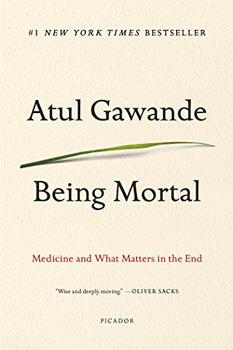
Medicine and What Matters in the End
by Atul Gawande Book Reviewed by:
Introduction
I learned about a lot of things in medical school, but mortality wasn't one of them. Although I was given a dry, leathery corpse to dissect in my first term, that was solely a way to learn about human anatomy. Our textbooks had almost nothing on aging or frailty or dying. How the process unfolds, how people experience the end of their lives, and how it affects those around them seemed beside the point. The way we saw it, and the way our professors saw it, the purpose of medical schooling was to teach how to save lives, not how to tend to their demise.
The one time I remember discussing mortality was during an hour we spent on The Death of Ivan Ilyich, Tolstoy's classic novella. It was in a weekly seminar called Patient-Doctor—part of the school's effort to make us more rounded and humane physicians. Some weeks we would practice our physical examination etiquette; other weeks we'd learn about the effects of socioeconomics and race on health. And one afternoon we contemplated the suffering of Ivan Ilyich as he lay ill and worsening from some unnamed, untreatable disease.
In the story, Ivan Ilyich is forty-five years old, a midlevel Saint Petersburg magistrate whose life revolves mostly around petty concerns of social status. One day, he falls off a stepladder and develops a pain in his side. Instead of abating, the pain gets worse, and he becomes unable to work. Formerly an "intelligent, polished, lively and agreeable man," he grows depressed and enfeebled. Friends and colleagues avoid him. His wife calls in a series of ever more expensive doctors. None of them can agree on a diagnosis, and the remedies they give him accomplish nothing. For Ilyich, it is all torture, and he simmers and rages at his situation.
"What tormented Ivan Ilyich most," Tolstoy writes, "was the deception, the lie, which for some reason they all accepted, that he was not dying but was simply ill, and he only need keep quiet and undergo a treatment and then something very good would result." Ivan Ilyich has flashes of hope that maybe things will turn around, but as he grows weaker and more emaciated he knows what is happening. He lives in mounting anguish and fear of death. But death is not a subject that his doctors, friends, or family can countenance. That is what causes him his most profound pain.
"No one pitied him as he wished to be pitied," writes Tolstoy. "At certain moments after prolonged suffering he wished most of all (though he would have been ashamed to confess it) for someone to pity him as a sick child is pitied. He longed to be petted and comforted. He knew he was an important functionary, that he had a beard turning grey, and that therefore what he longed for was impossible, but still he longed for it."
As we medical students saw it, the failure of those around Ivan Ilyich to offer comfort or to acknowledge what is happening to him was a failure of character and culture. The latenineteenth-century Russia of Tolstoy's story seemed harsh and almost primitive to us. Just as we believed that modern medicine could probably have cured Ivan Ilyich of whatever disease he had, so too we took for granted that honesty and kindness were basic responsibilities of a modern doctor. We were confident that in such a situation we would act compassionately.
What worried us was knowledge. While we knew how to sympathize, we weren't at all certain we would know how to properly diagnose and treat. We paid our medical tuition to learn about the inner process of the body, the intricate mechanisms of its pathologies, and the vast trove of discoveries and technologies that have accumulated to stop them. We didn't imagine we needed to think about much else. So we put Ivan Ilyich out of our heads.
Yet within a few years, when I came to experience surgical training and practice, I encountered patients forced to confront the realities of decline and mortality, and it did not take long to realize how unready I was to help them.
Excerpted from Being Mortal by Atul Gawande. Copyright © 2014 by Atul Gawande. Excerpted by permission of Metropolitan Books. All rights reserved. No part of this excerpt may be reproduced or reprinted without permission in writing from the publisher.
Theo of Golden by Allen Levi
One spring morning, a stranger arrives in the small southern city of Golden. No one knows where he has come from…or why…






Your guide toexceptional books
BookBrowse seeks out and recommends the best in contemporary fiction and nonfiction—books that not only engage and entertain but also deepen our understanding of ourselves and the world around us.


