
-
Your next favorite book
is waiting.
Summary | Excerpt | Reviews | Beyond the Book | Readalikes | Genres & Themes | Author Bio
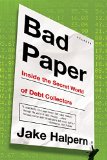
Chasing Debt from Wall Street to the Underworld
by Jake Halpern Book Reviewed by:
The marketplace for consumer debt, as we know it today, traces its origins to the late 1980s and early 1990s. One of the early pioneers of the debt-buying industry was a flamboyant self-made billionaire named Bill Bartmann, whose ability to promote his businesses—and himself—rivals that of Donald Trump and Don King. He grew up in Dubuque, Iowa, but dropped out of high school and left his home at the age of fourteen—at which point he claims to have taken up residence in the hayloft of a barn and joined a gang of ruffians known as the "Manor Boys." "The farmer who owned the barn found out I was living up there and then burned the few clothes that I had left," Bartmann told me. Bartmann eventually went into business, and grew rich by launching a successful oil equipment company. When oil prices crashed, in the mid-1980s, his company failed and Bartmann ended up $1 million in debt. Debt collectors started calling him around the clock.
Then, one day, his fortune changed when he saw an interesting advertisement in the newspaper. The federal government was auctioning off unpaid debts that belonged to two failed banks in Tulsa, Oklahoma. The government had bailed out the banks and taken their assets—including the unpaid debts—and was now trying to recoup its losses. This practice became more common in the early 1990s when the federal government's Resolution Trust Corporation bailed out a number of the failed financial institutions known as savings and loan associations, or S&Ls. Many of the S&Ls had made very risky loans, which ultimately caused them to fail. The government seized their assets and auctioned off nearly $500 billion of their unpaid loans. These auctions helped establish how vast quantities of unpaid debts could be priced at a discount and then sold to enterprising buyers.
At the auction in Tulsa, Bartmann ended up bidding on and winning a portfolio of unpaid debts for $13,000. To pay for it, he borrowed the $13,000 from the very same bank that was still trying to collect $1 million from him. The portfolio was a mix of various consumer loans, including auto loans, recreational vehicle loans, and home improvement loans. He promptly collected $64,000 on this portfolio. Bartmann continued buying paper from the federal government at a discount and then collecting on it with great success; within two years, he had paid off the $1 million that he owed the bank. In the early 1990s, Bartmann bought credit-card debt for the first time and entirely by accident. The credit-card accounts were simply mixed in with the other consumer loans in a portfolio he bought from the government. "Our first reaction was, Oh crap!" says Bartmann. "We didn't want them." The conventional wisdom at the time, says Bartmann, was that consumers were unlikely to repay old credit-card debts because they felt no sense of personal connection to the creditor. It wasn't like an auto loan where, presumably, the consumer made a single purchase and could likely remember the car, the dealer, and the dealership. This conventional wisdom proved false. These loans were very profitable to collect on—twice as profitable as his other paper—and Bartmann was soon in search of more of them.
In 1994, Bartmann recalls going directly to NationsBank, soon to be Bank of America, and offering to buy their old, unpaid credit-card accounts. When a debtor stops paying his or her credit-card bill, the banks count the balance as an asset for 180 days, during which time the bank's collectors try their very best to collect on what is owed. After that time, the Generally Accepted Accounting Principles (GAAP)—which banks must follow by law—require that these accounts no longer be counted as assets, because the money might not be collectible. Banks then "charge off" the accounts, taking a loss. Bartmann was, in effect, offering banks cash for what—on paper at least—appeared worthless or close to worthless. As he recalled: "They sold us their ugliest of the ugly for two cents on the dollar—these were four-year-old charged-off credit-card loans that had been sitting smoldering in the basement for God knows how many years—and we took them home and had an extremely good result with them." In order to maximize his returns, he also began classifying his collectors into distinct demographic groups and paired them with debtors of the same ilk: "We didn't want anyone from the NAACP calling anyone from the KKK, because that would be a nonstarter on day one."
Excerpted from Bad Paper by Jake Halpern. Copyright © 2014 by Jake Halpern. Excerpted by permission of Farrar, Straus & Giroux. All rights reserved. No part of this excerpt may be reproduced or reprinted without permission in writing from the publisher.
L.A. Women by Ella Berman
Two ambitious writers in 1960s LA face betrayal when one writes a novel based on the other's life.






Your guide toexceptional books
BookBrowse seeks out and recommends the best in contemporary fiction and nonfiction—books that not only engage and entertain but also deepen our understanding of ourselves and the world around us.


