
-
Your next favorite book
is waiting.
Summary | Excerpt | Reviews | Beyond the Book | Readalikes | Genres & Themes | Author Bio

The Wright Brothers, Glenn Curtiss, and the Battle to Control the Skies
by Lawrence Goldstone Book Reviewed by:
In 1891, Lilienthal was finally ready to test his calculations. He fashioned a set of fixed glider wings to the specifications he had developed from his research, strapped them to his shoulders, waited for wind conditions to be right, ran downhill . . . and soared. For the next five years, Otto Lilienthal made more than two thousand flights using eighteen different gliders; fifteen were monofoil and three bifoil. He maneuvered in the air by shifting his weight, usually by kicking his feet and thus altering his center of gravity. He became so adept that at times he could almost float, to allow photographers to gain proper focus. Because dry plate negatives had been perfected in the 1880s, the resulting images were of excellent resolution and soon made their way across the ocean. Lilienthal became a world-renowned figure but he had little use for popular acclaim. Instead, he continued to publish scholarly papers and articles and in 1895 patented his invention.
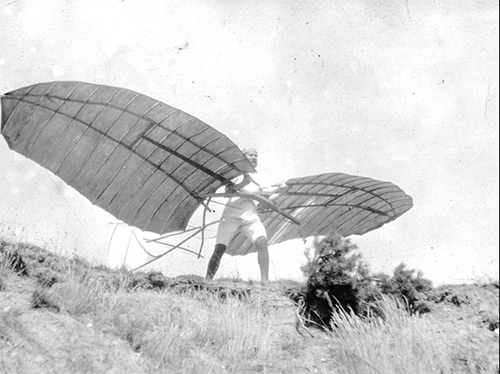
Otto Lilienthal prepares to go aloft.
But gliding was only an interim step; creating aerodynamic airfoils was only one aspect of what was commonly referred to as "the flying problem." To achieve the ultimate—self- propelled, controlled, heavier-than- air flight—issues of thrust, force, stability, and weight ratios needed to be addressed. And certainly no sophisticated flying machine would be maneuvered by an aviator kicking his feet. Still, efficient airfoils would expedite resolution of those other issues, so Lilienthal continued to glide, kick, and measure. As sophisticated as anyone living on the vagaries of air currents, Lilienthal was aware that luck had played a role in his continued success. And luck, he knew as well, had a habit of running out.
On August 9, 1896, Otto Lilienthal's did. During his second flight of the day, he stalled in a thermal about fifty feet off the ground, then fell, breaking his spine. The next day, Otto Lilienthal was dead. In his last hours, he uttered one of aviation's most famous epitaphs: "Sacrifices must be made."
Word of his accident spread across the globe, including to Dayton, Ohio, and the headquarters of the Wright Cycle Company, Wilbur and Orville Wright, proprietors. Wilbur had been following Lilienthal's exploits with fascination, and word of his death, as later Wilbur put it, "aroused a passive interest which had existed since my childhood." Lilienthal's passing left a void in the struggle for manned flight and on that day Wilbur decided to fill it.
Wilbur was fortunate in his timing. In 1896, after centuries of stumbles, streams of research and data were about to coalesce to provide final focus for what was to be one of history's most stunning achievements.
The heavens have been the home of the gods in virtually every recorded religion and not a single civilization from earliest antiquity fails to depict men and often women in flight. Sometimes these ancient aeronauts are in chariots, sometimes in other odd conveyances, and sometimes, like angels in Christianity even today, they fly by wings sprouting from their bodies. Achieving flight, therefore, might well be considered the oldest and most profound of all human aspirations.
Not surprisingly then, the science of flight has attracted the greatest minds in history—Aristotle, Archimedes, Leonardo, and Newton, to name just a few—but achieving the goal stumped all of them. Learning how to maintain a person or a craft in the air demanded more than a daunting scientific vision and meticulous mechanics; unlike many ground-based scientific enterprises, flight was almost impossible to test experimentally. Not that no one tried. In Roman times, slaves plunged to their deaths when ordered by men of science to leap from great heights with feathered wings strapped across their backs. Others throughout the centuries would fall to injury or death in a variety of quixotic contraptions.
Excerpted from Birdmen by Lawrence Goldstone. Copyright © 2014 by Lawrence Goldstone. Excerpted by permission of Ballantine Books. All rights reserved. No part of this excerpt may be reproduced or reprinted without permission in writing from the publisher.
Theo of Golden by Allen Levi
One spring morning, a stranger arrives in the small southern city of Golden. No one knows where he has come from…or why…






Your guide toexceptional books
BookBrowse seeks out and recommends the best in contemporary fiction and nonfiction—books that not only engage and entertain but also deepen our understanding of ourselves and the world around us.


