
-
Your next favorite book
is waiting.
Summary | Excerpt | Reviews | Beyond the Book | Readalikes | Genres & Themes | Author Bio
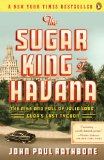
The Rise and Fall of Julio Lobo, Cuba's Last Tycoon
by John Paul Rathbone Book Reviewed by:
Even as a schoolboy growing up in London, I knew that prerevolutionary Cuba with its perfumed waters had indisputable failings. Everyone in 1970s England told me so; the message seemed to be in the very air I breathed. The red double-decker bus that I took to school each day passed a fashionable clothes shop on Kensington High Street called Red or Dead, which later became Che Guevara, and when that shop finally closed down a restaurant opened opposite, called Bar Cuba. Not only was that distant island ruled by one of the world's longest-serving heads of state - whose accomplishments in health and education I was perforce quick to recognize - everybody seemed to revere him too. It was embarrassing.
Even as a British schoolboy wearing shorts, a cap, and scuffed black shoes, I wondered if Cuba's failings had been so exceptional as to have nurtured a revolution that had once brought the world to the brink of nuclear war and had dispersed my mother's family and so many others around the world. It was so at odds with the stories that my mother and her family told me, even though I recognized them as tales of privileged, upper-class Cuban life.
I held the question inside me for many years, teasing away at its contradictions in only a tangential way. After college, I left England and worked as a journalist and economist in Colombia, Mexico, and Venezuela. I was searching, of course, for echoes of my mother's family's past: the music, some of the food, the fast almost slurred Spanish, the mixture of social casualness and Latin formality, the beauty of the mornings before the heat burnt away their color, and the unforgettable smell of guavas rotting in the sun that always draws one back to the Caribbean, as Gabriel García Márquez once put it. Yet while I spent a decade living around the Spanish Caribbean, I never visited Cuba. One reason I stayed away from the island, I told myself, was to inoculate myself against tropical lyricism.
When I eventually traveled to Cuba, I wanted to be able to see through its vehement sunsets, palm trees and romantic colonial past, in the same way that I wanted to see beyond the glamorous life captured in my mother's photographs. More important, I avoided Cuba because I feared that I wouldn't recognize the island from her stories. Worse, I feared that it wouldn't recognize me.
Finally, I began to make short trips. For a while, in the 1990s, I even ran a newsletter out of a London basement that described the travails of the Cuban economy and what it meant for the island's future. It was a confusing time. The collapse of the Soviet Union had ended Moscow's thirty-year patronage of Fidel Castro, and many exiles hoped that his revolution would finally end too. In Miami, expectations swelled of an eventual return and, among the older generations, maybe even something of those glorious prerevolutionary days as well. In Havana, Castro deftly turned those expectations in on themselves. Even as the Cuban ship of state seemed to be sinking beneath him, he conjured up a mythic image of prerevolutionary Cuba, only it was an abject vision rather than golden.
There can be no going back, he exhorted. ¡Socialismo o muerte! I objected to Fidel; I objected also to the feverish hatred of many exiles' anti-Castroism. From England, the vehemence of their passions, their bitterness and rage, sometimes had the feeling of a flat earth society. Publishing the newsletter, I became briefly what others called an expert. I gave talks in Europe and the United States, at universities and in government departments. Yet the more expert I became, the less truth I recognized in much of what I read or heard. Even the best commentary from the island was driven by a government-sponsored sleuthing that aimed to uncover a malignant force - usually capitalism. Yet neither did I recognize a rounded picture in the sugar-coated memories told to me in Miami. In time I came to see that exile imposed a kind of selective censorship, a critical numbing that might otherwise tarnish glorious memories, which can be all that is left when everything else is taken away.
Excerpted from The Sugar King of Havana by John Paul Rathbone. Reprinted by arrangement with The Penguin Press, a member of Penguin Group (USA), Inc. Copyright (c) John Paul Rathbone, 2010.

L.A. Women by Ella Berman
Two ambitious writers in 1960s LA face betrayal when one writes a novel based on the other's life.






Your guide toexceptional books
BookBrowse seeks out and recommends the best in contemporary fiction and nonfiction—books that not only engage and entertain but also deepen our understanding of ourselves and the world around us.


