
-
Your next favorite book
is waiting.
A couple of weeks back, Kim Kovacs posted about her reading challenge to read 80 books set in different countries within one year. Here, by popular demand, is her reading list as a spreadsheet, so you can sort the books by country, rating, fiction vs nonfiction and so forth.
On September 15, 2009 one of my (far too many) book groups embarked on a reading challenge entitled "Around the World in 80 Books." Its object was to read 80 books from 80 different countries over the course of the subsequent 12 months. Of the nearly seventy people who signed up to participate, six of us met the goal. Sure, there's a sense of accomplishment, but far more importantly I've found that I've learned quite a lot over the past year, both about history and about my reading tastes in general.
The first thing I discovered was that when one is looking for books about a specific country or region, it's FAR easier to come up with non-fiction books than novels. Most book sites don't allow you to search by a specific country. (Ever try to find a novel about Qatar or Oman? It ain't easy!) At first, this intimidated me. I've had an annual goal for as long as I can remember to read six non-fiction books a year, and most of the time I don't succeed. I do a fine job of BUYING non-fiction books; there are many that look really interesting. Somehow, though, they always seem to languish on my shelves longer than the novels I purchase. I finally decided, though, that if I was going to participate in this challenge, I'd just have to bite the bullet and read some non-fiction (yikes!).
The New Yorker has chosen its "20 Under 40" list of fiction writers worth watching. The last list was published in 1999 and included future literary stars such as Jhumpa Lahiri, Nathan Englander and Junot Díaz; plus the likes of Michael Chabon, Jeffrey Eugenides, and David Foster Wallace, who were already relatively well known - so the new list has been much anticipated.
The list will be published in the double fiction issue of The New Yorker that arrives on newsstands June 7.
As it happens, BookBrowse has been following these authors too. Below are links to bios of all 20, plus links to many of their books (at least one for each author) and, where available, links to their websites:
In her poem "The Miser," Ruth Padel describes a young Charles Darwin's predilection for collecting and classifying objects as a way to make "like Orpheus, a system against loss." One could say the same for the biography/memoir-in-verse, a dynamic form that allows poets to revisit the lives of their subjects through imagery, rhythm, and metaphor instead of the more rigid bounds of chronology that biographers must follow. Considering that biographies, autobiographies, and memoirs usually make a strong showing on bestseller lists, the poetic analogues to these forms deserve a wider audience and also provide an ideal introduction to newcomers wishing to dip a tentative toe into the rushing waters of poetry.
 Books and documentaries about the Lewis and Clark Expedition have proven popular in recent years, but Campbell McGrath opens a new window onto this famous duo in Shannon: A Poem of the Lewis and Clark Expedition, by focusing on one of its lesser-known figures: George Shannon, an 18-year-old expedition member who became lost from the group for sixteen days. Shannon himself kept no record of what happened during his accidental sojourn on the prairie (present-day Nebraska and South Dakota), so McGrath has free reign to re-create the young explorer's shifting emotions when confronted by the immensity of the wilderness. Implementing the perfect blend of high and low diction, McGrath captures Shannon's voice without strain or pretension in a series of free verse poems, one for each day spent wandering.
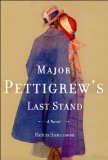 If you're in the USA, UK or Canada, look out for Major Pettigrew's Last Stand, publishing in hardcover in the next few days. It's a charming first novel by Helen Simonson starring retired Major Ernest Pettigrew and Mrs Jasmina Ali, widowed owner of the village shop. Set in a small country village in the south of England, the author absolutely nails the quintessentially English characters and setting, but the story evolves into something deeper than the anticipated microcosm of village life and prejudices. While very different to The Guernsey Literary Potato Peel Pie Society or The No. 1 Ladies Detective Agency series, readers of either of these are likely to appreciate Major Pettigrew's outlook on life.
It's been snowing here since before Christmas. Not much for some parts of the world, admittedly (I sent a picture of my kids sledging to a friend in Canada and she emailed back 'nice frost') but, for us on the south coast of England, it's a totally new experience.
Things I like about the snow:
