
-
Your next favorite book
is waiting.
Sam Tanenhaus, editor of the New York Times Book Review, just published his evaluation of Jonathan Franzen's Freedom, which he called "a masterpiece of American fiction." He went on to say, "The family romance is as old as the English-language novel itself -- indeed is ontologically inseparable from it. But the family as microcosm or micro-history has become Franzen's particular subject, as it is no one else's today."
Ahem.
Allegra Goodman
Alice Hoffman
Barbara Kingsolver
Jhumpa Lahiri
Claire Messud
Sue Miller
Alice Munro
Mona Simpson
Elizabeth Strout
 While stopped at a traffic light yesterday, I noticed a puttering station wagon next to me with a little old lady
in a floppy gardening hat behind the wheel. I could just make out her profile as she peered out her windshield patiently
waiting for the light to change.
While stopped at a traffic light yesterday, I noticed a puttering station wagon next to me with a little old lady
in a floppy gardening hat behind the wheel. I could just make out her profile as she peered out her windshield patiently
waiting for the light to change.
My obstructed view was not due to her petite stature or an advanced stage of osteoporosis, mind you, but rather from the climbing stacks of old newspapers, rotting stuffed animals, cardboard boxes, blankets, and foils in differing states of decomposition; overall, a stockpile that threatened to bust out the windows and swallow her whole.
 I recently joined the ranks of suspense novelists and while I didn't give the word suspense much thought as I was writing, I've since given it quite a bit of brain time. I suppose seeing your book called "A Novel of Suspense" on the cover will do that.
While suspense is a literary category that can embrace many different types of stories, it is also one of the most natural of elements in the real world. The broad definition I've come to these days is that suspense is simply a recognition of the fact that we don't really, on a moment to moment basis, know what the hell's going to happen next. Of course our natural defenses, the same ones that limit what noises come into our ears or what sights come into our eyes, keep the lid on this what's-coming anxiety and allow us to function. But then there are the moments, the ones most often exploited by writers, in which we can't deny that we are in the dark about the future, that we don't know what's around the corner.
The "what-ifs" that kick off so much of our mystery/thriller/suspense fiction are often rooted in our anxieties about life itself. What if I woke up in a strange land? What if I opened my freezer and found a severed hand there? What if an airplane dropped out of the sky and wiped out my back yard? The beauty of finding these oddities between covers is that we have some assurance the author does know what's going to happen next and will lead us through the suspense to the safety of knowledge.
Is it just me, or does there seem to be a wave of "intersecting lives" novels lately? I'm talking about novels which are structured around characters and place and which move forward episodically, rather than via a driving, suspenseful plot, a genre which is also sometimes called "a novel in stories." Two of the most decorated books of recent years fall into this category: Olive Kitteridge by Elizabeth Strout and Let the Great World Spin by Colum McCann. Other recent entries include A Short History of Women by Kate Walbert, Await Your Reply by Dan Chaon, and the forthcoming The Madonnas of Echo Park by Brando Skyhorse.
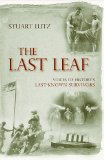 In my oral history book The Last Leaf: Voices of History's Last-Known Survivors, I interviewed over three dozen final eyewitnesses to, or last participants in, historically important events. All of the "Last Leaves" were octogenarians, nonagenarians or even centenarians. Their longevity is remarkable considering the average lifespan of an American born in 1900 was less than fifty. The Last Leaves have defied great actuarial odds. Readers often ask me, "What is the secret to their longevity?" The answer is simple – activity, both physical and mental.
 For example, the famous entertainer Kitty Carlisle Hart, the final lead performer in a Marx Brothers movie, told me, "I gave a concert on my 94th birthday, and am already booked for my 95th...I've been singing all over the country recently...Soon, I go to Palm Beach for a two week engagement." Colonel Norman Vaughan was the last man to travel to Antarctica with Admiral Richard Byrd in 1929.
 He participated in the grueling Iditarod dog sled race until he was 87. For his 89th birthday, he climbed the 10,302 foot Mount Vaughan (named for him by Byrd) in Antarctica, and was planning for a return visit on his 100th birthday when he died. "I'm proving that centenarians can still do great things," he noted. The 104 year old Hal Prieste, the world's oldest Olympian (he won a diving bronze at the 1920 Games), continued his daily exercise routine. In 2000, he flew twenty hours to Australia for the Sydney Olympics. Frank Buckles, America's last World War I soldier, recently turned 109. He kept a bucket of dumbbells by his chair and refused all assistance when walking. "I'll do it myself," he told me. "I gave up driving tractors and cars when I turned 102."
Miguel de Cervantes and William Shakespeare are considered to be two of the greatest writers in the history of world literature, and not only were they contemporaries, but they died on the same day - April 23rd, 1616. In Catalonia, an autonomous region in NE Spain, April 23rd is celebrated as both the Day of the Book (in honor of Shakespeare and Cervantes) and the Day of the Rose because it is the day we celebrate the patron saint of Catalonia, Sant Jordi (see previous post for more about this).
Please join me on a photo tour of Barcelona on this special day.....
