Book Club Discussion Questions
In a book club? Subscribe to our Book Club Newsletter and get our best book club books of 2025!
Please be aware that this discussion guide will contain spoilers!
-
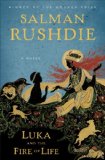
Luka and the Fire of Life was written for Rushdie's son Milan - in fact, Luka is Milan. How do you think Milan will like his gift?
-
What do you think of the fact that Rushdie models the story on the narrative of a video game? Would it make the story appeal more to kids, or is it just awkward?
-
Rushdie emphasizes again and again that the world we live in is woven out of imagination and storytelling, and this includes even everyday things like online games. But Soraya worries that magic is fading from the real world, because people don't think they need it anymore - because of technology. What do you think? And what do you think Rushdie is getting at?
-
The book is full of both childish jokes and highbrow literary references. Do you think these elements work against each other, or did you enjoy the effect?
-
Despite its good humour and adventures, Luka and the Fire of Life clearly touches on some pretty serious themes, specifically a boy's relationship with his father. Luka's ghost-father is named Nobodaddy, a figure Rushdie has borrowed from William Blake, whose Nobodaddy is a tyrant. Yet Rashid is gentle and fun-loving. In other words, Luka is fighting both for his father and against him. What do you think Milan's relationship with his father might be like?
-
The adventure in Luka and the Fire of Life goes upstream on the River of Time. What do you think Rushdie is saying about the relationship between time and imagination?
-
The least likeable characters in the book, the rats, are the ones most fixated on the notion of "respect." What do you think Rushdie is getting at with this parody?
-
The danger of the Swamp in the Mists of Time is that travellers will be so contented there that they'll simply stretch out happily and never leave. What's so bad about that?
-
At one point, Nobodaddy says, "The Fire of Life is the only flame that creates - that restores instead of destroying" (p. 119). What is the Fire of Life?
-
Rushdie brings many mythological figures into the story, often for comic effect, but he stays very quiet about the two most important ones: the "Old Boy" who is so helpful at the end of the story, is one of the most famous of all the Greek gods, yet Rushdie never names him. And Captain Aag, it turns out, was once named Menetius, and in Greek myth, Menetius was the brother of the "Old Boy." What is Rushdie getting at? Who is the "Old Boy"? And, since this is a book at least partly about brothers, why does Rushdie make a villain and a good guy into brothers?
-
What do you think of the way Rushdie brings together the gods of very different traditions and mixes them up with fairy tales as well? Do you think it is disrespectful, or is he paying a compliment?
-
Do you think it's strange that the person Luka falls in love with has the same name as his mother? And why is she an otter? And why do otters love insulting others so much?
-
At one point Luka thinks: "there is no such thing as a purely good deed" (p. 160). What do you think he means by that? Do you think it's true?
-
In the end, Luka figures out that the World of Magic is contained by his father. He doesn't seem disappointed by this at all. Were you?
-
At the end of the story, Luka has misgivings about the Ott Potatoes and wishes they might just disappear. Given that one of them just saved his father, why would he want to get rid of the rest?
Unless otherwise stated, this discussion guide is reprinted with the permission of Random House. Any page references refer to a USA edition of the book, usually the trade paperback version, and may vary in other editions.