Book Club Discussion Questions
In a book club? Subscribe to our Book Club Newsletter and get our best book club books of 2025!
Please be aware that this discussion guide will contain spoilers!
These are original discussion questions written by BookBrowse.
-
What were you doing during the time period depicted in the novel? Were you impacted by the economic downturn, and if so, in what ways?
-
What parallels do you see between the financial situation in the book and today's global economy? What differences do you see between then and now?
-
What did you think of the novel's overall structure, with one character's story flowing into the next?
-
Nine main characters are each given a chapter in the book. Whose story did you find the most compelling?
-
Did you feel any of the main characters were evil, or did you mostly feel they were well-meaning?
-
What role does money – the pursuit of it, the lack of it, the loss of it – play in each character's life?
-
One of the threads that runs through the novel is countries outsourcing their factory work to China, where goods can be made more inexpensively. On the one hand, it leads to unemployment in the US, but on the other, it allows US citizens to pay less for materials. Sometimes it's also the only way for a company to compete with others in the same business. What's your take on this trend? Do you think it can or should be reversed? Why or why not? Do companies have a choice, in your opinion?
-
In Chapter 1, Chinese mayor and factory owner Liang Dacheng must convince his striking employees that working with the Americans is the patriotic thing to do. He tells the crowd it is their duty to "raise the triple banner of flexibility, pragmatism, and reform." Wang Min, the leader of the protest, disagrees. "It's a sellout!" he proclaims. (p. 21). Who is correct, in your opinion, and why? Did your opinion of Liang Dacheng change over the course of the chapter that features him?
-
Ryan Forrester thinks that clean-air acts and regulations were "most likely the death blow to the country's ailing manufacturing industry." (p. 42). What's your opinion on environmental regulations in the US, particularly now that many policies are being rolled back? Do you think the US went overboard, or not far enough when it instituted such regulations in the first place? What influences your opinion on the matter?
-
In Cleveland, Ohio, the family-owned business Payne Tool and Die is about to go out of business. Ryan Forrester tells the family that if they want to keep the company afloat, they'll have to outsource to China, but instead the family patriarch wants to sell their personal property to keep it running. He's outvoted, but had his strategy prevailed, do you think he could have saved the company?
-
Simon Blackwell, a banker in London, thinks to himself that trading is just dumb luck – "being in the right place at the right time" – and equates it to betting at a roulette table (p. 89). What do you think of his attitude about the stock market? Do you share his opinion at all?
-
Tomoko Watanabe attends a sales pitch for a book by a local celebrity hawking investment strategies. Have you ever attended something similar? What did you think of her adopting the woman's advice? How did it change her?
-
Ernesto Hernandez, an undocumented worker from Mexico, is a talented artist who makes his living as a house painter. When he meets the wealthy Kit, he allows her to believe he's a student. She embellishes his story still more when he's introduced to her parents, who then provide him with a studio in which to work. When they find out the truth, they pull all support. Do you think their anger was justified? Do you feel the outcome would have been different if he'd been honest in the first place? Why or why not?
-
Charlie Weeks is in Norway selling bonds to a small city government. He almost dies in a snowstorm, but Gunnar Johannessen, a member of the town council, saves him. They become close, until Charlie finds out Gunnar advised the council against buying his bonds, at which point he feels betrayed. What did you think of Charlie's reaction here? Why does Gunnar's lack of support hit him so hard? Why do you think the council ignored Gunnar's advice?
-
Birgit Johannessen is in Brazil visiting her sister, Karen, who's an activist trying to save the Amazon rain forest from development. They're invited to a local governor's plantation and are entertained by his son, Ricardo. He tells them that "the Amazon has become both the engine of China's growth and Brazil's path to sharing China's rising prosperity." He goes on, "You can't be only focused on trees and eco-habitats. There are hungry people to feed." (p. 241). Later, he gets angry because non-citizens are trying to tell the Brazilian government how to run their country ("Isn't it a little presumptuous for you to show up here in our country claiming you know what's best for us?" p. 245). What's your take on this issue?
-
Arkady Antonov's father sends him to Cuba to observe negotiations around Cuba's offshore oil fields. Before he leaves, his father bets him $10 million that he'll never find love. He goes about trying to disprove this, and does find the woman of his dreams, Yunaisy. Do you think he's motivated by the payout, or is he truly in love? Once Arkady confesses his wealth, Yunaisy changes, trying to meet his standards and ultimately instigating a tragic result. Whom do you blame for the way the chapter ends? Should Arkady have been honest with Yunaisy from the start, and if so, would the end result have been different?
-
Tyler Wilson is in mourning over the loss of his son, Chris, and blames himself for the car accident that caused the child's death – he'd lost his job and couldn't afford to get the car fixed and its brakes failed. His friend Ray tells him it's The New World Order that's to blame, because in sending jobs to China they left people with "no jobs, no house, no savings." (p. 297). The pair end up in New York City taking hostages and making unreasonable demands. Why do you suppose Tyler went along with Ray's scheme? Did you foresee the outcome, and what did you think of the book's ending?
-
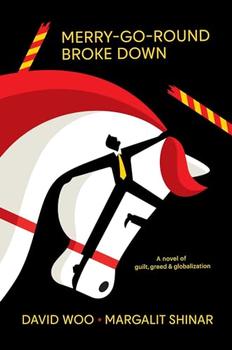
To what do you think the title, The Merry-Go-Round Broke Down, refers to, now that you've read the book?
-
Have you read any books that have had a similar theme or style? If so, how did they compare to this one?
-
Overall, what did you think of The Merry-Go-Round Broke Down? (No spoilers in this thread, please!)
Unless otherwise stated, this discussion guide is reprinted with the permission of Regalo Press. Any page references refer to a USA edition of the book, usually the trade paperback version, and may vary in other editions.