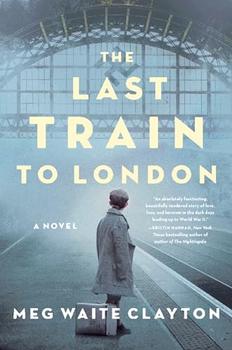
Book Club Discussion Questions
In a book club? Subscribe to our Book Club Newsletter and get our best book club books of 2025!
Please be aware that this discussion guide will contain spoilers!
-
The book begins with words from Elie Wiesel's Nobel Peace Prize acceptance speech: "One person of integrity can make a difference." What is integrity? In what ways is it challenging to possess? Where are there powerful examples of integrity in action throughout the novel?
-
Consider Geertruida Wijsmuller, Tante Truus to the children. What are her most impressive qualities? What makes her willing to take such risks to help the children? What skills make her so successful?
-
In what ways are the Neuman family and the Perger family similar or different? How does this affect the relationship between Stephan and Zofie-Helene?
-
In what ways is it significant that the young Stephan Neuman is a playwright? What are
his goals and responsibilities as such? What other skills allow him to successfully
survive his persecution?
-
How does Zofie-Helene, as a mathematics prodigy, process and articulate her
experience in the world? In what ways might such abstract thinking be useful, especially
in a time of fear and danger?
-
What does Käthe Perger work to accomplish as editor of the Vienna Independent newspaper? What is the role of the press in times of political and social unrest? Why is journalism seen as such a threat to the Nazis and other totalitarian regimes?
-
In what ways is paradox—The Liar's Paradox, The Theater Paradox, The Friendship
Paradox, etc.—relevant to the subject matter of the novel? What does paradox suggest about the nature of human experience?
-
Why might the stories of Sherlock Holmes be so important to Zofie-Helene? Why are
they banned by the Nazi regime?
-
Why does Stephan's Aunt Lisl value painting, in particular abstract painting? What does
it mean that, "photos were somehow less true than…paintings, even though they were
more real"? Why were "cubist and futurist and expressionist works" offensive—or even a
threat—to Hitler?
-
In what complex ways were Tante Truus and her husband Joop influenced by their
experience of three miscarriages? How might they have behaved differently if they had
had children of their own?
-
What is so powerful and significant about Schubert's "Ave Maria" and other music
mentioned throughout the novel? What might it mean that, for Zofie-Helene, "music fill[s] the empty spaces between the numbers and symbols inside her"?
-
What is the difference between propaganda and journalism? How was Hitler able to
convince so many that "his lies are the truth and the truth is a lie"? How does modern
communication technology including the Internet and social media make this more or
less likely?
-
Truss learned from her father that "courage isn't the absence of fear, but rather going
forward in the face of it." What might be other ways to define courage? What are
effective ways to handle fear?
-
Consider the personal details of Adolf Eichmann's life before power—his time with
Mischa Sebba, his being denied entrance into the Hotel Metropole, etc. How might these
have influenced his ability to visit such terror on fellow humans? What's the relationship
between personal experience and political leadership?
-
What might go into the profoundly difficult and complex decision for parents to send a
child away that he or she might be safe?
-
What particular strengths does Ruchele Neuman exhibit? What went into her decision to
send her sons, Stephan and Walter, to safety?
-
What is the role and value of literature to Stephan, his Aunt Lisl, and others? Why are
the words of Stefan Zweig so comforting to Stephan, even when living in the tunnels
beneath the streets?
-
Truss laments to her husband Joop that, "I'm a woman who can't bear children in a world that values nothing else from me." How does such a narrow, restrictive, even
oppressive value system exist despite the many and important accomplishments of
women? Which girls and women in the novel find ways to transcend such limits?
-
Zofie-Helene learns from her mother that "people never expect…a girl in charge" but that "it can work in her favor." What might this mean?
-
How is it that "decent German people" came to permit and witness and even participate
in the violent persecution of their fellow citizens "like holiday makers at a fair ground"?
-
What is powerful and significant about the infinity necklace that Stephan returns to ZofieHelene years after they are safe in England?
-
In what profound ways was Tante Truus the "Mother of 1001 children"? What did she
understand about children, especially in such traumatic times? What is her legacy?
These questions were originally posted on the author's website at: https://megwaiteclayton.com/
Unless otherwise stated, this discussion guide is reprinted with the permission of Harper. Any page references refer to a USA edition of the book, usually the trade paperback version, and may vary in other editions.