Book Club Discussion Questions
In a book club? Subscribe to our Book Club Newsletter and get our best book club books of 2025!
Please be aware that this discussion guide will contain spoilers!
-
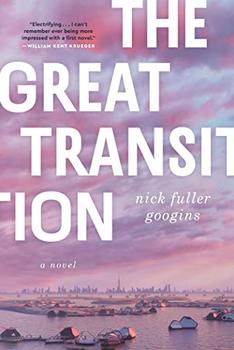
Compare and contrast Emi's parents, Kristina and Larch. How do they define the future? What are their different priorities for their daughter and themselves?
-
Emi often listens to music (specifically the "oldies") when she is worried about the planet and wondering what she can do now that the crisis is over. What does this tell us about humanity in the post-Transition future? Do you find yourself using music to cope with anxiety in your life? Do you ever turn to music to grapple with with the big problems facing society?
-
The field producer Joanna Lee reminds Larch that Corps Power was propaganda: "The good kind. Hearts and minds." Do you believe Culture Corps had good intentions in televising positive content about fighting the climate crisis? Do you think there such a thing as good propaganda?
-
Larch and Kristina have different ethnic backgrounds. How does race and immigration play a role in their individual worldviews and their outlooks on the future?
-
Kristina says, "School isn't the only place to learn ... School can't teach you how to live with hunger, or go weeks without a shower. The greatest lessons come from life experience." Do you agree with Kristina's view? Why do you think the author, who is an elementary school teacher, would include this perspective in his novel?
-
We get to witness the progress of Emi's North American History paper for Mrs. Helmandi's class. What do these drafts reveal to readers? How was this component necessary for the novel?
-
Larch's best friend, Lucas, is Puerto Rican. However, he views the Transition differently from Kristina, who was born and raised in central Mexico. If Lucas and Kristina are both refugees from the Global South, why don't they share similar views? How do they interpret their experiences differently?
-
"A revolution is not a tea party" is thrown into conversations multiple times throughout the book, a variation of the famous saying coined by Mao Zedong. What does this phrase mean to you? Can a revolution be peaceful? Give examples of historic revolutions that emulate, or contradict, that slogan.
-
Why do you think Indigenous people are exempt from extraction duty? What does this tell readers in regard to the relationship between Indigenous people and North American land post-Transition?
-
Kristina abruptly leaves Emi and Larch to work for the Furies. Later, Kristina tells Larch that she did it to keep her family safe. How does Kristina view parenting, in comparison to how Larch views it? Do you consider Kristina to be a good mother? How do traditional parenting roles play into this conversation?
-
Reena and Angel, who befriend Emi in New York, want to join the Furies and participate in the revolution. Do you think children and young adults have a place in this revolution? In what ways do children and teenagers today become involved in political conversations, such as those about gun control or the climate? Should they be involved? Why or why not?
-
Socioeconomics play a huge role in this book. We learn that the Furies are targeting rich officials whose actions led to the climate crisis. In a conversation between members of Larch's deconstruction crew, his coworker Ellen says "The rich are coming off a two-hundred-year rager that burned our planet to the ground. We're the cleanup crew. The moment we're done the party will be back on. And if you think you're getting an invite, Larch, I just feel sorry for you." What are your thoughts about the class gap? Do you believe, if given the chance, the rich will relinquish their lifestyles and accept a lower standard of living? Is there a chance that a new, more equal "normal" can be instated?
-
Larch is vocal about Emi enjoying her youth and participating in celebrations. Are celebrations essential to society? Can joy be defined as another form of resistance? In what ways do you practice active joy?
-
Larch and Kristina's love story is one with many obstacles and much turbulence. Towards the very end of the book, we witness the conversation between the couple about having a child. Why do you think Kristina changed her mind about having a child? Do you think young people today have valid concerns about bringing children into the world, given the ongoing climate crisis?
Unless otherwise stated, this discussion guide is reprinted with the permission of Atria Books. Any page references refer to a USA edition of the book, usually the trade paperback version, and may vary in other editions.