Book Club Discussion Questions
In a book club? Subscribe to our Book Club Newsletter and get our best book club books of 2025!
Please be aware that this discussion guide will contain spoilers!
-
Lark is dealing with extreme grief throughout most of the book, which House says is his own meditation on the way he believes most of us have been grieving through the last few years, whether because of the pandemic, national division, witnessing the climate crisis, or personal reasons. Did reading the book make you think about your own experiences with grief?
-
Lark Ascending asks the question of what will happen if climate displacement happens to Americans in the near future. Did reading the novel make you think about the climate crisis and, in particular, climate refugees, in a new way?
-
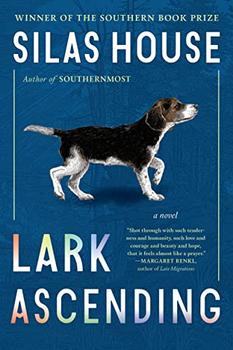
Some of the chapters are told from the point of view of the beagle, Seamus. How did
you feel about these sections of the book? Were they effective? Did they bring a new
element of hope or wonder to the grim scenario at hand? Does Lark's relationship
with Seamus remind you of your connections to animals?
-
While the book is epic in scope, taking place in Appalachia, Maine, Nova Scotia, as well as on a journey across the North Atlantic, the longest section of the book takes place in
Ireland and is an homage to the country whose people have long fought against larger
forces for their own culture to survive. Did you think the use of Ireland in this scenario
was an effective one?
-
One of the consistent themes in all of Silas House's work is that of created family, and this novel is perhaps his closest look at this concept and the way so many people who are not blood-related create unbreakable bonds. Talk about the family that is created between Lark, Seamus, and Helen.
-
House has said he wanted to create al tender love story between two men set against the backdrop of a fundamentalist government that has outlawed LGBTQ relationships because he knows it has happened in the past and he believes it will happen again in the future. What were your feelings about the love between Arlo and Lark? Was this your first time to read a book from the POV of a gay narrator?
-
Did you have a favorite section of the book that should be the focus of particular conversation?
-
Throughout the book, characters are constantly in motion and are traveling so much that Lark and Helen find it hard to settle down at the end. Did you feel the rhythm of
the book was informed by the constant motion? Did this rhythm contribute to the page-turning aspect of the novel?
-
Although the book focuses on three main characters, there are many memorable
secondary characters throughout such as Arlo's sister, Sera, the quiet girl, Charlotte, the
mysterious and wild Ronan, the calm and decisive Johanna, and many others. What
secondary character has stuck with you the most? Who is your favorite main character
of the book?
-
The book is named after a famous piece of classical music which is referenced briefly
in the book. Did you already know this one movement piece of music? If so, what are
your feelings about the song? House has said that the music is a journey that contains
joy, sorrow, and everything in between and he wanted the novel to reflect that. Did it
accomplish that for you?
-
Throughout the book Lark has been aiming for the sanctuary of Glendalough. But
when he gets there he is told his dog cannot stay. How did you feel about Lark's
response to this? Did you feel the compromise that is found between Lark, Helen, and
Seamus-who cannot let go of their wildness-and the group at Glendalough was a
satisfactory one?
-
House has said that the tragic character Rowan is actually "a double of Lark, but the
difference is that Lark had good people to nurture him while Rowan had a terrible man
teaching her the ways of the world, so the way they are similar-being wild survivors
alone in the world-yet so different-Rowan has lost her humanity while Lark has held
onto his-is commentary on the how much of who we are is owed to our opportunities
in life. Without the guidance of his good parents," House says, "Lark could have easily
turned out like Rowan. So she is a villain in the book but I also find her character to be a
very sad one, and I feel sorry for her." How do you feel about this?
-
How did you feel about the framing device of Lark in his old age telling the story?
Was it effective for you? Why or why not?
For the full book club kit please refer to the
publisher's page.
Unless otherwise stated, this discussion guide is reprinted with the permission of Algonquin Books. Any page references refer to a USA edition of the book, usually the trade paperback version, and may vary in other editions.