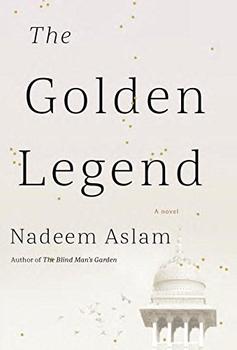
Book Club Discussion Questions
In a book club? Subscribe to our Book Club Newsletter and get our best book club books of 2025!
Please be aware that this discussion guide will contain spoilers!
-
Disguise and deception are central themes of The Golden Legend. Discuss the ways in which the novel's characters deceive those around them. Why do they feel the need to keep secrets? What are the consequences of their deception?
-
The Hanged Mutineer's tree is the last almond tree in Badami Bagh. It grows in Helen and Lily's courtyard, but it is burned down in the violent aftermath of the announcement from the minaret revealing Lily and Aysha's relationship. Examine the symbolism of this tree. How did it get its name?
-
Discuss the role that the book by Massud's father, entitled That They Might Know Each Other, plays in The Golden Legend. What is That They Might Know Each Other about? What happens to Nargis and Massud's copy? How is that book connected to the title of Aslam's novel?
-
What is the Hagia Sophia? What is the Córdoba Mosque? Why might Nargis and Massud have chosen to hang models of these religious structures from their ceiling? Why does Helen find the models so comforting?
-
Explore the relationship among religion, power, and freedom as it is depicted in The Golden Legend.
-
Who was Massud's brother? How did he die? Why does Nargis evoke his memory when Major Burhan visits her house for the first time?
-
Analyze the relationship between the United States and Pakistan as it is portrayed in the novel. How are the tensions between the two nations evident in the aftermath of Massud's death? How does the military-intelligence agency contribute to this dynamic?
-
Discuss Imran's past. Where did he grow up, and what was the political situation like there? Why did he decide to join the training camp, and what made him leave? How does his previous involvement with this militant group continue to affect his life today?
-
The mosque on the island in the Vela River becomes a safe haven for Nargis, Helen and Imran as they try to evade capture by the police. Describe the mosque and the landscape around it. Why is the mosque now in disuse? In what ways does it represent the Pakistan that Nargis and Massud, who designed it, hoped for?
-
Discuss the bond that forms between Helen and Imran. What do they have in common? Why do you think they develop such an intense connection?
-
Compare and contrast Nargis's life before and after she decides to live as a Muslim. What does she gain? What does she lose? Do you think she regrets her decision?
-
Explore the motif of flowers in the novel. When and where do flowers appear? What does their appearance suggest about the endurance of beauty?
-
Describe the novel's treatment of radical Islam. Which characters are connected to extremism? How do their beliefs and actions impact both Christian and Muslim members of the community? What motivates them? What does the novel suggest about the lengths to which extremist movements will go?
-
On page 283, Major Burhan tells Bishop Solomon, "I would do anything for Pakistan," to which Bishop Solomon responds, "For the Pakistani state, perhaps. Not the Pakistani people." What does Bishop Solomon mean by this?
-
Why does Bishop Solomon commit suicide in a courtroom? What might his suicide represent to the Christian citizens of Pakistan?
-
Ghosts are ever present throughout the novel. In what sense is Badami Bagh, as well as the people who live there, haunted by the past?
-
Discuss the conclusion of the novel. What happens to Helen and Imran? To Lily and Aysha? To Nargis? Is the tone of the ending hopeful or despairing? What do the final pages suggest about the future of Pakistan and the possibility of justice?
Unless otherwise stated, this discussion guide is reprinted with the permission of Knopf. Any page references refer to a USA edition of the book, usually the trade paperback version, and may vary in other editions.