Book Club Discussion Questions
In a book club? Subscribe to our Book Club Newsletter and get our best book club books of 2025!
Please be aware that this discussion guide will contain spoilers!
-
Is Tadpole a reliable narrator? In what sense is Tadpole still immature at the beginning of the novel? Does that change as he tells Gugu's story?
-
Why does Mo Yan frame Gugu's story with Tadpole's letters to Sugitani Akihito? What information do the letters provide that the narrative itself does not?
-
"Wang Gan was tall and well built, while his sister never grew to full size and remained a tiny thing—to be unkind, a dwarf" (p. 6). How does this statement foreshadow the events to come?
-
Was Gugu sincere in her attempt to kill herself after Huang Qiuya shamed her with KMT's (Kuomintang's) propaganda flyer? What might have happened to Gugu if she had refused to perform abortions?
-
Mo Yan does not initially reveal that Sugitani Akihito is the son of the Japanese commander who took the young Gugu, her mother and her grandmother captive. Were you surprised to learn about their relationship? Why does Tadpole choose to reveal so much to an outsider?
-
Should Tadpole have supported Renmei's desire to have a second child, even though she became pregnant without his knowledge? Was he to blame for her death?
-
Did the events surrounding Chen Mei's birth affect your opinions about Gugu and Little Lion? Where do you think Mo Yan's sympathies lie? Who are the villains in Frog?
-
Discuss Little Lion's evolution from staunch party supporter and Gugu's protégé to desperate would-be mother. What is her role in the novel?
-
After her encounter with the frogs, Gugu impulsively marries master doll maker Hao Dashou. Soon afterwards, Qin He, who had long adored Gugu without hopes of reciprocity, becomes a doll maker whose work rivals and may even exceed Hao Dashou's. What is the significance of this duality?
-
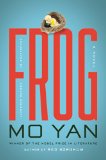
In Chinese mythology, frogs have multiple symbolic meanings, ranging from someone with healing powers or financial acuity to a short-sighted or unfeeling person. Why did Mo Yan choose Frog for the title of this book?
-
If Chinese culture valued girls and boys equally, would the one-child policy have caused as much grief as it did?
-
The Japanese Occupation of China and the hostilities between the People's Republic of China and the Republic of China (Taiwan) underlie many of the novel's most pivotal events. Yet, Mo Yan never brings these conflicts into the foreground. Why might this be?
-
There are currently more than seven billion people living on earth and the number continues to rise every minute. Do you think overpopulation already is or will soon be a problem? What are some other ways in which governments could address the issues raised by our planet's rising population?
-
The dark humor and surreal nature of Mo Yan's work has drawn comparisons to Franz Kafka and Joseph Heller. Do you agree? Are there other writers whose work Mo Yan's novel evokes?
-
Have you read any of Mo Yan's earlier novels? If so, what are some ways in which Frog continues his earlier themes? In what ways does it depart from them?
Unless otherwise stated, this discussion guide is reprinted with the permission of Viking. Any page references refer to a USA edition of the book, usually the trade paperback version, and may vary in other editions.