
-
Your next favorite book
is waiting.
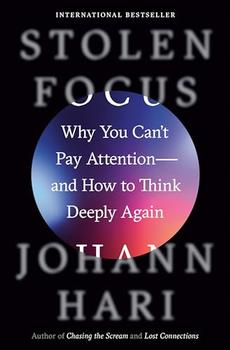
Why You Can't Pay Attention--and How to Think Deeply Again
by Johann Hari
Our ability to pay attention is collapsing. From the author of Chasing the Scream and Lost Connections comes a groundbreaking examination of why this is happening—and how to get our attention back.
In the United States, teenagers can focus on one task for only sixty-five seconds at a time, and office workers average only three minutes. Like so many of us, Johann Hari was finding that constantly switching from device to device and tab to tab was a diminishing and depressing way to live. He tried all sorts of self-help solutions—even abandoning his phone for three months—but nothing seemed to work. So Hari went on an epic journey across the world to interview the leading experts on human attention—and he discovered that everything we think we know about this crisis is wrong.
We think our inability to focus is a personal failure to exert enough willpower over our devices. The truth is even more disturbing: our focus has been stolen by powerful external forces that have left us uniquely vulnerable to corporations determined to raid our attention for profit. Hari found that there are twelve deep causes of this crisis, from the decline of mind-wandering to rising pollution, all of which have robbed some of our attention. In Stolen Focus, he introduces readers to Silicon Valley dissidents who learned to hack human attention, and veterinarians who diagnose dogs with ADHD. He explores a favela in Rio de Janeiro where everyone lost their attention in a particularly surreal way, and an office in New Zealand that discovered a remarkable technique to restore workers' productivity.
Crucially, Hari learned how we can reclaim our focus—as individuals, and as a society—if we are determined to fight for it. Stolen Focus will transform the debate about attention and finally show us how to get it back.
"[A] fresh take on focus and attention ... You'll learn a lot from this book, and its well-researched data is presented in a highly readable style laced with stories and personal anecdotes. Which is to say, against all odds, it will hold your attention." —The Wall Street Journal
"Where other books about our relationship to technology tend to focus on personal responsibility, stressing the importance of self-control, Stolen Focus takes a step back and examines the ecosystem that created the problem... . Hari's writing is incredibly readable." —San Francisco Chronicle
"Big-name websites and apps strive to distract because that's the key to profitability. When we're looking at our screens, these companies make money; when we're not, they don't... . It's a call to arms, to be sure, and I'm tempted to tell my Twitter followers about it—but I've deleted the app from my phone." —The Washington Post
This information about Stolen Focus was first featured
in "The BookBrowse Review" - BookBrowse's membership magazine, and in our weekly "Publishing This Week" newsletter. Publication information is for the USA, and (unless stated otherwise) represents the first print edition. The reviews are necessarily limited to those that were available to us ahead of publication. If you are the publisher or author and feel that they do not properly reflect the range of media opinion now available, send us a message with the mainstream reviews that you would like to see added.
Any "Author Information" displayed below reflects the author's biography at the time this particular book was published.
Johann Hari is a writer and journalist. He has written for The New York Times, Le Monde, The Guardian, and other newspapers. His TED Talks have been viewed over 70 million times, and his work has been praised by a broad range of people, from Oprah Winfrey to Noam Chomsky to Joe Rogan.

If you liked Stolen Focus, try these:

L.A. Women by Ella Berman
Two ambitious writers in 1960s LA face betrayal when one writes a novel based on the other's life.






Your guide toexceptional books
BookBrowse seeks out and recommends the best in contemporary fiction and nonfiction—books that not only engage and entertain but also deepen our understanding of ourselves and the world around us.

