
-
Your next favorite book
is waiting.
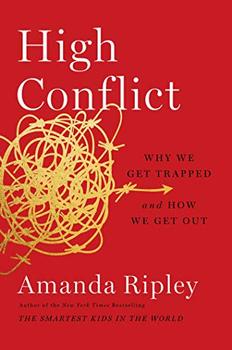
Why We Get Trapped and How We Get Out
by Amanda Ripley
When we are baffled by the insanity of the "other side"—in our politics, at work, or at home—it's because we aren't seeing how the conflict itself has taken over.
That's what "high conflict" does. It's the invisible hand of our time. And it's different from the useful friction of healthy conflict. That's good conflict, and it's a necessary force that pushes us to be better people.
High conflict, by contrast, is what happens when discord distills into a good-versus-evil kind of feud, the kind with an us and a them. In this state, the normal rules of engagement no longer apply. The brain behaves differently. We feel increasingly certain of our own superiority and, at the same time, more and more mystified by the other side.
New York Times bestselling author and award-winning journalist Amanda Ripley investigates how good people get captured by high conflict—and how they break free.
Our journey begins in California, where a world-renowned conflict expert struggles to extract himself from a political feud. Then we meet a Chicago gang leader who dedicates his life to a vendetta—only to find himself working beside the man who killed his childhood idol. Next, we travel to Colombia, to find out whether thousands of people can be nudged out of high conflict at scale. Finally, we return to America to see what happens when a group of liberal Manhattan Jews and conservative Michigan corrections officers choose to stay in each other's homes in order to understand one another better.
All these people, in dramatically different situations, were drawn into high conflict by similar forces, including conflict entrepreneurs, humiliation, and false binaries. But ultimately, all of them found ways to transform high conflict into something good, something that made them better people. They rehumanized and recategorized their opponents, and they revived curiosity and wonder, even as they continued to fight for what they knew was right.
People do escape high conflict. Individuals—even entire communities—can short-circuit the feedback loops of outrage and blame, if they want to. This is a mind-opening new way to think about conflict that will transform how we move through the world.
"The fascinating stories, global history, and dialogue from local politics Ripley includes keep the book moving at a brisk pace... Readers interested in conflict management and negotiation and the decision-making process will be intrigued as Ripley thoughtfully explains the intensities and nuances of conflict, and the crux of high conflict in any setting." —Booklist
"A revealing study of 'high conflict,' the intractable sort that seems to be running like a virus through American society... Ripley's observations are provocative, and she introduces us to ideas of mediation and problem-solving that would make many people less miserable if put into practice... Students of mediation, social psychology, and conflict resolution will find much of value here." —Kirkus Reviews
"A brilliant book that reveals how poisonous showdowns work. But more than just highlighting the problems, Ripley's book also provides solutions. Equally valuable in our personal lives, as in navigating the polarized time we're living in." —Jonah Berger, New York Times bestselling author of The Catalyst and Contagious
"Amanda Ripley shows that the same minds that get us into bitter tribal battles can get us out of them. Via riveting stories in diverse settings—urban gangland, a war-torn central American nation, fractious municipal politics—Ripley proves that happy endings can happen in real life." —Robert Wright, New York Times bestselling author of Why Buddhism is True
This information about High Conflict was first featured
in "The BookBrowse Review" - BookBrowse's membership magazine, and in our weekly "Publishing This Week" newsletter. Publication information is for the USA, and (unless stated otherwise) represents the first print edition. The reviews are necessarily limited to those that were available to us ahead of publication. If you are the publisher or author and feel that they do not properly reflect the range of media opinion now available, send us a message with the mainstream reviews that you would like to see added.
Any "Author Information" displayed below reflects the author's biography at the time this particular book was published.
Amanda Ripley is the New York Times bestselling author of The Smartest Kids in the World, High Conflict, and The Unthinkable. She writes for The Atlantic, Politico, The Washington Post, The New York Times, and The Wall Street Journal, among other publications.

If you liked High Conflict, try these:
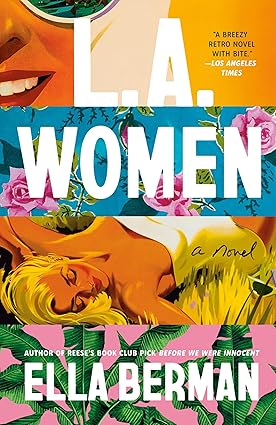
L.A. Women by Ella Berman
Two ambitious writers in 1960s LA face betrayal when one writes a novel based on the other's life.

Your guide toexceptional books
BookBrowse seeks out and recommends the best in contemporary fiction and nonfiction—books that not only engage and entertain but also deepen our understanding of ourselves and the world around us.

