
-
Your next favorite book
is waiting.
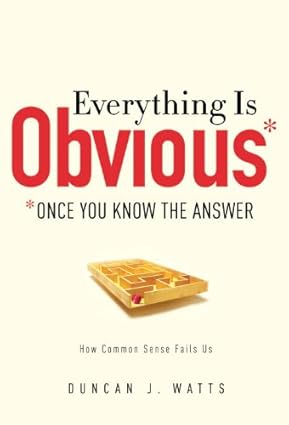
Once You Know the Answer
by Duncan J. Watts
Why is the Mona Lisa the most famous painting in the world? Why did Facebook succeed when other social networking sites failed? Did the surge in Iraq really lead to less violence? How much can CEO's impact the performance of their companies? And does higher pay incentivize people to work hard?
If you think the answers to these questions are a matter of common sense, think again. As sociologist and network science pioneer Duncan Watts explains in this provocative book, the explanations that we give for the outcomes that we observe in life—explanation that seem obvious once we know the answer—are less useful than they seem.
Drawing on the latest scientific research, along with a wealth of historical and contemporary examples, Watts shows how common sense reasoning and history conspire to mislead us into believing that we understand more about the world of human behavior than we do; and in turn, why attempts to predict, manage, or manipulate social and economic systems so often go awry.
It seems obvious, for example, that people respond to incentives; yet policy makers and managers alike frequently fail to anticipate how people will respond to the incentives they create. Social trends often seem to have been driven by certain influential people; yet marketers have been unable to identify these "influencers" in advance. And although successful products or companies always seem in retrospect to have succeeded because of their unique qualities, predicting the qualities of the next hit product or hot company is notoriously difficult even for experienced professionals.
Only by understanding how and when common sense fails, Watts argues, can we improve how we plan for the future, as well as understand the present—an argument that has important implications in politics, business, and marketing, as well as in science and everyday life.
"Mr. Watts, a former sociology professor and physicist who is now a researcher for Yahoo, has written a fascinating book that ranges through psychology, economics, marketing and the science of social networks." —The Wall Street Journal
"Common sense is a kind of bespoke make-believe, and we can no more use it to scientifically explain the workings of the social world than we can use a hammer to understand mollusks." —The New York Times
This information about Everything Is Obvious was first featured
in "The BookBrowse Review" - BookBrowse's membership magazine, and in our weekly "Publishing This Week" newsletter. Publication information is for the USA, and (unless stated otherwise) represents the first print edition. The reviews are necessarily limited to those that were available to us ahead of publication. If you are the publisher or author and feel that they do not properly reflect the range of media opinion now available, send us a message with the mainstream reviews that you would like to see added.
Any "Author Information" displayed below reflects the author's biography at the time this particular book was published.
Duncan J. Watts, a professor of sociology at Columbia University, is a principal research scientist at Yahoo! Research. A former officer in the Royal Australian Navy, he holds a Ph.D. in Theoretical and Applied Mechanics from Cornell University. He is the author of Six Degrees: The Science of a Connected Age (Norton, 2003). He lives in New York City.

If you liked Everything Is Obvious, try these:
Theo of Golden by Allen Levi
One spring morning, a stranger arrives in the small southern city of Golden. No one knows where he has come from…or why…






Your guide toexceptional books
BookBrowse seeks out and recommends the best in contemporary fiction and nonfiction—books that not only engage and entertain but also deepen our understanding of ourselves and the world around us.

