-
Your next favorite book
is waiting.
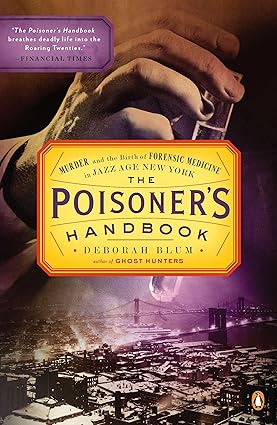
Murder and the Birth of Forensic Medicine in Jazz Age New York
by Deborah Blum
Pulitzer Prize-winning science writer Deborah Blum follows New York City's first forensic scientists to discover a fascinating Jazz Age story of chemistry and detection, poison and murder.
Deborah Blum, writing with the high style and skill for suspense that is characteristic of the very best mystery fiction, shares the untold story of how poison rocked Jazz Age New York City. In The Poisoner's Handbook Blum draws from highly original research to track the fascinating, perilous days when a pair of forensic scientists began their trailblazing chemical detective work, fighting to end an era when untraceable poisons offered an easy path to the perfect crime.
Drama unfolds case by case as the heroes of The Poisoner's Handbook—chief medical examiner Charles Norris and toxicologist Alexander Gettler—investigate a family mysteriously stricken bald, Barnum and Bailey's Famous Blue Man, factory workers with crumbling bones, a diner serving poisoned pies, and many others. Each case presents a deadly new puzzle and Norris and Gettler work with a creativity that rivals that of the most imaginative murderer, creating revolutionary experiments to tease out even the wiliest compounds from human tissue. Yet in the tricky game of toxins, even science can't always be trusted, as proven when one of Gettler's experiments erroneously sets free a suburban housewife later nicknamed "America's Lucretia Borgia" to continue her nefarious work.
From the vantage of Norris and Gettler's laboratory in the infamous Bellevue Hospital it becomes clear that killers aren't the only toxic threat to New Yorkers. Modern life has created a kind of poison playground, and danger lurks around every corner. Automobiles choke the city streets with carbon monoxide; potent compounds, such as morphine, can be found on store shelves in products ranging from pesticides to cosmetics. Prohibition incites a chemist's war between bootleggers and government chemists while in Gotham's crowded speakeasies each round of cocktails becomes a game of Russian roulette. Norris and Gettler triumph over seemingly unbeatable odds to become the pioneers of forensic chemistry and the gatekeepers of justice during a remarkably deadly time. A beguiling concoction that is equal parts true crime, twentieth-century history, and science thriller, The Poisoner's Handbook is a page-turning account of a forgotten New York.
"With the pacing and rich characterization of a first-rate suspensenovelist, Blum makes science accessible and fascinating." —Publishers Weekly (starred review)
"Caviar for true-crime fans and science buffs alike." —Kirkus Reviews
"Formative figures in forensics, Norris and Gettler become fascinatingcrusaders in Blum's fine depiction of their work in the law-floutingatmosphere of Prohibition-era New York." —Booklist
"The Poisoner's Handbook opens one riveting murder case after another in this chronicle of Jazz Age chemical crimes where the real-life twists and turns are as startlingas anything in fiction. Deborah Blum turns us all into forensic detectives by the end of this expertly written, dramatic page-turner that will transform the way you think about the power of science to threaten and save our lives." —Matthew Pearl, author of The Last Dickens and The Dante Club
"The Poisoner's Handbook is a wonderfully compelling hybrid of history and science built around eccentric characters. One scene reads like Patricia Cornwell and the next like Oliver Sacks. From movie stars and aristocrats to homicidal grandmothers and entrepreneurial gangsters, from the government's poisoning of alcohol during Prohibition to the dangers of radiation and automobile pollution, Blum follows an amazing array of poignant tragedies through the laboratory of these crusading public servants." —Michael Sims, author of Apollo's Fire and Adam's Navel
This information about The Poisoner's Handbook was first featured
in "The BookBrowse Review" - BookBrowse's membership magazine, and in our weekly "Publishing This Week" newsletter. Publication information is for the USA, and (unless stated otherwise) represents the first print edition. The reviews are necessarily limited to those that were available to us ahead of publication. If you are the publisher or author and feel that they do not properly reflect the range of media opinion now available, send us a message with the mainstream reviews that you would like to see added.
Any "Author Information" displayed below reflects the author's biography at the time this particular book was published.
Pulitzer Prize winner Deborah Blum is a professor of science journalism at the University of Wisconsin. She worked as a newspaper science writer for twenty years, winning the Pulitzer in 1992 for her writing about primate research, which she turned into a book, The Monkey Wars (Oxford, 1994). Her other books include Sex on the Brain (Viking, 1997) and Love at Goon Park (Perseus, 2002). She has written about scientific research for The Los Angeles Times, The New York Times, Discover, Health, Psychology Today, and Mother Jones. She is a past president of the National Association of Science Writers and now serves on an advisory board to the World Federation of Science Journalists and the National Academy of Sciences.

If you liked The Poisoner's Handbook, try these:
Theo of Golden by Allen Levi
One spring morning, a stranger arrives in the small southern city of Golden. No one knows where he has come from…or why…

Your guide toexceptional books
BookBrowse seeks out and recommends the best in contemporary fiction and nonfiction—books that not only engage and entertain but also deepen our understanding of ourselves and the world around us.