
-
Your next favorite book
is waiting.
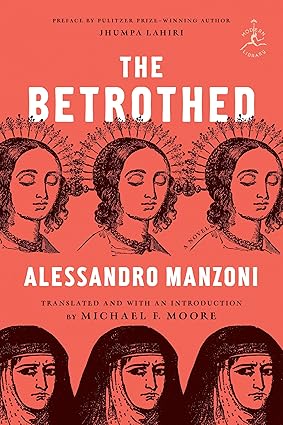
by Alessandro Manzoni
The Betrothed is a cornerstone of Italian culture, language, and literature. Published in its final form in 1842, The Betrothed has inspired generations of Italian readers and writers.
Giuseppe Verdi composed his majestic Requiem Mass in honor of Manzoni. Italo Calvino called the novel "a classic that has never ceased shaping reality in Italy" while Umberto Eco praised its author as a "most subtle critic and analyst of languages." The Betrothed has been celebrated by Primo Levi and Natalia Ginzburg, and is one of Pope Francis's favorite books. But, until now, it has remained relatively unknown to English readers.
In the fall of 1628, two young lovers are forced to flee their village on the shores of Lake Como after a powerful lord prevents their marriage, plunging them into the maelstrom of history. Manzoni draws on actual people and events to create an unforgettable fresco of Italian life and society. In this greatest of historical novels, he takes the reader on a journey through the Spanish occupation of Milan, the ravages of war, class tensions, social injustice, religious faith, and a plague that devastates northern Italy. But within Manzoni's epic tale, readers will also hear powerful echoes of our own day.
"An important new translation ... It feels strange to have had a bona fide canonical classic hiding in plain sight for all these years. But with [Michael F.] Moore's vigorous and companionable translation, the book is now here for everyone to see... . Now the English-speaking world can discover what the fuss is all about." —The Wall Street Journal
"The Betrothed emerges in the new translation as a work that anyone who cares about nineteenth-century fiction should want to read. It has the great events—war, famine, plague—and the record of their impact on humble people. It has the sentimentality: demure maidens and brave lads and black-hearted villains. It has passages of lyrical description and passages where the specificity of detail verges on the sociological. It has the prolixity, annoying to some, comforting to others. In other words, it is an exemplary historical novel." —The New Yorker
"Michael F. Moore's new version strikes me as remarkable, extraordinarily well pitched, finding the right levels of colloquialism and eloquence. Moore preserves the heteroglossia of the novel, its rich impasto of spoken and written styles whose incompatibility is one of its deep subjects. And he manages to catch Manzoni's narrative voice, which is not easy to characterize." —The New York Review of Books
This information about The Betrothed was first featured
in "The BookBrowse Review" - BookBrowse's membership magazine, and in our weekly "Publishing This Week" newsletter. Publication information is for the USA, and (unless stated otherwise) represents the first print edition. The reviews are necessarily limited to those that were available to us ahead of publication. If you are the publisher or author and feel that they do not properly reflect the range of media opinion now available, send us a message with the mainstream reviews that you would like to see added.
Any "Author Information" displayed below reflects the author's biography at the time this particular book was published.
Alessandro Manzoni (1785-1873) is best known for his novel The Betrothed, which ranks among the masterpieces of world literature. It was first published in 1827 and then in 1842 in a revised edition. Manzoni was also a poet, prolific essayist, and playwright. In his life and in his writing, he was committed to the cause of Italian independence and the forging of a modern Italian identity, culture, and language.

If you liked The Betrothed, try these:
Theo of Golden by Allen Levi
One spring morning, a stranger arrives in the small southern city of Golden. No one knows where he has come from…or why…


Your guide toexceptional books
BookBrowse seeks out and recommends the best in contemporary fiction and nonfiction—books that not only engage and entertain but also deepen our understanding of ourselves and the world around us.

