
-
Your next favorite book
is waiting.
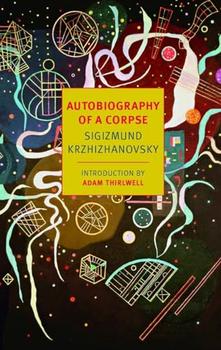
by Sigizmund Krzhizhanovsky
The stakes are wildly high in Sigizmund Krzhizhanovsky's fantastic and blackly comic philosophical fables, which abound in nested narratives and wild paradoxes.
This new collection of eleven mind-bending and spellbinding tales includes some of Krzhizhanovsky's most dazzling conceits: a provincial journalist who moves to Moscow finds his existence consumed by the autobiography of his room's previous occupant; the fingers of a celebrated pianist's right hand run away to spend a night alone on the city streets; a man's lifelong quest to bite his own elbow inspires both a hugely popular circus act and a new refutation of Kant. Ordinary reality cracks open before our eyes in the pages of Autobiography of a Corpse, and the extraordinary spills out.
"Sly, vibrant, and often very funny, Krzhizhanovsky's stories, originally written in the 1920s and '30s (though virtually unpublished during the author's lifetime), are a joy… Full of precise detail, this book will instruct, delight, and then leave the reader pondering long after the reading is finished." —Publishers Weekly
"The stories in this collection by the early Soviet writer Sigizmund Krzhizhanovsky are nearly as fantastic as the crashing combination of consonants at the beginning of his surname." —The New York Times Book Review
"In Thirlwell's thoughtful introduction, the British novelist declares that Krzhizhanovsky's mode is 'the most useful vehicle available for the most intricate philosophy.' This vehicle is also among the most palatable: If Krzhizhanovsky's stories are intricately philosophic, they're delivered in such an entertaining manner that the medicine goes down quite pleasantly indeed." —The Boston Globe
"Krzhizhanovsky is one of the greatest Russian writers of the last century." —Financial Times
This information about Autobiography of a Corpse (New York Review Books Classics) was first featured
in "The BookBrowse Review" - BookBrowse's membership magazine, and in our weekly "Publishing This Week" newsletter. Publication information is for the USA, and (unless stated otherwise) represents the first print edition. The reviews are necessarily limited to those that were available to us ahead of publication. If you are the publisher or author and feel that they do not properly reflect the range of media opinion now available, send us a message with the mainstream reviews that you would like to see added.
Any "Author Information" displayed below reflects the author's biography at the time this particular book was published.
Sigizmund Krzhizhanovsky (1887-1950), the Ukrainian-born son of Polish emigrants, studied law and classical philology at Kiev University. After graduation and two summers spent exploring Europe, he was obliged to clerk for an attorney. A sinecure, the job allowed him to devote most of his time to literature and his own writing. In 1920, he began lecturing in Kiev on theater and music. The lectures continued in Moscow, where he moved in 1922, by then well known in literary circles. Lodged in a cell-like room on the Arbat, Krzhizhanovsky wrote steadily for close to two decades. His philosophical and phantasmagorical fictions ignored injunctions to portray the Soviet state in a positive light. Three separate efforts to print collections were quashed by the censors, a fourth by World War II. Not until 1989 could his work begin to be published. Like Poe, Krzhizhanovsky takes us to the edge of the abyss and forces us to look into it. "I am interested," he said, "not in the arithmetic, but in the algebra of life."

If you liked Autobiography of a Corpse (New York Review Books Classics), try these:

L.A. Women by Ella Berman
Two ambitious writers in 1960s LA face betrayal when one writes a novel based on the other's life.






Your guide toexceptional books
BookBrowse seeks out and recommends the best in contemporary fiction and nonfiction—books that not only engage and entertain but also deepen our understanding of ourselves and the world around us.

