-
Your next favorite book
is waiting.
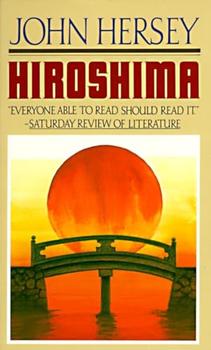
Pulitzer Prize-winning journalist and bestselling author John Hersey's seminal work of narrative nonfiction which has defined the way we think about nuclear warfare. "One of the great classics of the war" (The New Republic) that tells what happened in Hiroshima during World War II through the memories of the survivors of the first atomic bomb ever dropped on a city.
Hiroshima is the story of six human beings who lived through the greatest single manmade disaster in history. John Hersey tells what these six -- a clerk, a widowed seamstress, a physician, a Methodist minister, a young surgeon, and a German Catholic priest -- were doing at 8:15 a.m. on August 6, 1945, when Hiroshima was destroyed by the first atomic bomb ever dropped on a city. Then he follows the course of their lives hour by hour, day by day.
The New Yorker of August 31, 1946, devoted all its space to this story. The immediate repercussions were vast: newspapers here and abroad reprinted it; during evening half-hours it was read over the network of the American Broadcasting Company; leading editorials were devoted to it in uncounted newspapers.
Almost four decades after the original publication of this celebrated book John Hersey went back to Hiroshima in search of the people whose stories he had told. His account of what he discovered about them -- the variety of ways in which they responded to the past and went on with their lives -- is now the eloquent and moving final chapter of Hiroshima.
"Nothing can be said about this book that can equal what the book has to say. It speaks for itself, and in an unforgettable way, for humanity." —The New York Times
"One of the great classics of the war." —The New Republic
This information about Hiroshima was first featured
in "The BookBrowse Review" - BookBrowse's membership magazine, and in our weekly "Publishing This Week" newsletter. Publication information is for the USA, and (unless stated otherwise) represents the first print edition. The reviews are necessarily limited to those that were available to us ahead of publication. If you are the publisher or author and feel that they do not properly reflect the range of media opinion now available, send us a message with the mainstream reviews that you would like to see added.
Any "Author Information" displayed below reflects the author's biography at the time this particular book was published.
John Hersey was born in Tientsin, China, in 1914 and lived there until 1925, when his family returned to the United States. He studied at Yale and Cambridge, served for a time as Sinclair Lewis's secretary, and then worked several years as a journalist. Beginning in 1947 he devoted his time mainly to writing fiction. He won the Pulitzer Prize, taught for two decades at Yale, and was president of the Authors League of America and Chancellor of the American Academy of Arts and Letters. John Hersey died in 1993.

If you liked Hiroshima, try these:

L.A. Women by Ella Berman
Two ambitious writers in 1960s LA face betrayal when one writes a novel based on the other's life.






Your guide toexceptional books
BookBrowse seeks out and recommends the best in contemporary fiction and nonfiction—books that not only engage and entertain but also deepen our understanding of ourselves and the world around us.