-
Your next favorite book
is waiting.
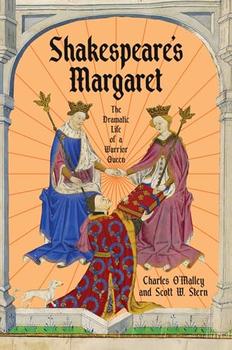
The Dramatic Life of a Warrior Queen
by Charles O'Malley, Scott W. Stern
Shakespeare's most powerful female character, her historical inspiration, and her reinventions in performance through the centuries.
She is more violent than Lady Macbeth, more complex than Ophelia, more strategic than King Lear's daughters. She is the only Shakespearean character, male or female, whose entire life―from youth to old age―appears on stage. She is a wealth of insight into Shakespeare's understanding of, and influence on, ideas of gender and sexuality, and she speaks by far the most lines of any of his female characters. She has allowed the likes of Peggy Ashcroft, Helen Mirren, and Sophie Okonedo full range for their stunning talents. Yet today, most audiences have still never heard of Margaret of Anjou.
But who was Margaret? In the fifteenth century, she was a fourteen-year-old French princess married to an English king, soon thrust into command amid a bloody civil war. A hundred and fifty years later, she was resurrected on the Elizabethan stage in four of Shakespeare's earliest plays, Henry VI, Parts 1, 2, and 3 and Richard III.
And in every era since the Bard's, actors, directors, and producers have recast their own Margaret, slicing, dicing, and rearranging the original Shakespeare to highlight or diminish Margaret's role depending on the sensibilities of the time. It is this evolution of Margaret's portrayal that Charles O'Malley and Scott W. Stern track in Shakespeare's Margaret, from Elizabethan boy-actors in wigs enacting misogynist fears of witchy women to feminist celebrations of Margaret's uninhibited grasp of power and clever commentaries on global politics and world leaders such as Margaret Thatcher. Her story, as it has changed over the centuries across the page and on the stage, brings to life the evolution of theatre and shows how Shakespeare's plays have always been living collaborations among actors, directors, writers, critics, and history itself, still unfolding.
"An insightful study of Shakespeare's first great female character." —Kirkus Reviews
"O'Malley and Stern ingeniously probe the sweep of Shakespearean history...The result is a fascinating biography of a singular character and a revealing commentary on theater's power to evolve with the times." —Publishers Weekly
"This wonderfully imaginative 'biography' of one of Shakespeare's most fascinating and fully realized female characters gives Queen Margaret―fiercely ambitious, ruthless, dangerous, and irrepressible―a life of her own. Margaret lives!" ―Stephen Greenblatt, author of Dark Renaissance
"Margaret's image has, over the centuries, been colored, shaded, and shifted by playwrights, the primary one being Shakespeare. As Charles O'Malley and Scott W. Stern show in this fascinating study, in unearthing who Margaret was, we also uncover an important history of who we are." ―Philippa Kelly, author of The King and I and dramaturg of Margaret of Anjou
This information about Shakespeare's Margaret was first featured
in "The BookBrowse Review" - BookBrowse's membership magazine, and in our weekly "Publishing This Week" newsletter. Publication information is for the USA, and (unless stated otherwise) represents the first print edition. The reviews are necessarily limited to those that were available to us ahead of publication. If you are the publisher or author and feel that they do not properly reflect the range of media opinion now available, send us a message with the mainstream reviews that you would like to see added.
Any "Author Information" displayed below reflects the author's biography at the time this particular book was published.
Charles O'Malley holds a doctorate in dramaturgy and dramatic criticism from the Yale School of Drama and has worked at theatres across the United States. He is the editor of Toward a Just Pedagogy of Performance.
Scott W. Stern is a scholar and critic. He is the author of The Trials of Nina McCall, a New York Times Editors' Choice selection, and There Is a Deep Brooding in Arkansas, which the Times called "powerful new history."

If you liked Shakespeare's Margaret, try these:
Theo of Golden by Allen Levi
One spring morning, a stranger arrives in the small southern city of Golden. No one knows where he has come from…or why…

Your guide toexceptional books
BookBrowse seeks out and recommends the best in contemporary fiction and nonfiction—books that not only engage and entertain but also deepen our understanding of ourselves and the world around us.