
-
Your next favorite book
is waiting.
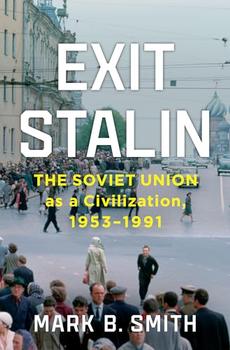
The Soviet Union as a Civilization, 1953-1991
by Mark B. Smith
A magisterial, revisionist narrative history of the Soviet Union in its post-Stalin heyday, bringing a forgotten society to vivid life and offering a new explanation for how it suddenly collapsed.
To those of us in the West, the Soviet Union is synonymous with Stalinism. The common view of the USSR is of a brutal regime that squelched dissent and oversaw a drab, terrified society. Yet as Cambridge historian Mark B. Smith demonstrates in Exit Stalin, after the death of the murderous Joseph Stalin in 1953, the Soviet Union was at a crossroads. Would it break from the dictator's reign or continue his campaign of violence and fear?
The answer was both. The USSR remained harsh and authoritarian, yet it also earnestly sought to fulfill the Russian Revolution's promise of an egalitarian, progressive future. Smith shows how vacation resorts, Pioneer camps, and new opportunities for private life coexisted with corruption scandals, KGB surveillance, and censorship. Re-creating the everyday rhythms of the country, he takes us into the Soviet Union's culture, including TV shows and films that were little-known in the West. Ordinary citizens navigated the contradictions of existence under Khrushchev and his successors, building lives within a system they often accepted, believed in, or could not imagine abandoning. The result was the emergence of a distinctive and functioning civilization, a far cry from the vicious dictatorship of the West's imagination.
A brilliantly original narrative of ordinary life in the late Soviet Union, Exit Stalin also presents a new account of its end, showing how a series of unexpected decisions unraveled the entire project. Ultimately, Smith reveals that the shortages, coercion, and incompetence that underlaid the USSR―and that by the late 1980s would doom it―have to be understood alongside the acceptance it always had from most of its citizens. And this reality, in turn, is crucial for understanding Russia and the rest of the former Soviet Union in the twenty-first century.
"An essential and accessible addition to the library of Soviet and post-Soviet studies." ―Kirkus Reviews (starred review)
"Richly detailed…Mark Smith's impressive history gives readers a powerful sense of what it was like to live under communism in the four decades between Stalin's death and the country's disintegration at the end of the cold war." ―Financial Times (UK)
"The most insightful and accurate cultural history of the Soviet Union that I have encountered, and a very good read, to boot." ―Jack F. Matlock., Jr., author of Autopsy on an Empire
"To this enthralling journey across an archipelago of twentieth-century Russian people and situations, Mark B. Smith brings deep historical knowledge, analytical prowess, and formidable emotional intelligence. At the end of it you have not just learned something, you have been somewhere. Essential reading for anyone with an interest in contemporary Russia and its people." ―Christopher Clark, author of The Sleepwalkers: How Europe Went to War in 1914
This information about Exit Stalin was first featured
in "The BookBrowse Review" - BookBrowse's membership magazine, and in our weekly "Publishing This Week" newsletter. Publication information is for the USA, and (unless stated otherwise) represents the first print edition. The reviews are necessarily limited to those that were available to us ahead of publication. If you are the publisher or author and feel that they do not properly reflect the range of media opinion now available, send us a message with the mainstream reviews that you would like to see added.
Any "Author Information" displayed below reflects the author's biography at the time this particular book was published.
Mark B. Smith is an associate professor of modern history at the University of Cambridge. His scholarship focuses on Soviet and modern Russian history. He is the author of The Russia Anxiety: And How History Can Resolve It.

If you liked Exit Stalin, try these:
L.A. Women by Ella Berman
Two ambitious writers in 1960s LA face betrayal when one writes a novel based on the other's life.






Your guide toexceptional books
BookBrowse seeks out and recommends the best in contemporary fiction and nonfiction—books that not only engage and entertain but also deepen our understanding of ourselves and the world around us.

