
-
Your next favorite book
is waiting.
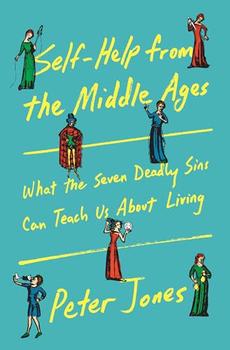
What the Seven Deadly Sins Can Teach Us About Living
by Peter Jones
In this charming journey into the past, a historian reveals medieval wisdom that can still guide us today.
Peter Jones was teaching medieval history at a university in Siberia when his third icy winter there plunged him into a dark place. Luckily, he knew something few of us know-- that for all its reputation for darkness and superstition, the Middle Ages were the golden age of self-help. So he set out on a journey to explore the wisdom of medieval scholars, saints, and mystics, looking for an alternative path through the challenges of modern life.
Never in history, Jones marvels in Self-Help from the Middle Ages, has so much energy and talent gone into studying how the mind works as in the medieval centuries. Although today we think of the Seven Deadly Sins as a catalog of forbidden behavior, in the Middle Ages, at the height of their currency, they were a path to self-knowledge and self-forgiveness. Together, pride, envy, anger, sloth, greed, gluttony and lust were a psychological map that laid out seven basic patterns of thought, showing how our thinking can go astray and how we can find our way home.
In Self-Help from the Middle Ages, Jones explores each sin, searching the hellscapes of Hieronymous Bosch and Giotto, the intimate confessions of Dante and Margery Kempe, and the personal struggles of Francis of Assisi and Catherine of Siena. Along the way he discovers a treasure trove of lost truths about temptation, frustration, addiction, compulsion, burnout, rage, fear, anxiety, and grief that still pulse with life. With beautiful illustrations drawn from medieval art and literature, his book is a gift to all who love history and anyone who has ever sought wisdom from the past.
"Historian Jones debuts with an illuminating and eclectic survey of how medieval thinkers grappled with perennial psychological challenges through the framework of the seven deadly sins... . This captivates." —Publishers Weekly (starred review)
"A scholarly and forgiving rethinking of problematic behavior for a world sketched by psychology and secularism." —Kirkus Reviews
"Self-Help from the Middle Ages is one of the most compelling medieval history books I have ever read. It does what I feel all good history books should do – it informs us about ourselves; it does not just tell us stories about the long-since dead. It will tantalise and delight those who think they know everything there is to know about the medieval mindset as well as those who cannot imagine that there were once different ways of thinking. I genuinely loved this book." —Ian Mortimer, author of The Time Traveler's Guide to Medieval England
"This book came as a wonderful surprise. Peter Jones, a learned historian, combines self-help, the middle ages, and autobiographical confessions and somehow weaves a tapestry that triumphantly relates all three. In particular, he highlights the subtlety and psychological insights in medieval writers, whose wise treatments of disorderly desires have helped him to navigate his own life, and could help any of us to do the same." —Simon Blackburn, author of Think: A Compelling Introduction to Philosophy
This information about Self-Help from the Middle Ages was first featured
in "The BookBrowse Review" - BookBrowse's membership magazine, and in our weekly "Publishing This Week" newsletter. Publication information is for the USA, and (unless stated otherwise) represents the first print edition. The reviews are necessarily limited to those that were available to us ahead of publication. If you are the publisher or author and feel that they do not properly reflect the range of media opinion now available, send us a message with the mainstream reviews that you would like to see added.
Any "Author Information" displayed below reflects the author's biography at the time this particular book was published.
Peter Jones received his Ph.D. in medieval history from New York University. He taught at the School of Advanced Studies at the University of Tyumen in Siberia, where he was Chair of History. Today, he is a Marie Curie fellow at Complutense University of Madrid.

If you liked Self-Help from the Middle Ages, try these:
L.A. Women by Ella Berman
Two ambitious writers in 1960s LA face betrayal when one writes a novel based on the other's life.






Your guide toexceptional books
BookBrowse seeks out and recommends the best in contemporary fiction and nonfiction—books that not only engage and entertain but also deepen our understanding of ourselves and the world around us.

