
-
Your next favorite book
is waiting.
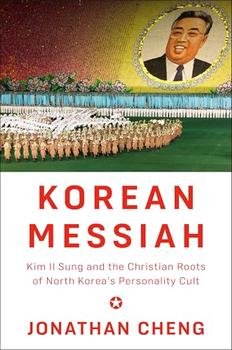
Kim Il Sung and the Christian Roots of North Korea's Personality Cult
by Jonathan Cheng
A landmark history of North Korea, told through the rise of the Kim dynasty and its surprising ties to American Christianity—a spectacular, penetrating account of the Hermit Kingdom.
For nearly eight decades, North Korea has marched defiantly to its own beat, shaking off its Soviet and Chinese sponsors to emerge as the world's most enigmatic nation—a nuclear-armed state ruled by a dictatorial dynasty. Underpinning the state is a personality cult more soaked in religiosity than those constructed by Stalin or Mao—one that traces its roots back to the Christian fervor of post–Civil War America.
Jonathan Cheng, the Wall Street Journal's China bureau chief and former Korea bureau chief, takes us deep inside Pyongyang, a city once so dominated by Christianity that it was known as the "Jerusalem of the East." Cheng introduces us to Samuel Moffett, a Presbyterian missionary from Madison, Indiana, who would venture into Pyongyang at the end of the nineteenth century and build a remarkable following—one that would include the Kim family that today presides over one of the world's harshest persecutors of the Christian faith.
At the center of this story is North Korea's founder, Kim Il Sung, son of two fervent Christians and progenitor of an ideology known as Kimilsungism, an exercise in idolatry that has elevated him, and his successor son and grandson, to Christlike status, from the humble manger where he was born to the subway seat on which the venerated leader once placed his posterior, cordoned off as if it were a religious relic.
Drawing on letters, diaries, and never-before-unearthed archival material that temper and often contradict the glorious historical record promoted by Kim Il Sung's legions of hagiographers, Korean Messiah tells the true story of a country shrouded in fictions.
"An eye-opening view of North Korea's apocalyptic, messianic, weird—and Christian-based—cult of personality, [with] fascinating insight into the birth of the moral equivalent of a totalitarian theocracy." —Kirkus Reviews (starred review)
"This thorough and fascinating work is essential for anyone interested in the history of North Korea ... Cheng argues convincingly that, while crafting his cult of personality, Kim [Il-sung] nevertheless drew on the Christian lessons, rituals, and models of devotion that he learned at church from childhood." —Library Journal (starred review)
"Korean Messiah is a long-overdue and important addition to our understanding of contemporary North Korea. Cheng expertly fills in another missing piece of the DPRK puzzle." —Adam Johnson, Pulitzer Prize-winning author of The Orphan Master's Son
"More than any book in memory, Korean Messiah provides an answer to the essential riddle that is North Korea, of how a personality cult so powerful it can pass down through generations came to be. Cheng has produced a work as magisterial as it is fascinating, and it should be required reading for all those who hope to understand the modern-day Hermit Kingdom." —Scott Anderson, author of King of Kings
This information about Korean Messiah was first featured
in "The BookBrowse Review" - BookBrowse's membership magazine, and in our weekly "Publishing This Week" newsletter. Publication information is for the USA, and (unless stated otherwise) represents the first print edition. The reviews are necessarily limited to those that were available to us ahead of publication. If you are the publisher or author and feel that they do not properly reflect the range of media opinion now available, send us a message with the mainstream reviews that you would like to see added.
Any "Author Information" displayed below reflects the author's biography at the time this particular book was published.
Jonathan Cheng is the China bureau chief for the Wall Street Journal, and was previously the Korea bureau chief, running coverage of the Korean peninsula, including politics and society in both North and South Korea. A native of Toronto, he lives in Beijing. He has traveled to North Korea twice.

If you liked Korean Messiah, try these:

L.A. Women by Ella Berman
Two ambitious writers in 1960s LA face betrayal when one writes a novel based on the other's life.






Your guide toexceptional books
BookBrowse seeks out and recommends the best in contemporary fiction and nonfiction—books that not only engage and entertain but also deepen our understanding of ourselves and the world around us.

