
-
Your next favorite book
is waiting.
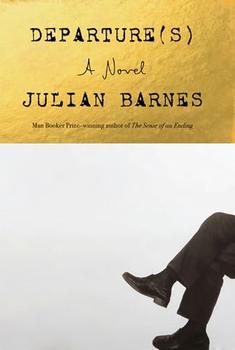
On the occasion of his eightieth birthday, one of our great novelists delivers a playful and profound work about memory, love, and the writer's endgame.
Shortly after our narrator, a writer named Julian, begins this compact book by discussing the workings of involuntary memory, he interrupts himself with a bulletin to the reader: "There will be a story—or a story within the story—but not just yet."
Of course, whether Departure(s) is mostly fiction or not, there is a lot of its author in it, including Barnes's reckoning with the blood disorder he has been living with since he was diagnosed in 2020, his long preoccupation with dying and grief, and his mordant sense of the indignities and lost opportunities we're prey to in love. The story he promises to deliver is a love story, that of two friends he met at university in the 1960s, that time of touted but rarely experienced sexual freedom. Julian played matchmaker to Stephen (tall, gangling, uncertain) and Jean (tart and attractive); as the third wheel he was deeply invested in the success of their love and insulted when they broke up. Time is swift, and forty years later, he tries again, watching as their rekindled affair produces joys, betrayals, and disappointments of a different order.
"Life and memory can be so ... quixotic, don't you find?" Barnes uses both his novelistic memory and his (real?) personal diary entries to examine not just the quixotic relationship of Jean and Stephen but his writer's eye upon it, and how his efforts in their behalf add up in the end. Having promised them he'd never write about them, he breaks the promise to fulfill one, amply, to his readers, in this delightful and poignant novelist's game that only Julian Barnes knows how to play.
"Proustian in both focus and scope, Barnes' philosophical flights are ... reminiscent of W. G. Sebald, but with a warmth, humanity, and humor that are distinctly his own... . This is a rewarding and profound exploration of the human condition from a deeply captivating writer." —Booklist (starred review)
"Barnes explores memory, identity, and aging in this elegiacal and witty metafictional novella... . [and] remains in top form. Readers with a penchant for the precise prose of Ian McEwan or the collage metafiction of Sigrid Nunez will love his latest." —Library Journal (starred review)
"A revelatory meditation on love, death, and memory... . Barnes dives headlong into the slippery nature of memory and what one forgets through time or necessity. It's an understated but graceful valediction by a writer whose work won't soon be forgotten." —Publishers Weekly
"An autofictional remembrance... . Questioning the merits of novel-writing as an endeavor, the way it prompts the writer to exaggerate and betray... . It's clear that Barnes is writing with a certain urgency." —Kirkus Reviews
This information about Departure(s) was first featured
in "The BookBrowse Review" - BookBrowse's membership magazine, and in our weekly "Publishing This Week" newsletter. Publication information is for the USA, and (unless stated otherwise) represents the first print edition. The reviews are necessarily limited to those that were available to us ahead of publication. If you are the publisher or author and feel that they do not properly reflect the range of media opinion now available, send us a message with the mainstream reviews that you would like to see added.
Any "Author Information" displayed below reflects the author's biography at the time this particular book was published.
Julian Barnes is the author of twenty-five previous books, for which he has received the Man Booker Prize, the Somerset Maugham Award, the E. M. Forster Award from the American Academy of Arts and Letters, the Prix Médicis and Prix Femina in France, and the Jerusalem Prize. In 2017 he was awarded the Légion d'honneur. His work has been translated into more than forty languages. He lives in London.

If you liked Departure(s), try these:

L.A. Women by Ella Berman
Two ambitious writers in 1960s LA face betrayal when one writes a novel based on the other's life.






Your guide toexceptional books
BookBrowse seeks out and recommends the best in contemporary fiction and nonfiction—books that not only engage and entertain but also deepen our understanding of ourselves and the world around us.


