
-
Your next favorite book
is waiting.
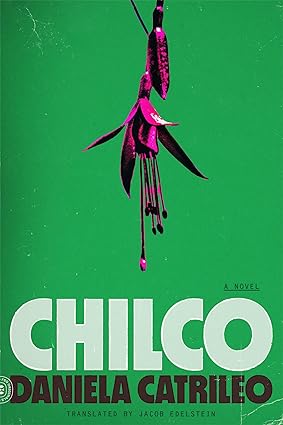
by Daniela Catrileo
A near-future fable about love, life, and friendship in a world that's coming apart.
Chilco is the name of Pascale's home island. It is also the Mapudungun word for fuchsia: a word that evokes tropical lushness, wetness, the deep greenness of the forest. Pascale's partner, Marina, grew up in the vertical slums of Capital City, a place scarred by centuries of colonialism and now the ravages of feckless developers. Every day the couple fear a sinkhole will open up and take with it another poor neighborhood, another raft of desperate refugees from the hinterlands: the indigenous, the poor, who are toiling for an all-consuming machine that is devouring the earth from beneath their feet.
When they finally flee the collapsing city to live in Chilco, are they escaping from the crushing weight of centuries of colonial repression that have eroded indigenous memories, language, and culture, or are they merely stepping into a twisted, lush new version of it? From her first days in this place where she's supposed to feel safe and at home, Marina can't avoid the feeling that everything is decaying around her―there is a smell of putrefaction in the air that no one except her can detect; there are seismic rifts that the political cruelties of the times have opened up in her own relationship with Pascale; and she is haunted by insistent memories of her past.
In Chilco, Daniela Catrileo's baroque, tropical jeremiad, the wounds of capitalism and empire inflict themselves on the person and on the land, but linger most devastatingly in language and memory. Indigenous Mapudungun and Quechua words, history, and cosmology form the chorus to this tropical fever dream of life, love, death, and friendship.
"Impressive ... Catrileo keeps the novel afloat with razor-sharp observations on the city's exploitive colonial history and staggering decay. It's a rewarding story of chosen family." ―Publishers Weekly
"If the imposition of new ecologies was integral to the European colonization of the Americas, any process of resistance and decolonization must be ecological, too. It's in poetry and fiction that the imagination for such a thing could take root―and Catrileo understands this well. Chilco's imagistic and documentary structure, its radical mixture of poetry and fiction, is held together by the novel's emphasis on the ecology of the island ... For her and her characters, it's not the future that flashes tantalizingly on the horizon, but the possibility of truly going home." ―The New Republic
This information about Chilco was first featured
in "The BookBrowse Review" - BookBrowse's membership magazine, and in our weekly "Publishing This Week" newsletter. Publication information is for the USA, and (unless stated otherwise) represents the first print edition. The reviews are necessarily limited to those that were available to us ahead of publication. If you are the publisher or author and feel that they do not properly reflect the range of media opinion now available, send us a message with the mainstream reviews that you would like to see added.
Any "Author Information" displayed below reflects the author's biography at the time this particular book was published.
Daniela Catrileo is a writer, an artist, an activist, and a professor of philosophy. She is a member of the Colectivo Mapuche Rangiñtulewfü and part of the editorial team for Yene, a digital magazine featuring art, writing, and critical thought from across Wallmapu and the Mapuche diaspora. She has published two collections of poetry: Río herido and Guerra florida; two chapbooks: El territorio del viaje and Las aguas dejaron de unirse a otras aguas; and a book of short stories: Piñen.

If you liked Chilco, try these:
Theo of Golden by Allen Levi
One spring morning, a stranger arrives in the small southern city of Golden. No one knows where he has come from…or why…






Your guide toexceptional books
BookBrowse seeks out and recommends the best in contemporary fiction and nonfiction—books that not only engage and entertain but also deepen our understanding of ourselves and the world around us.

