
-
Your next favorite book
is waiting.
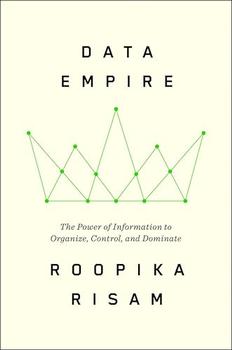
The Power of Information to Organize, Control, and Dominate
by Roopika Risam
A groundbreaking new lens on human history arguing that data has always been the seed of power—those who hold it have drawn and enforced borders, exploited nature, and governed lives—and that reckoning with this legacy must galvanize us to resist it.
Historians have pointed to guns, germs, steel, religion, agriculture, and the female body as the engines of human history. But what do they all have in common? Every human approach to power and domination has involved collecting data—from tracking where and how long animals live to sharpen the hunt, to classifying our fellow humans by sex, race and religion to stratify, isolate, and subjugate them. Recording and mastering data has always been the foundation of rule—and we are living through it now, too.
In Data Empire, Roopika Risam uncovers the hidden history of data as a force that has shaped civilizations, upheld empires, and controlled lives. From ancient cave markings and knotted strings to colonial censuses and modern digital surveillance, Risam shows how data has always been a technology of control.
In this paradigm-shifting study, Risam confronts how data has deepened inequality, justified conquest, and fueled racial hierarchies over 11,000 years. Empire was never just about weapons or ships, she argues. It was built on information that now rules us. Both a sweeping history and a sharp critique, Data Empire is a call to recognize the power data holds—and to imagine what resistance looks like in an age defined by it. The story of humanity is the story of data—and knowing its past is the first step to breaking its grip on our lives and futures.
"[A] brilliant history...Elegantly weaving scholarly research with trenchant political analysis, this is a must-read for those seeking to understand the deep history of the AI boom." —Publishers Weekly (starred review)
"From Neolithic times to the present day, a social scientist reveals how human recordkeeping became a powerful, sometimes coercive technology for shaping human lives...An expansive and sobering history of the interplay of human data, conquest, and control." —Kirkus Reviews
"The author's arguments will resonate with readers of Nexus by Yuval Noah Harari, The Age of Surveillance Capitalism by Shoshana Zuboff, and The Power of Knowledge by Jeremy Black...A sweeping and convincing argument that information undergirds power." —Library Journal
"Both a historical survey and a call to action, this work challenges readers to imagine digital resistance in a world defined by corporate and state extraction. Data Empire is essential for historians, digital humanities scholars, and social activists." —Booklist
"A book that promises not to just show how empires have collected and weaponized data over the ages, but also how we can resist...[A]n easy must-read." —NPR, "15 Books Our Critics Can't Wait to Read This Summer"
"Roopika Risam has let data's story unfurl over centuries and across continents. The result is something profound, a chance to see how our current moment of LLMs and data brokers and ubiquitous surveillance sits in the bigger story of human history. This is an essential book." —Jer Thorp, author of Living in Data
This information about Data Empire was first featured
in "The BookBrowse Review" - BookBrowse's membership magazine, and in our weekly "Publishing This Week" newsletter. Publication information is for the USA, and (unless stated otherwise) represents the first print edition. The reviews are necessarily limited to those that were available to us ahead of publication. If you are the publisher or author and feel that they do not properly reflect the range of media opinion now available, send us a message with the mainstream reviews that you would like to see added.
Any "Author Information" displayed below reflects the author's biography at the time this particular book was published.
Roopika Risam is Associate Professor of Digital Humanities and Social Engagement at Dartmouth. Her research explores how histories of race, empire, and technology shape the modern world. She is the author of New Digital Worlds: Postcolonial Digital Humanities in Theory, Praxis, and Pedagogy, taught in over 150 universities worldwide, and co- editor of four collections, including Anti-Racist Community Engagement and The Digital Black Atlantic. Her work has been supported by over $4.3 million in grants from the NEH, Mellon Foundation, and others. She is also known for her public scholarship and digital projects, including Torn Apart/Separados, which visualized the U.S. government's family separation policy at the border. Risam is past president of the Association for Computers and the Humanities, the U.S. scholarly organization for digital research in the humanities.

If you liked Data Empire, try these:

by Moudhy Al-Rashid
Published 2026
Humanity's earliest efforts at recording and drawing meaning from history reveal how lives millennia ago were not so different from our own.

by Mustafa Suleyman
Published 2025
An urgent warning of the unprecedented risks that AI and other fast-developing technologies pose to global order, and how we might contain them while we have the chance—from a co-founder of the pioneering artificial intelligence company DeepMind
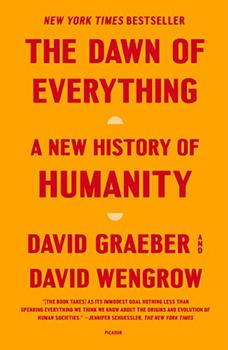
by David Graeber
Published 2023
A dramatically new understanding of human history, challenging our most fundamental assumptions about social evolution―from the development of agriculture and cities to the origins of the state, democracy, and inequality―and revealing new possibilities for human emancipation.

L.A. Women by Ella Berman
Two ambitious writers in 1960s LA face betrayal when one writes a novel based on the other's life.






Your guide toexceptional books
BookBrowse seeks out and recommends the best in contemporary fiction and nonfiction—books that not only engage and entertain but also deepen our understanding of ourselves and the world around us.

