
-
Your next favorite book
is waiting.
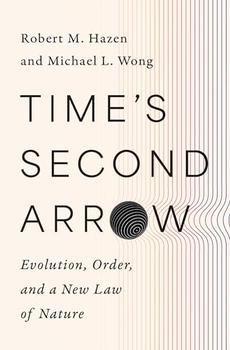
Evolution, Order, and a New Law of Nature
by Robert M. Hazen
A distinguished geoscientist and rising-star astrobiologist offer a stunning new theory upending 150 years of established science―and an inspiring new vision of our universe.
Of the codified laws of nature, famously, only one inscribes a direction to time: the dreaded second law of thermodynamics, which declares that the disorder of a closed system tends to increase as time passes. New shoes eventually scuff, our bodies weaken and die. Yet our senses tell us that miraculous order constantly emerges, too: children grow and learn; spontaneous patterns manifest in murmurations of starlings. Can it be true that the laws of our universe mandate only dissolution―rendering the intricate order of a butterfly's wing, the much-vaunted complexity of the human brain, merely incidental?
In Time's Second Arrow, star scientists Robert M. Hazen and Michael L. Wong overturn more than a century of scientific canon, arguing that, in fact, there must be a second "arrow of time"―a heretofore missing law of nature that explains how the marvelously complex constituents of our universe came to be. Evolution, they boldly propose, is a universal phenomenon―not only in biology, but in the entire atomic, chemical, mineral, and physical universe. Showing how a natural process of selection for increasing function has shaped the universe since its inception, they explore how this new law could possibly help us identify life on other planets and―perhaps―even understand the purpose and meaning of life on Earth in a new way.
Elegantly written and deeply moving, Time's Second Arrow reveals how our cosmic inheritance includes, even alongside loss and decay, a drive toward wondrous invention and progress―ultimately revising our understanding of the universe and our place within it.
"A paradigm-shifting work of scientific daring that inspires us to reconsider the emergence of life in the cosmos … [T]here are times when the facts alone exert their own poetry. When this happens in a science book, it can be transcendent." ―Kirkus Reviews (starred review)
"Time's Second Arrow…present[s] an audacious hypothesis: that the increasing complexity observable in the history of life, the universe, and everything reflects a fundamental, hitherto unrecognized law of nature…A laudably concise, compelling account of how everything around us came to be." ―Andrew H. Knoll, author of A Brief History of Earth
"Time's Second Arrow is bubbling with ideas, all inspired by one of the biggest outstanding questions in science: the origin and evolution of complexity... . The insights here help to move us toward a unified understanding of the physical and biological realms." ―Sean Carroll, New York Times best-selling author of The Biggest Ideas in the Universe
This information about Time's Second Arrow was first featured
in "The BookBrowse Review" - BookBrowse's membership magazine, and in our weekly "Publishing This Week" newsletter. Publication information is for the USA, and (unless stated otherwise) represents the first print edition. The reviews are necessarily limited to those that were available to us ahead of publication. If you are the publisher or author and feel that they do not properly reflect the range of media opinion now available, send us a message with the mainstream reviews that you would like to see added.
Any "Author Information" displayed below reflects the author's biography at the time this particular book was published.
Robert M. Hazen, a geoscientist at the Carnegie Institution for Science, is the author of Symphony in C, among other titles. He lives in Bethesda, Maryland.
Michael L. Wong is a planetary scientist and astrobiologist at the Carnegie Institution for Science. He lives in Washington, DC.

If you liked Time's Second Arrow, try these:

by Lisa Kaltenegger
Published 2025
Riveting and timely, a look at the research that is transforming our understanding of the cosmos in the quest to discover whether we are alone.

by Ferris Jabr
Published 2025
A vivid account of a major shift in how we understand Earth, from an exceptionally talented new voice. Earth is not simply an inanimate planet on which life evolved, but rather a planet that came to life.
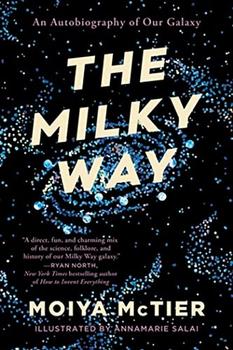
by Moiya McTier
Published 2023
Astrophysicist and folklorist Dr. Moiya McTier channels the Milky Way in this approachable and utterly fascinating autobiography of the titular galaxy, detailing what humans have discovered about everything from its formation to its eventual death, and what more there is to learn about this galaxy we call home.

L.A. Women by Ella Berman
Two ambitious writers in 1960s LA face betrayal when one writes a novel based on the other's life.






Your guide toexceptional books
BookBrowse seeks out and recommends the best in contemporary fiction and nonfiction—books that not only engage and entertain but also deepen our understanding of ourselves and the world around us.

