
-
Your next favorite book
is waiting.
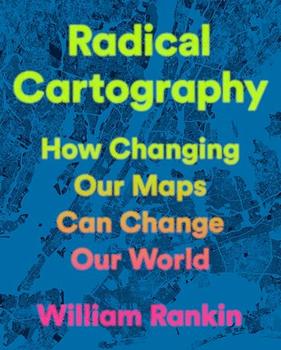
How Changing Our Maps Can Change Our World
by William Rankin
A stunning, thought-provoking exploration of how maps shape our understanding of the world.
Maps are ubiquitous in contemporary life—not just for navigation, but for making sense of our society, our environment, and even ourselves. In an instant, huge datasets can be plotted on command and we can explore faraway places in exacting detail. Yet the new ease and speed of data mapping can often lead to the same results as ever: over-simplified maps used as tools for top-down control.
Cartographer and historian William Rankin argues that it's time to reimagine what a map can be and how it can be used. Maps are not neutral visualizations of facts. They are innately political, defining how the world is divided, what becomes visible and what stays hidden, and whose voices are heard. What matters isn't just the topics or the data, but how maps make arguments about how the world works. And the consequences are enormous. A map's visual argument can change how cities are designed and how rivers flow, how wars are fought and how land claims are settled, how children learn about race and how colonialism becomes a habit of mind. Maps don't just show us information—they help construct our world.
Brimming with vibrant maps, including many "radical" maps created by Rankin himself and by other cutting-edge mapmakers, Radical Cartography exposes the consequences of how maps represent boundaries, layers, people, projections, color, scale, and time. Challenging the map as a tool of the status quo, Rankin empowers readers to embrace three unexpected values for the future of cartography: uncertainty, multiplicity, and subjectivity. Changing the tools—changing the maps—can change the questions we ask, the answers we accept, and the world we build.
"Striking...Rankin argues for a 'radical' approach to cartography that not only spotlights marginalized groups but also is "less well-behaved," embracing noise and messiness ... Lavishly illustrated with maps and photographs, this stuns." —Publishers Weekly (starred review)
"An edifying read about the power of maps... These values [Rankin] proposes for radical cartography in maps—uncertainty, multiplicity, and subjectivity—have the potential to be a tool for change." —Kirkus Reviews
"Rankin effectively makes the case that "radical cartography resists the urge to show the world everywhere as crisp, clear and unambiguous" by embracing uncertainty, multiplicity, and subjectivity. Readers interested in current possibilities in mapmaking and data visualization will appreciate this far-reaching book." —Booklist
"This is it: the full download from a true genius of cartography. Radical Cartography will make you see maps, and, indeed, your place on the planet, with fresh eyes." —Daniel Immerwahr, author of How to Hide an Empire
"A groundbreaking and fascinating work, Radical Cartography brings the human back into geography. This is a timely and significant intervention that provides essential tools for challenging authoritative—and authoritarian—voices." —Paul Richardson, author of Myths of Geography
This information about Radical Cartography was first featured
in "The BookBrowse Review" - BookBrowse's membership magazine, and in our weekly "Publishing This Week" newsletter. Publication information is for the USA, and (unless stated otherwise) represents the first print edition. The reviews are necessarily limited to those that were available to us ahead of publication. If you are the publisher or author and feel that they do not properly reflect the range of media opinion now available, send us a message with the mainstream reviews that you would like to see added.
Any "Author Information" displayed below reflects the author's biography at the time this particular book was published.
William Rankin is an associate professor of history at Yale University, where he focuses on the history of mapping and the geographic sciences. Born and raised outside Chicago, he was originally trained as an architect before receiving a dual PhD in the history of science and architecture from Harvard University. In addition to his work as a historian, he is also an award-winning cartographer, and his maps—available at www.radicalcartography.net—have appeared in numerous books, magazines, and exhibits around the world.

If you liked Radical Cartography, try these:

by Ali Smith
Published 2026
From a literary master, a moving and genre-bending story about our era-spanning search for meaning and knowing.
by Frank Wilczek
Published 2022
One of our great contemporary scientists reveals the ten profound insights that illuminate what everyone should know about the physical world.
by Kate Harris
Published 2019
A brilliant, fierce writer makes her debut with this enthralling travelogue and memoir of her journey by bicycle along the Silk Road—an illuminating and thought-provoking fusion of The Places in Between, Lab Girl, and Wild that dares us to challenge the limits we place on ourselves and the natural world.
Theo of Golden by Allen Levi
One spring morning, a stranger arrives in the small southern city of Golden. No one knows where he has come from…or why…






Your guide toexceptional books
BookBrowse seeks out and recommends the best in contemporary fiction and nonfiction—books that not only engage and entertain but also deepen our understanding of ourselves and the world around us.

