
-
Your next favorite book
is waiting.
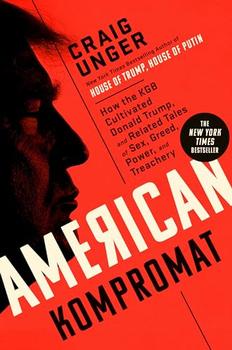
How the KGB Cultivated Donald Trump, and Related Tales of Sex, Greed, Power, and Treachery
by Craig Unger
Kompromat n.—Russian for "compromising information"
This is a story about the dirty secrets of the most powerful people in the world—including Donald Trump.
Based on exclusive interviews with intelligence officers in the CIA, FBI, and the KGB, thousands of pages of FBI investigations, police investigations, and news articles in English, Russian, and Ukrainian. American Kompromat shows that from Trump to Jeffrey Epstein, kompromat was used in operations far more sinister than the public could ever imagine.
The book addresses what may be the single most important unanswered question of the entire Trump era: Is Donald Trump a Russian asset?
The answer, American Kompromat says, is yes, supporting that conclusion with the first richly detailed narrative on how the KGB allegedly first "spotted" Trump as a potential asset, how it cultivated him, arranged his first trip to Moscow, and pumped him full of KGB talking points.
Among its many revelations, American Kompromat reports for the first time that:
• According to former KGB major Yuri Shvets, Trump first did business over forty years ago with a Manhattan electronics store co-owned by a Soviet émigré, triggering protocols through which the Soviet spy agency began efforts to cultivate Trump as an asset, launching a decades-long "relationship" of mutual benefit to Russia and Trump, from real estate to real power.
• Trump's 1987 invitation to Moscow was billed as a scouting trip for a hotel, but according to Shvets, was actually initiated by a high-level KGB official. These sorts of trips were usually arranged for "deep development."
• Before Trump's first Moscow trip, he met with Natalia Dubinin, who worked at the United Nations library in a vital position usually reserved as a cover for KGB operatives.
• In 1987, according to Shvets, the KGB circulated an internal cable hailing the successful execution of an active measure by a newly cultivated American asset who took out full-page ads in The New York Times, The Washington Post, and The Boston Globe promoting policies promoted by the KGB. The ads had been taken out by Donald Trump, who, Shvets said, would become a "special unofficial contact" for the KGB.
In addition to exploring Trump's ties to the KGB, American Kompromat also reveals:
• How Jeffrey Epstein and Trump jostled for influence and financial supremacy for years. Epstein became a millionaire in part with the help of Ghislaine Maxwell's father—media tycoon Robert Maxwell, who allegedly served as a spy and likely gave Epstein a sum between $10 and $20 million before his death in 1991.
• How the Epstein-Ghislaine Maxwell sex-trafficking operation provided a source and marketplace for sexual kompromat.
• How the Epstein-Maxwell ring helped enable young women with possible ties to Russian intelligence to gain access to the highest levels of Silicon Valley and the worlds of artificial intelligence, supercomputers, and the internet. This, at a time when Vladimir Putin has asserted, "Whoever becomes the leader in this sphere [artificial intelligence] will become the ruler of the world."
• How John Mark Dougan, a former deputy sheriff in Mar-a-Lago's Palm Beach County, says he acquired 478 videos confiscated from the Jeffrey Epstein investigation, fled to Moscow, became only the fourth American to win asylum in Russia, and immediately gained access to Putin's inner circle, showing the ongoing power that comes from kompromat and how its value is highest before it is "used."
"A must-read. The gun's not quite smoking, but the barrel's plenty hot, and there are Russian shell casings all around." —Kirkus Reviews (starred review)
"By compiling decades of Trump's seedy ties, disturbing and consistent patterns of behavior, and unexplained contacts with Russian officials and criminals, Unger makes a strong case that Trump is probably a compromised trusted contact of Kremlin interests." —The Washington Post
"For the first time a former KGB employee has gone on record to describe Donald Trump's historic relationship with the Kremlin. It's a bombshell that must be looked into." —Robert Baer, former CIA operative and author of See No Evil
This information about American Kompromat was first featured
in "The BookBrowse Review" - BookBrowse's membership magazine, and in our weekly "Publishing This Week" newsletter. Publication information is for the USA, and (unless stated otherwise) represents the first print edition. The reviews are necessarily limited to those that were available to us ahead of publication. If you are the publisher or author and feel that they do not properly reflect the range of media opinion now available, send us a message with the mainstream reviews that you would like to see added.
Any "Author Information" displayed below reflects the author's biography at the time this particular book was published.
Craig Unger is the author of seven books, including the New York Times bestsellers American Kompromat, House of Trump, House of Putin and House of Bush, House of Saud. For fifteen years he was a contributing editor for Vanity Fair, where he covered national security, the Middle East, and other political issues. A frequent analyst on MSNBC and other broadcast outlets, he was a longtime staffer at New York Magazine, has served as editor-in-chief of Boston magazine, and has contributed to Esquire, The New Yorker, and many other publications. He also appears frequently as an analyst on MSNBC, CNN, and other broadcast outlets. Unger has written about the Trump-Russia scandal for The New Republic, Vanity Fair, and The Washington Post. He is a graduate of Harvard University and lives in Brooklyn, New York.

If you liked American Kompromat, try these:
by Orlando Figes
Published 2023
From "the great storyteller of Russian history" (Financial Times), a brilliant account of the national mythologies and imperial ideologies that have shaped Russia's past and politics - essential reading for understanding the country today.
by Joseph Kanon
Published 2023
From "master of the genre" (the Washington Post) Joseph Kanon, an espionage thriller set at the height of the Cold War, when a captured American who has spied for the KGB is swapped by the British and returns to East Berlin needing to know who arranged his release and what they want from him.
by Joshua Yaffa
Published 2021
From a leading journalist in Moscow and correspondent for The New Yorker, a groundbreaking portrait of modern Russia and the inner struggles of the people who sustain Vladimir Putin's rule.

L.A. Women by Ella Berman
Two ambitious writers in 1960s LA face betrayal when one writes a novel based on the other's life.





Your guide toexceptional books
BookBrowse seeks out and recommends the best in contemporary fiction and nonfiction—books that not only engage and entertain but also deepen our understanding of ourselves and the world around us.

