
-
Your next favorite book
is waiting.
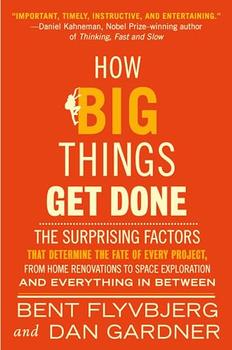
The Surprising Factors That Determine the Fate of Every Project, from Home Renovations to Space Exploration and Everything In Between
by Bent Flyvbjerg
Nothing is more inspiring than a big vision that becomes a triumphant, new reality. Think of how the Empire State Building went from a sketch to the jewel of New York's skyline in twenty-one months, or how Apple's iPod went from a project with a single employee to a product launch in eleven months.
These are wonderful stories. But most of the time big visions turn into nightmares. Remember Boston's "Big Dig"? Almost every sizeable city in the world has such a fiasco in its backyard. In fact, no less than 92% of megaprojects come in over budget or over schedule, or both. The cost of California's high-speed rail project soared from $33 billion to $100 billon—and won't even go where promised. More modest endeavors, whether launching a small business, organizing a conference, or just finishing a work project on time, also commonly stall out. But why do some projects fail?
Understanding what distinguishes the triumphs from the failures has been the life's work of Oxford professor Bent Flyvbjerg, dubbed "the world's leading megaproject expert." In How Big Things Get Done, he identifies the errors in judgment and decision-making that lead projects, both big and small, to fail, and the research-based principles that will make you succeed with yours. For example:
• Understand your odds. If you don't know them, you won't win.
• Plan slow, act fast. Getting to the action quick feels right. But it's wrong.
• Think right to left. Start with your goal, then identify the steps to get there.
• Find your Lego. Big is best built from small.
• Be a team maker. You won't succeed without an "us."
• Master the unknown unknowns. Most think they can't, so they fail. Flyvbjerg shows how you can.
• Know that your biggest risk is you.
Full of vivid examples ranging from the building of the Sydney Opera House, to the making of Pixar blockbusters, to a home renovation in Brooklyn gone awry, How Big Things Get Done reveals how to get any ambitious project done—on time and on budget.
"Entertaining ... The picture that [Flyvbjerg] and Mr Gardner draw of why projects, large and small, tend to go wrong is compelling... . There are lessons here for managers of all stripes." —The Economist
"[How Big Things Get Done is] a book that every legislator, city council member and corporate executive ought to read." —Wall Street Journal
"This book distills the best scientific advice on planning big projects. And it is arguably the bargain of the century." —Philip E. Tetlock, co-author of Superforecasting
"How Big Things Get Done ... is a crystal-clear pattern of surprising reasons why almost all big human projects fail to deliver as expected—and a road map for the book's lucky readers to avoid them." —Ola Rosling, CEO and co-founder of Gapminder; co-author of Factfulness
This information about How Big Things Get Done was first featured
in "The BookBrowse Review" - BookBrowse's membership magazine, and in our weekly "Publishing This Week" newsletter. Publication information is for the USA, and (unless stated otherwise) represents the first print edition. The reviews are necessarily limited to those that were available to us ahead of publication. If you are the publisher or author and feel that they do not properly reflect the range of media opinion now available, send us a message with the mainstream reviews that you would like to see added.
Any "Author Information" displayed below reflects the author's biography at the time this particular book was published.
Bent Flyvbjerg is the first BT Professor at Oxford University and the VKR Professor at the IT University of Copenhagen, an economist, and "the world's leading megaproject expert," according to global accounting network KPMG. He has consulted on over one hundred projects costing $1 billion or more and has been knighted by the Queen of Denmark.

If you liked How Big Things Get Done, try these:

by Mustafa Suleyman
Published 2025
An urgent warning of the unprecedented risks that AI and other fast-developing technologies pose to global order, and how we might contain them while we have the chance—from a co-founder of the pioneering artificial intelligence company DeepMind
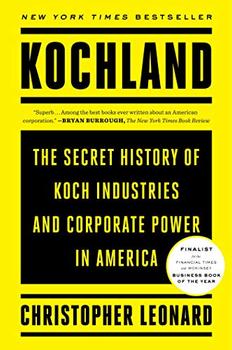
by Christopher Leonard
Published 2020
Just as Steve Coll told the story of globalization through ExxonMobil and Andrew Ross Sorkin told the story of Wall Street excess through Too Big to Fail, Christopher Leonard's Kochland uses the extraordinary account of how one of the biggest private companies in the world grew to be that big to tell the story of modern corporate America.

by Tyler Anbinder
Published 2017
A defining American story, never before told with such breadth of scope, lavish research, and resounding spirit.

L.A. Women by Ella Berman
Two ambitious writers in 1960s LA face betrayal when one writes a novel based on the other's life.






Your guide toexceptional books
BookBrowse seeks out and recommends the best in contemporary fiction and nonfiction—books that not only engage and entertain but also deepen our understanding of ourselves and the world around us.

