
-
Your next favorite book
is waiting.
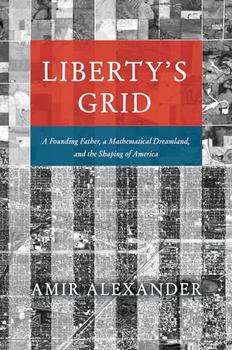
A Founding Father, a Mathematical Dreamland, and the Shaping of America
by Amir Alexander
The surprising history behind a ubiquitous facet of the United States: the gridded landscape.
Seen from an airplane, much of the United States appears to be a gridded land of startling uniformity. Perpendicular streets and rectangular fields, all precisely measured and perfectly aligned, turn both urban and rural America into a checkerboard landscape that stretches from horizon to horizon. In evidence throughout the country, but especially the West, the pattern is a hallmark of American life. One might consider it an administrative convenience—an easy way to divide land and lay down streets—but it is not. The colossal grid carved into the North American continent, argues historian and writer Amir Alexander, is a plan redolent with philosophical and political meaning.
In 1784 Thomas Jefferson presented Congress with an audacious scheme to reshape the territory of the young United States. All western lands, he proposed, would be inscribed with a single rectilinear grid, transforming the natural landscape into a mathematical one. Following Isaac Newton and John Locke, he viewed mathematical space as a blank slate on which anything is possible and where new Americans, acting freely, could find liberty. And if the real America, with its diverse landscapes and rich human history, did not match his vision, then it must be made to match it.
From the halls of Congress to the open prairies, and from the fight against George III to the Trail of Tears, Liberty's Grid tells the story of the battle between grid makers and their opponents. When Congress endorsed Jefferson's plan, it set off a struggle over American space that has not subsided. Transcendentalists, urban reformers, and conservationists saw the grid not as a place of possibility but as an artificial imposition that crushed the human spirit. Today, the ideas Jefferson associated with the grid still echo through political rhetoric about the country's founding, and competing visions for the nation are visible from Manhattan avenues and Kansan pastures to Yosemite's cliffs and suburbia's cul-de-sacs. An engrossing read, Liberty's Grid offers a powerful look at the ideological conflict written on the landscape.
"Alexanderʼs entertaining survey of this long-forgotten but once heated debate probes at the weird ways science and politics intersect. Readers will be utterly engrossed." ―Publisher's Weekly
"Liberty's Grid draws a startling connection between the American love of rectilinear layout and philosophical ideas about America itself—the landscape as the graph paper our national identity is scribbled on. You'll never look at Manhattan the same way again." ―Jordan Ellenberg, author of Shape: The Hidden Geometry of Information, Biology, Strategy, Democracy, and Everything Else
"Alexander's important new book illuminates the geometrical premises and ideological implications of westward expansion and urban development, offering fresh perspectives on the conflicting and controversial ways Americans imagined their future and transformed the continent. Liberty's Grid will provoke and inform ongoing debates about the pathways we are following—and the history we are inscribing—on our national landscape." ―Peter S. Onuf, author of Jefferson's Empire: The Language of American Nationhood
"Anyone interested in the history or the geography of the United States will welcome Alexander's novel perspective on the westward expansion of the US. Alexander's emphasis on the geometry of the development of the landscape makes this compulsively readable book a necessary contribution to the literature of Indigenous resistance." ―Michael Harris, author of Mathematics without Apologies: Portrait of a Problematic Vocation
This information about Liberty's Grid was first featured
in "The BookBrowse Review" - BookBrowse's membership magazine, and in our weekly "Publishing This Week" newsletter. Publication information is for the USA, and (unless stated otherwise) represents the first print edition. The reviews are necessarily limited to those that were available to us ahead of publication. If you are the publisher or author and feel that they do not properly reflect the range of media opinion now available, send us a message with the mainstream reviews that you would like to see added.
Any "Author Information" displayed below reflects the author's biography at the time this particular book was published.
Amir Alexander teaches history at the University of California, Los Angeles. His writing has appeared in the New York Times, Wall Street Journal, Nature, Washington Post, and Los Angeles Times. He is the author of four books, including Infinitesimal: How a Dangerous Mathematical Theory Shaped the Modern World and Proof! How the World Became Geometrical.

If you liked Liberty's Grid, try these:

by Greg Grandin
Published 2026
From the Pulitzer Prize–winning historian, the first comprehensive history of the Western Hemisphere, a sweeping five-century narrative of North and South America that redefines our understanding of both.
by Clint Smith
Published 2022
The Atlantic staff writer and poet Clint Smith's revealing, contemporary portrait of America as a slave owning nation.

by Anthony McCann
Published 2019
An "epic exploration" of the 2016 right-wing Oregon Occupation - "an excellent microcosm by which we might better understand our difficult national history and distressing political moment" (Maggie Nelson).
Theo of Golden by Allen Levi
One spring morning, a stranger arrives in the small southern city of Golden. No one knows where he has come from…or why…






Your guide toexceptional books
BookBrowse seeks out and recommends the best in contemporary fiction and nonfiction—books that not only engage and entertain but also deepen our understanding of ourselves and the world around us.

