
-
Your next favorite book
is waiting.
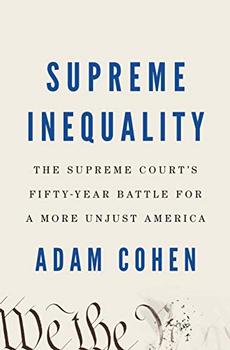
The Supreme Court's Fifty-Year Battle for a More Unjust America
by Adam Cohen
From New York Times bestselling author Adam Cohen, a revelatory examination of the conservative direction of the Supreme Court over the last fifty years since the Nixon administration.
In the early 1960s, the Supreme Court led by Chief Justice Earl Warren was at the height of its power, expanding civil rights for the poor and minorities and promoting equality. Its rulings integrated schools across the South, established the Miranda warning for suspects in police custody, and recognized the principle of one person, one vote. But when Warren retired in 1969, newly elected President Richard Nixon, who had been working tirelessly behind the scenes to put a stop to what he perceived as the Court's liberal agenda, had his new administration launch a total assault on the Warren Court's egalitarian victories, moving to dismantle its legacy and replace liberal justices with ones more loyal to his views. During his first three years, he appointed four justices to the Supreme Court, thereby setting its course for the next fifty years.
In Supreme Inequality, Adam Cohen surveys the most significant Supreme Court rulings since Nixon and exposes how rarely the Court has veered away from its agenda of promoting inequality. Contrary to what Americans might like to believe, the Court does little to protect the rights of the poor and disadvantaged, and, in fact, it has not been on their side for decades. Many of the greatest successes of the Warren Court, such as school desegregation, voting rights, and protecting workers, have been abandoned in favor of rulings that protect corporations and privileged Americans, who tend to be white, wealthy, and powerful.
As the nation comes to grips with two new Trump-appointed justices, Cohen proves beyond doubt that the modern Court has been one of the leading forces behind the nation's soaring level of economic inequality, and that an institution revered as a source of fairness has been systematically making America less fair. A triumph of American legal, political, and social history, Supreme Inequality holds to account the highest court in the land, and shows how much damage it has done to America's ideals of equality, democracy, and justice for all.
"Weaving legal, political, and social history, Cohen creates a richly detailed, but accessible, account for all interested in the personalities and politics that have shaped and are continuing to shape not only the U.S. criminal justice system but also the fabric of American life. A must-read." - Library Journal (starred review)
"Cohen examines roads not taken, ones that might have 'built a different society,' while noting that the court is likely to take an even more rightward tack in coming years. A provocative and maddening study of judicial activism for the benefit of the haves over the have-nots." - Kirkus Reviews
"[I]mpassioned but one-sided...a blistering critique in which politics overshadow constitutional principles." - Publishers Weekly
"Brown v. Board? Roe v. Wade? Sure. But with Supreme Inequality you dig down and understand the real direction of the Court over the last five-plus decades. It's imperative. And you can't put it down—with not just the law but the stories behind the law. Don't miss it." - Peter Edelman, Carmack Waterhouse Professor of Law and Public Policy, Georgetown University Law Center
"With Supreme Inequality, Adam Cohen has built, brick by brick, an airtight case against the Supreme Court of the last half-century. With his trademark precision and broad sweep, Cohen proves that the high court has created one system of legal protections for America's wealthy corporate interests and a second for the poor and middle classes...Cohen's book is a closing statement in the case against an institution tasked with protecting the vulnerable, which has emboldened the rich and powerful instead." - Dahlia Lithwick, senior editor, Slate
This information about Supreme Inequality was first featured
in "The BookBrowse Review" - BookBrowse's membership magazine, and in our weekly "Publishing This Week" newsletter. Publication information is for the USA, and (unless stated otherwise) represents the first print edition. The reviews are necessarily limited to those that were available to us ahead of publication. If you are the publisher or author and feel that they do not properly reflect the range of media opinion now available, send us a message with the mainstream reviews that you would like to see added.
Any "Author Information" displayed below reflects the author's biography at the time this particular book was published.
Adam Cohen, a former member of the New York Times editorial board and senior writer for Time magazine, is the author of Imbeciles: The Supreme Court, American Eugenics, and the Sterilization of Carrie Buck and Nothing to Fear: FDR's Inner Circle and the Hundred Days That Created Modern America. A graduate of Harvard Law School, he was president of volume 100 of the Harvard Law Review.

If you liked Supreme Inequality, try these:
by Masha Gessen
Published 2021
A bestselling, National Book Award–winning journalist's bracing elucidation of our tumultuous times.

by Dovey Johnson Roundtree
Published 2019
"Dovey Johnson Roundtree set a new path for women and proved that the vision and perseverance of a single individual can turn the tides of history." —Michelle Obama
by Michael J.. Sandel
Published 2010
Michael J. Sandel's "Justice" course is one of the most popular and influential at Harvard. Up to a thousand students pack the campus theater to hear Sandel relate the big questions of political philosophy to the most vexing issues of the day. Justice offers readers the same exhilarating journey that captivates Harvard students.

L.A. Women by Ella Berman
Two ambitious writers in 1960s LA face betrayal when one writes a novel based on the other's life.







Your guide toexceptional books
BookBrowse seeks out and recommends the best in contemporary fiction and nonfiction—books that not only engage and entertain but also deepen our understanding of ourselves and the world around us.


