When We Were Orphans Reading Guide & Discussion Questions

Summary |  Excerpt |  Reading Guide |  Reviews |  Read-Alikes |  Genres & Themes |  Author Bio
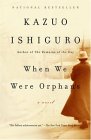
When We Were Orphans by Kazuo Ishiguro

When We Were Orphans

by Kazuo Ishiguro
  • Critics' Consensus (4):
  • Readers' Rating (5):
  • First Published:
  • Sep 1, 2000, 320 pages
  • Paperback:
  • Oct 2001, 352 pages
  • Rate this book

About this Book

Book Club Discussion Questions

Print PDF


Please be aware that this discussion guide will contain spoilers!

  1. The function of memory is already a major component of the narrative in the opening pages of the book: Christopher is writing in 1930 about something that happened in 1923, and within that memory are the memories of even earlier events. And throughout the book, what Christopher does and does not recollect, is of great concern for him. How has Ishiguro used the vagaries of Christopher's memory to shape the novel? How does the narrative itself mimic the ways in which memory functions?

  2. What role does Sarah Hemmings play in this early part of the novel as it relates to Christopher? What is behind her urgent need to meet Sir Cecil? What is it about Sarah that moves Christopher to tell her about his past when he had told no one else in all the years he'd been in England? Why is he "surprised and slightly alarmed" [p. 72] to have opened up to her?

  3. Before Christopher returns to Shanghai, the narrative hints at what we don't yet know, and at the complexity of what we will learn in the course of the novel. For instance, Christopher, speaking about his uncle Philip, says, "It is perfectly possible that at that stage [before the disappearance of Christopher's father] he wished nothing but good for me, that he had no more inkling than I did of the course of things to come" [p. 85]. What is Ishiguro's intention in using anticipatory passages such as this one? How does this narrative tool affect your reading of the novel?

📖

Get the full reading guide

Join BookBrowse free to unlock all 17 discussion questions, author background, themes, and more for When We Were Orphans.

Join free — it takes 30 seconds

Already a member? Log in →

  1. How does the author develop themes of identity and belonging throughout the narrative?
  2. What role does the setting play in shaping the characters' decisions and relationships?
  3. Discuss how the ending reframes the events of the story. Were you surprised?


Unless otherwise stated, this discussion guide is reprinted with the permission of Vintage. Any page references refer to a USA edition of the book, usually the trade paperback version, and may vary in other editions.
Membership Advantages
  • Reviews
  • "Beyond the Book" articles
  • Free books to read and review (US only)
  • Find books by time period, setting & theme
  • Read-alike suggestions by book and author
  • Book club discussions
  • and much more!
  • Just $60 for 12 months or $20 for 3 months.
  • More about membership!
Book Club Giveaway!
Win L.A. Women

L.A. Women by Ella Berman

Two ambitious writers in 1960s LA face betrayal when one writes a novel based on the other's life.


Enter

BookBrowse Book Club

  • Book Jacket
    Days of Sun and Shadow
    by India Hayford
    A young woman’s coming-of-age story set in the early American frontier, shaped by tragedy, nature, and resilience.
  • Book Jacket
    Merry-Go-Round Broke Down
    by David Woo, Margalit Shinar
    Nine linked stories reveal how globalization sparks life-changing consequences across continents.
  • Book Jacket
    Chelsea Girls
    by Catherine Lloyd
    A glamorous biographical novel on Mary Quant, whose daring design of the miniskirt revolutionized fashion.

Members Recommend

  • Book Jacket
    An Infinite Love Story
    by Chanel Cleeton
    “A tender, romantic drama that soars as high as it’s astronauts.” —Kate Quinn
  • Book Jacket
    Summer of Love
    by Kerri Maher
    Three women reshape their family's Napa Valley winery after the 1967 Summer of Love.
Book
Trivia
  • Book Trivia

    Can you name the title?

    Test your book knowledge with our daily trivia challenge!

Wordplay

Solve this clue:

The C is A R

and be entered to win..

Your guide toexceptional          books

BookBrowse seeks out and recommends the best in contemporary fiction and nonfiction—books that not only engage and entertain but also deepen our understanding of ourselves and the world around us.


