Book Club Discussion Questions
Please be aware that this discussion guide will contain spoilers!
About This Book
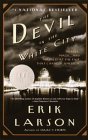
In
The Devil
in the White City, Erik Larson takes readers into a richly complex moment in
American history, a moment that would draw together the best and worst of the
Gilded Age, the grandeur and triumph of the human imagination, and the poverty,
violence, and depravity that surrounded it.
The book's two most powerful figures, the great architect Daniel Burnham and
the psychopathic killer, Henry H. Holmes, in many ways embody the opposing
forces of the age. Burnham was responsible for building the White City,
overcoming a series of crushing professional obstacles and personal tragedies to
make the Fair the magical, awe-inspiring event that it was. He brought together
some of the greatest architects of the day—Charles McKim, George Post, Richard
Hunt, Frederick Law Olmsted, and others—convinced them of the importance of
the Fair, and somehow got them to work together to achieve what many considered
to be an impossible project in an astonishingly brief amount of time.
Simultaneously, in the shadow of the White City, Henry H. Holmes set up his own
World's Fair Hotel to take advantage of naive young single women arriving in
Chicago from surrounding small towns. Using his mesmerizing charm and an uncanny
ability to fend off creditors and police, Holmes bent his victims to his will
and committed a series of murders as cold-blooded as any in American history.
But
The Devil in the White City is about more than just two men. It is
about America on the threshold of the twentieth century—a time of widespread
violence, fantastic wealth, growing labor unrest, and financial panic; a time
when Buffalo Bill could take a bow to Susan B. Anthony; and a time when men and
women as diverse as Jane Addams, Theodore Dreiser, Thomas Edison, Samuel Gompers,
and Frank Lloyd Wright—could all gaze in wonder at the magnificence of the
White City.
Reading Guide
- In the note "Evils Imminent," Erik Larson writes "Beneath the gore
and smoke and loam, this book is about the evanescence of life, and why some men
choose to fill their brief allotment of time engaging the impossible, others in
the manufacture of sorrow" [xi]. What does the book reveal about "the
ineluctable conflict between good and evil"? What is the essential difference
between men like Daniel Burnham and Henry H. Holmes? Are they alike in any way?
- At the end of The Devil in the White City, in Notes and Sources,
Larson writes "The thing that entranced me about Chicago in the Gilded Age was
the city's willingness to take on the impossible in the name of civic honor, a
concept so removed from the modern psyche that two wise readers of early drafts
of this book wondered why Chicago was so avid to win the world's fair in the
first place" [p. 393]. What motives, in addition to "civic honor," drove
Chicago to build the Fair? In what ways might the desire to "out-Eiffel
Eiffel" and to show New York that Chicago was more than a meat-packing
backwater be seen as problematic?
- The White City is repeatedly referred to as a dream. The young poet Edgar
Lee Masters called the Court of Honor "an inexhaustible dream of beauty" [p.
252]; Dora Root wrote "I think I should never willingly cease drifting in that
dreamland" [p. 253]; Theodore Dreiser said he had been swept "into a dream
from which I did not recover for months" [p. 306]; and columnist Teresa Dean
found it "cruel . . . to let us dream and drift through heaven for six months,
and then to take it out of our lives" [p. 335]. What accounts for the
dreamlike quality of the White City? What are the positive and negative aspects
of this dream?
📖
Get the full reading guide
Join BookBrowse free to unlock all 13 discussion questions, author background, themes, and more for The Devil in the White City.
Join free — it takes 30 seconds
Already a member? Log in →
- How does the author develop themes of identity and belonging throughout the narrative?
- What role does the setting play in shaping the characters' decisions and relationships?
- Discuss how the ending reframes the events of the story. Were you surprised?
Unless otherwise stated, this discussion guide is reprinted with the permission of Vintage.
Any page references refer to a USA edition of the book, usually the trade paperback version, and may vary in other editions.