Book Club Discussion Questions
Please be aware that this discussion guide will contain spoilers!
Introduction
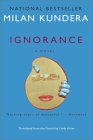
The collapse of the communist regimes of Eastern Europe in 1989 put an end not only to an ideology but to a perennial European character, the Émigré. After decades of being pitied as the Great Victim or despised as the Great Traitor [p. 30], he (or she) was now free to go back home, perhaps even morally obliged to do so. But what is home? Is it merely a place or something more tenuous and less easily attainable? And can someone who's spent half a life in the grip of nostalgia -- "the suffering caused by an unappeased yearning to return" [p. 5] -- emerge from it so easily? These are among the questions that Milan Kundera poses in
Ignorance, a novel whose remarkably brief span encompasses two centuries of European history along with the intertwining relationships of several contemporary Europeans.
Twenty years after leaving their native country, two Czech émigrés meet in the Paris airport as they wait for the flight to Prague. Irena is considering returning home for good. Josef, who found asylum in Denmark and married a Danish woman, is only visiting. Irena still keenly remembers the night many years before when she and Josef flirted in a bar in Prague. Josef can't remember Irena's name. Although they are immediately drawn to each other, their attraction -- at least on Irena's part -- is based on a misapprehension, one that will become apparent only at the most awkward and humiliating possible moment.
In the days leading up to their assignation, Kundera tracks his protagonists' movements with the smooth precision of a surveillance camera. We see Irena at a reunion of her old friends; with her bawdy, irrepressibly competitive mother, and with her entrepreneurial Swedish boyfriend, Gustav, who loves the vulgar, tourist-friendly Prague that Irena despises. We follow Josef to a meeting with his long-estranged brother and sister-in-law, a meeting in which tenderness vies with guilt and resentment. And,
Ignorance being a Kundera novel, we also encounter a series of dazzling meditations on emigration, memory and loss, and particularly on
The Odyssey, the founding epic of nostalgia, whose hero sacrifices the luxuries of exile for a risky return to a home where he is now a stranger.
Discussion Questions
- As in his previous novels, Kundera isn't content to merely tell a story; he also comments on it, via digressions on themes ranging from history to etymology and music. What is the effect of this method? Does it emotionally distance you from the narrative and characters or cause you to see them in a different light? Would you describe Ignorance as a realist novel?
- When her Parisian friend Sylvie urges her to go home to her country, Irena replies "You mean this"--meaning Paris -- "isn't my home anymore?" This exchange suggests that "home" may be a relative phenomenon, that today's home may not be tomorrow's. How is this theme developed elsewhere in Ignorance? Can any of Kundera's characters be said to have a true home, or is home in this book always changeable, unreliable, and perhaps even illusory? And is going home a guarantee of happiness?
- Even as Ignorance questions the permanence of home, it also raises doubts about the authenticity of the self, as in this moment when Irena glimpses her reflection in a department store mirror: "The person she saw was not she, it was somebody else, or…it was she but she living a different life." [p. 31] How would you sum up this novel's view of identity? Have Kundera's characters chosen their identities or have their identities been imposed on them by outside forces?
📖
Get the full reading guide
Join BookBrowse free to unlock all 9 discussion questions, author background, themes, and more for Ignorance.
Join free — it takes 30 seconds
Already a member? Log in →
- How does the author develop themes of identity and belonging throughout the narrative?
- What role does the setting play in shaping the characters' decisions and relationships?
- Discuss how the ending reframes the events of the story. Were you surprised?
Unless otherwise stated, this discussion guide is reprinted with the permission of Harper Perennial.
Any page references refer to a USA edition of the book, usually the trade paperback version, and may vary in other editions.