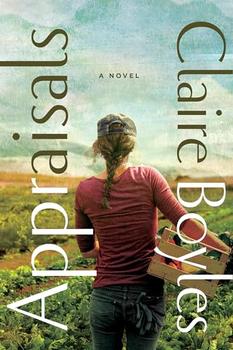
Appraisals: A Novel
by Claire Boyles
Appraisals captures the harsh gray area of contemporary rural life (7/20/2026)
Claire Boyles delivers a stunning, deeply empathetic debut novel with Appraisals. Set against the stark beauty and harsh economic realities of present-day rural Colorado, this novel weaves together powerful themes of land, legacy, and family bonds. I was reminded of Willa Cather's classic "My Antonia," which also treats the American rural West not as a passive backdrop, but as an active character that shapes the morality, resilience, and identity of the families who work it. And both stories feature females as an anchor of rural fortitude; in Appraisals, it's a well-grounded story across four generations of women.
Boyles writes with honesty and lyricism, whether it's the colorful orchestration of fruits and vegetables for the farmer's market, or the onset of evening with nightjars on their low flightpath, or the inevitable farming "red in neck-breaking and feather plucking." She truly captures the quiet heartbreak and fierce resilience of a farming family fighting forces beyond their control, from the forces of nature, to the cruelties of small-farming economics, especially the predatory bank loans, to the brutalities of fracking. I found Appraisals poignant, urgent, yet hopeful, and it will make for a great book group selection, let alone compel you to buy from your local farmer's market more frequently.

Fatherland: A Novel
by Victoria Shorr
Unpleasant Tale of a Father's Abandonment (2/15/2026)
The synopsis for Fatherland says it's about the American dream gone bust due to a father's infidelity and the effects on his daughter across decades and milestones. Technically, that's true but I had no feel for why Lora, the aggrieved wife, adored Martin, how a 1950s housewife survived such abandonment, not exactly a time of personal or financial independence for most women. Nor was there much believable delving into why Josie, the daughter, was motivated to keep in touch with him when each meeting leads her to be more disillusioned and distraught than the last one.
Author Victoria Shorr is an acclaimed author and many like her unsentimental style. But for me, it created a barrier making it difficult to connect with any of Fatherland's characters. I also found Shorr's frequent use of pronouns confusing, you'll need to read carefully whom the "she" and "he" is referring to.
If you are looking for a nuanced exploration of a family grappling with a father's betrayal, you might be better served by the emotional depth of Anne Tyler's Dinner at the Homesick Restaurant. Or if you want to better understand an irredeemably cheating husband, read any of John Updike's Rabbit books.

Ginseng Roots: A Memoir
by Craig Thompson
The search for meaning and home through Ginseng roots (4/24/2025)
You cannot tell that author Craig Thompson suffers from hand degeneration in his gorgeously and intricately illustrated graphic memoir about growing up on a ginseng farm in Wisconsin. I have scant knowledge about ginseng and only a little more about Wisconsin, mostly owing to its status as Blue Wall state. After reading (and viewing) this 435-page memoir, I feel closer to both.
Thompson doesn't just show the grueling nature of Ginseng farming, he also takes readers on a fascinating journey into the herb's very roots in China, the US, Korea, and Taiwan, both through the new people he encounters along the way and reuniting with his parents, long-time farmers, and sometimes via an impish female Ginseng Avatar. I appreciated Thompson's Zen-like empathy for his parents with whom he disagrees on various fronts, for his brother, whom he travels to Asia with, and for all those behind getting this fussy plant to folks who benefit from its medicinal properties.
If you've never read a memoir in cartoon form (although calling it a cartoon feels like it falsely reduces Thompson's compelling narrative into a children's genre), you might get hooked on this memoir alternative. I know I did.