Write your own review!
Gwen C. (Clearfield, PA)
A Hundred Flowers
This book drew me in from the first page. The story is told from the perspectives of different characters ( a popular trend, and used to advantage here) and encompasses five months in 1958 with one Chinese family's struggles in the aftermath of the Communist Party's rise to power. I'm no student of Chinese history or politics, but Gail Tsukiyama seamlessly introduced the necessary backstory into her tightly woven, wonderful plot. A momentous misunderstanding of a person's name, father-son relationships, Chinese lore and stories, and much more make for a fascinating read, with a satisfying - yet totally realistic - conclusion. As a language lover I couldn't resist underlining many beautiful and illuminating phrases and I thoroughly enjoyed the occasional Chinese words intermingled in the text. This would be an excellent read for book clubs. My only criticism is I wished for a map - and could not tear myself away from the book to look up locations.
Peg S. (Durham, North Carolina)
A Hundred Schools of Thought
The structure of short passages, fully and continuously portraying each character gave a broad view of the of the change in a professor's family's life under Mao TseTung and communism. I considered this a kaleidoscopic view of an educated Chinese family, the changes in their large home and life with the kapoc tree in their courtyard. I loved this book and want to read more by Gail Tsukiyama.
Judy B. (Santa Fe,, NM)
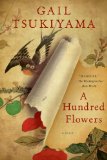
A Hundred Flowers by Gail Tsukiyama
Gail Tsukiyama has done it again---written a most wonderful story. This is what I would call a "gentle" book........a book that "gently" tells you a story and "gently" brings you through some of life's worst moments and "gently" deposits you at the end, leaving you thinking "How wonderful is this story?"
The story starts in the late 50's in China during the Cultural Revolution. A little boy named Tao falls out of a Kapok tree in his courtyard of his house and breaks his leg. Then you find out that his father has been taken away from the home and sent to be "re-educated." The time line of the story is from July, 1958 to November, 1958, but in that time all the characters are are fully sketched and their histories are fully known. The story is told from the viewpoint of several characters: Kai Ying, the mother; Tao, the little boy; Wei, the grandfather; and Song, the Auntie. Also there is a side story of Suyin and her baby, a young 15 year old girl who is taken in by the mother.
The story builds until the grandfather confesses a secret that leads him on a journey and finally his return to the family home.
A beautiful, wonderful, "gentle" story!!!
 Dorothy T.
Under the Kapok Tree
Dorothy T.
Under the Kapok Tree
Gail Tsukiyama has once again given readers a beautifully written novel that, unlike her other works that take place in Japan, is set in China during 1958, when the effects of Mao’s Communist regime is being felt among the people.
The story is driven by the characters of Kai Ying, her son Tao, and her father-in-law Wei. It is their journeys, both literal and within themselves, that drew me in. Each one must deal with the consequences of the absence of Sheng, Kai Ying’s husband, who was arrested and shipped off to a labor camp, and the effects on their relationships with each other. This author has a gift for making me feel like I am in the places she describes and for developing characters that I know and care about.
If you have yet to read one of her books, this is a good one to start with. If you are acquainted with her work, this one will not disappoint.
Cathryn_Conroy
Beautifully Written: A Profound Novel About Loss and Courage
With evocative descriptions of everything from the thorns of a kapok tree to the sooty grime of a train, this lovely novel by Gail Tsukiyama will transport you to China at the beginning of the Chinese Cultural Revolution when so many traditional elements of Chinese society were brutally purged—including many who disagreed with the government and had the courage to say so. It was a dangerous time.
It's 1957. Sheng and Kai Ying are happily married with a 7-year-old son named Tao. They live in Sheng's family's villa in Guangzhou, a bustling port city on the Pearl River, along with his aging father, Wei, and an old family friend, Auntie Song. The family endures two crises. Although Mao has decreed "Let a hundred flowers bloom; let a hundred schools of thought contend," the government cracks down hard on any one with a dissenting point of view. One day, Sheng is arrested for writing a letter criticizing the Communist Party and is sent 1,000 miles away to Luoyang, a diminished industrial city, to be "reeducated," a brutal years-long process of intense labor and near starvation that most do not survive.
One year later, Tao is climbing the kapok tree in the villa's courtyard in an attempt to see the peaks of White Cloud Mountain in the far distance, but he slips and falls 30 feet to hard surface below. While his injuries are severe, he survives the fall, but it forever changes all their lives. And then during a monsoon, a 15-year-old pregnant girl stumbles into the courtyard in hard labor. Who is she? Why did she choose this home? Meanwhile, secrets abound in this household, but Wei's secret is so dark and disturbing, it is taking a toll on his health.
This is a beautifully written historical novel filled with grace and remarkable insight into the human condition, especially when lives are irrevocably torn asunder and the only way to survive is through courage. But as sad and troubling as it is, the story ends with a sense of hope and redemption.
Judith S. (Santa Clarita, California)
Resilience and stubbornness to survive
“She marveled at nature's resiliency, its sheer stubbornness to survive.”
Those are the thoughts of Auntie Song, one of the characters in Gail Tsukiyama’s newest book. It is the story of an extended family told from five different perspectives through a year of many changes. Some of the challenges they face are common to many lives; a child’s accident, grief at the death of a spouse, the birth of a child. Other concerns are unique to the cataclysmic social changes of Mao Tse-Tung’s regime.
The family consists of Kai Ying, the mother of Tao, her elderly father-in law, Wei, and Auntie Song, a courtesy aunt who occupies a portion of their family home. As the year progresses a pregnant , homeless teenager joins the family. Much of the family’s unique distress is due to its absent member. Sheng, the husband, the father, the beloved son, has been arrested and sent to a distant reeducation camp.
I liked all of these characters. They are very human in their strengths and weaknesses. Kai Ying has admirable sensitivity to her patients as she prepares her herbal remedies and Auntie Song’s optimism and strong survival instincts are inspiring. The book is somewhat slow and occasionally disjointed as the storytelling shifts from one person to another, but the overall picture of this family was very satisfying. They have nature’s resiliency and a sheer stubbornness to survive.
Amy L. (Tucson, AZ)
Another Gentle Winner
Gail Tsukiyama is an author I greatly admired. Her "Samurai's Garden" is one of my favorite books, for its exquisite prose, dignity, nobility and simplicity. "A Hundred Flowers" is marked by the same simplicity, nobility and dignity. Set during Mao's cultural revolution, it shows us the impact of the revolution from the multiple viewpoints of family members. Each narrator (boy, mother, grandfather and aunt/family friend) provides a unique view of the same events while revealing deeply personal information. It is a moving affirmation of life during a difficult period in Chinese history.
Teresa M. (Naples, FL)
A Hundred Flowers
I've read two of the author's previous books and especially loved The Samurai's Garden. Tsukiyama is a gifted writer who creates wonderful characters reader's grow to love. I also enjoy learning something new, and in this book, we learn about Mao's "Hundred Flowers Campaign" started in the 1950"s, and used to flush out dissidents and subsequently imprison them.
The story centers around a family torn apart by Mao's campaign, and one of the character's quotes nicely sums up the book, "Sometimes the best lessons are in the journey, regardless of the outcome."