Write your own review!
 Cathryn_Conroy
A Highly Readable History Book: Deep Dive into the People, Places, and Events That Caused the Civil War
Cathryn_Conroy
A Highly Readable History Book: Deep Dive into the People, Places, and Events That Caused the Civil War
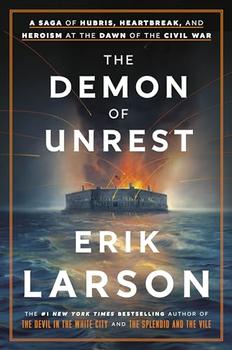
Why did the Civil War happen? How did it start? I'm not talking about who fired the first shots at and from Fort Sumter off the coast of Charleston, South Carolina, although that is an important and fascinating part of this book. I'm talking about the actions, misdeeds, speeches, blatant lies, intrigues, fears, and distrust between Northerners and Southerners that set in motion this tragic, bloody war.
The answers are in this book by Erik Larson, and some of it reminds me of our current divisive and polarized political climate. There is a warning here: As George Santayana wrote in 1905, "Those who cannot remember the past are condemned to repeat it."
This highly readable history book takes a deep dive into the stories of people, places, and events from November 1860 when Abraham Lincoln was elected as our 16th president to April 1861 with the surrender of Fort Sumter.
It dramatically zeroes in on the causes of the Civil War as depicted in the major and minor players, as well as the effect of specific events, including the Union occupying and arming Fort Sumter along with its hero commander Major Robert Anderson, the secession of Southern states one by one, the presidential election of Abraham Lincoln, and the almost criminal inaction and ineptitude of Lincoln's predecessor, James Buchanan, to do anything to stop the South from secession and tamp down the incensed and angry rhetoric. Most important of all is the role slavery played in this war—from Northern repugnance to Southern insistence it was all about "state's rights."
Do read the introduction, a note to readers that is titled "Dark Magic." It is Larson's prescient thoughts about being well into the research for this book about the saga of Fort Sumter as he watched on television the Capitol assault on January 6, 2021. He writes, "I had the eerie feeling that present and past had merged."
One clever ploy: Each section of the book is introduced with a pertinent part of "The Code Duello," which in its entirety is a detailed explanation of the code of honor for a duel. The creative effect is to change the Civil War into a national duel, which it seemingly was as it was cloaked—at least in the early months—in chivalry's code of honor.
Hilmi Arifim
Master storyteller Erik Larson delivers a gripping account of the tumultuous months between Lincoln's election and the Confederate shelling of Sumter—a period marked by tragic mistakes and miscommunication, inflamed egos and outsized ambitions, undes
In his latest appealing historical excavation, Larson, author of The Splendid and the Vile, Dead Wake, and other acclaimed books of popular history, examines the run-up to the Civil War during the six months between Lincoln’s November 1860 election and the surrender of Fort Sumter: a dismal period when bumblers, not excluding Lincoln, and fanatics dominated. People will fight for their freedom, but more will fight for their money, a fact that persuaded the Founding Fathers to continue the practice of slavery. Abolition became a major issue in the North early in the 19th century, enraging southerners. At the time, there was a widespread belief that Black men and women were fit for nothing better than being enslaved. All major southern religious traditions agreed, along with scholars, educators, journalists, and scientists. Most northerners agreed but hated that enslaved people worked for nothing; this depressed wages so there was opposition to slaves moving into territories and new states. Powerless before taking office, Lincoln vastly overestimated pro-Union sentiment in the South. He assured northern audiences that matters would calm down, believing (against all evidence) that secessionists were rational and that slavery in existing states was inviolate. Popular history demands a hero, so Larson concentrates on Maj. Robert Anderson, commander of the forts in Charleston harbor. Although he was a slaveowner, he did his duty, defending Fort Sumter until it became impossible and returning to the North to great acclaim. True to his style, Larson includes interesting portraits of obscure peripheral figures that enrich the narrative, including James Hammond, a wealthy but obnoxious planter and senator, and Mary Chesnut, wife of an even wealthier planter who kept an invaluable diary.
Anthony_Conty
A Whole New Level of Research
"The Demon of Unrest" by Erik Larson focuses on the months between Abraham Lincoln's election and the start of the Civil War, requiring much research, as with most of his work. The facts seem new, like you are reading fiction, especially those about James Buchanan and his role in overseeing the secession of South Carolina and the beginning of the conflict.
When I read that the novel would focus on the time between Lincoln's victory and Fort Sumter, I did not at first recognize how much verbal promises from Buchanan laid the groundwork for distrust and anger. When the South Carolina governor demanded a surrender, every act came off as aggression or escalation. It was a mess that few could navigate.
My history buff friends will know about the assassination attempt before Lincoln's inauguration, thwarted by a railroad president and others, but novices like me will find it quite fascinating. The author often uses "coercion" when Lincoln tries to walk the line between doing what is right and appeasing the South. No one knew how aggressive he would be.
The cast of characters, especially Major Robert Anderson and Governor Francis Perkins, shows the resolve on each side. Lincoln had friends like an ex-con, Stephen Hurlbut, who thought they had the connections to make a difference. Communication between the two sides was weak. Letters went undelivered, and many assumed hostility without confirmation, leading to uncertainty about intentions and goals up North.
Once we inevitably reached actual violent wartime, I felt the disarray and chaos associated with Fort Sumter. I grew to know some characters well enough to experience the horrors fully. When you are a Marylander, the Civil War is a big deal. Most of BookBrowse's picks for Best Nonfiction have plentiful research, unlike anything I could ever pull off myself.
She Treads Softly
in-depth account of events leading up to the start of the Civil War
The Demon of Unrest: A Saga of Hubris, Heartbreak, and Heroism at the Dawn of the Civil War by Erik Larson is a highly recommended in-depth look at the months between Lincoln’s November 1860 election and the surrender of Fort Sumter which lead up to the Civil War.
Larson brings to bear his penchant for presenting extensive historical research in a vivid, compelling manner in the telling the story of a deeply divided nation and the events leading up to the start of the Civil War. "At the heart of this suspense-filled narrative are Major Robert Anderson, Sumter’s commander and a former slave owner sympathetic to the South but loyal to the Union; Edmund Ruffin, a vain and bloodthirsty radical who stirs secessionist ardor at every opportunity; and Mary Boykin Chesnut, wife of a prominent planter, conflicted over both marriage and slavery and seeing parallels between them. In the middle of it all is the overwhelmed Lincoln, battling with his duplicitous secretary of state, William Seward, as he tries desperately to avert a war that he fears is inevitable—one that will eventually kill 750,000 Americans."
For those who enjoy any and all historical accounts surrounding the Civil War, The Demon of Unrest will be a welcomed addition to your library. This has been hailed as one of the most anticipated books of the year. Personally, ever since I read Isaac's Storm, still a favorite, reading any new Eric Larson book is a necessity. The presentation was compelling and the research is extensive, but I'll sheepishly admit I wanted the narrative to move along just a little bit faster. However, I know several Civil War buffs who will revel in the details.
In the opening Larson does write, “I was well into my research on the saga of Fort Sumter and the advent of the American Civil War when the events of January 6, 2021, took place.” Rather than be so specific and pinning the current ideological divisions on one day, it might have behooved him to simply say that turmoil and division between Americans is present again. Thanks to Crown Publishing for providing me with an advance reader's copy via NetGalley. My review is voluntary and expresses my honest opinion.

 Book Reviewed by: