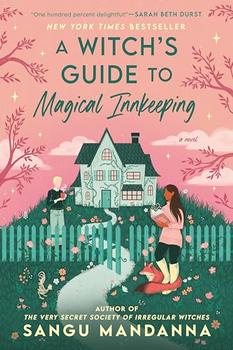
A Witch's Guide to Magical Innkeeping
by Sangu Mandanna
an enjoyable read (6/27/2026)
A Witch’s Guide To Magical Innkeeping is the third stand-alone novel by British author, Sangu Mandanna. You might come across the Batty Hole Inn in Lancashire, especially if lost or adrift. Probably not if you’re going to be a difficult customer, because Sera Swan’s spell is quite picky. She runs the inn with her great aunt Jasmine, and has the care of her eleven-year-old cousin, Theo, a witch whose Icelandic parents fear his powers.
Keeping them company are Matilda, an odd black woman with an enthusiasm for gardening, Nicholas, a twenty-three-year-old armour-wearing knight, Clemmie, a witch whose curse backfired to trap her in the body of a fox, and Roo-Roo, the undead rooster that Sera accidentally reincarnated when she was resurrecting a recently-dead Jasmine with an illegal spell.
That illegal spell, fifteen years earlier, took Sera from being one of the most gifted witches in the land, to having barely enough power to keep her protection spell over the inn going. It’s true, Sera would love to have her magic back, but that would require a reversal spell, to be found in the Ninth Compendium of Uncommon Spells, kept securely in the library of the British Guild of Sorcery.
When that book turns up at the inn, due to some covert action by Theo and Clemmie (who wants Sera to remove the fox curse), the Chancellor of the Guild is hot on its heels. But strangely, they’re not in as much trouble as they ought to be. The spell, though, presents more challenge than just translating it from ancient language: the ingredients are cryptic and seem impossible to source. Until luscious Luke Larsen turns up at the inn…
It’s disappointing that Mandanna chooses to pepper this sweet cosy fantasy romance with an unnecessary expletive: the F-word occurs 33 times, counted because it’s simply not a good fit with the characters, and doesn’t enhance the story. Not quite as good as The Very Secret Society of Irregular Witches, but still an enjoyable read.
This unbiased review is from an uncorrected proof copy provided by NetGalley and Hodder and Stoughton

Villa Coco: A Novel
by Andrew Sean Greer
Absolutely delightful! (6/26/2026)
Villa Coco is the fifth stand-alone novel by award-winning, bestselling American author, Andrew Sean Greer. Our American protagonist, unnamed until the final pages, is twenty-one when he emerges from the sexual freedom of his college days with a qualification in Archives and Record Management.
His college advisor alerts him to an advertised position cataloguing a collection at a country house in Tuscany. It includes a stipend, travel, board and room. His parents are relieved he is finally going to take life seriously, and he vows celibacy after his recent excesses.
Finally arriving at San Drogo, he learns his employer has given him the name Giovedi, calling him her man Thursday, and despite his protestations, the name clings. Baronessa Lisabetta, known to many as Coco, is ninety-two, not as frail as she looks and often imperious, always accompanied by two pugs, Pushkin and Gorky, and occasionally by a failed truffle dog called Cesare.
It’s late September and he has until Christmas to do the job. He’s a little concerned about the Baronessa’s cavalier approach: feeding the pugs, pruning her roses, making appointments, preventing the stone marten from killing the chickens, and dealing with the overflowing septic tank seem to take priority over the cataloguing.
When he manages to start, trying to get some sort of direction about how she wants the many objects classified produces anecdotes that often bear little relevance to the work, and the way she wants her books sorted is certainly novel. “I’m trained in archives and records. Organization. But Villa Coco is nothing but chaos”, he remarks, and wonders “Was she sitting on a fortune? Or a trash heap?”
He finds he is expected to interrupt his work to help with the olive harvest and, early on, the Baronessa stipulates three requirements. He is to: dress for dinner, learn to speak Italian, and learn about Italian history and culture. With the second, her close friend, Oscar suggests he find a warm dictionary. Giacomo, the cousin in the lizard-green Fiat fits the bill, sorely testing his vow.
His naivete still sticks out: “… being American seemed to me, before my later travels, the natural state of being in the world. What could be wrong with that?” Along the way, he learns style and acquires some decent clothing, and the food! “Everything I had tasted in America, everything Italian, was a distant memory of the old country. Like a spell written down but never heard. Of course some enchantment was lost.”
But there is something going on behind the scenes to which Giovedi is not privy, and he begins to wonder if he is in the company of thieves and forgers…
What a wonderful tale! It is filled with characters the reader can’t help but find endearing, the mistranslations and quirky customs are hilarious, and the dialogue, priceless: “’The mechanic says it needs a new belt or a fan.’
‘A belt! Or a fan!’ she said. ‘This is a very well-dressed car.’”
Greer’s descriptive prose is simply marvellous. He charms the reader on the first page with San Drogo’s statue: “The saint wore a floppy hat and seemed overburdened with a crosier, a scythe, and a sleeping lamb, as if he were carrying the shopping for another, more important saint” and doesn’t let up: “There were seasonal clothes to be brought out, brushed of mothballs or unwrapped from tissue, all the while brushing mothballs from her old stories and unwrapping her peculiar thoughts from the tattered tissue of her discretion.” Absolutely delightful!
This unbiased review is from a copy provided by Hachette Australia

Yesteryear: A Novel
by Caro Claire Burke
exceptional debut. (6/18/2026)
“So much of my life was dedicated to broadcasting a vision of nostalgia; a better and more beautiful version of America. A celebration of the days of yore.”
Yesteryear is the first novel by American author, Caro Claire Burke. The audio version is narrated by Rebecca Lowman. A decade after Christian wife, Natalie Heller Mills first begins posting on social media about the farm she and Caleb have bought, she has five children, with a sixth on the way, a cow, a horse and a coop of chickens, rows of vegetables, five million followers on Instagram, almost a million followers on Youtube, and a thriving online business selling cutting boards, aprons, salt blends and indoor paint.
Yesteryear Ranch is five hundred acres situated between two mountain ranges in rural Idaho and Natalie sees her roles of wife, mother, and influencer as seducing three lovers at once. Be it her marriage, her mothering, or her food prep, Natalie finds the best approach is faking emotions until she feels them. When a podcaster praises Yesteryear Ranch, she likens it to truffles: he has seen the rot but considers it a perfectly fermented version of America.
Not that everyone is convinced: there are plenty of comments from The Angry Women, whom she dismisses as women with crappy jobs, snotty kids and loser husbands, or single, whiny and depressed. And there are definitely some wrinkles below the surface of this seemingly perfect life…
When she wakes one icy winter morning to find she’s in a cabin that’s not quite her cabin, a kitchen like hers but more primitive, children that aren’t hers but call her “Mama”, and a husband who looks like Caleb, only harder, colder, she’s shocked. Is she hallucinating? Having a particularly vivid nightmare? Has she been abducted, put into a weird reality TV show set in the mid-nineteenth Century? She certainly feels like she’s being watched. Eventually, she begins to believe it’s a test from the Lord. If she passes the test, will she get her real life back?
With cleverly constructed alternating narratives, Burke gradually reveals how college student Natalie becomes influencer Natalie and how she finally comes to be inhabiting that bad dream. Not until much later in the tale does it become apparent that the narrative Natalie presents might be rather less reliable than it first seems.
Burke skilfully demonstrates America’s appetite for the trad wife image, and the double standards that see extramarital sex as manageable while gay sex is not. The story comments on patriarchy, politics and religion, has a truly nasty protagonist and a delicious dose of schadenfreude. Joanna Cannon said “perceptive, timely, wickedly funny and deeply disturbing” which succinctly summarises this exceptional debut.
Land: A Novel
by Maggie O'Farrell
Maggie O’Farrell always delivers. (6/18/2026)
“… the cragged cliffs that fall off into the pounding sea: a geometric shape moving among grand and yielding irregularities. How radiant, how lovely is the land – and yet how empty. It is as if he has passed through a rent into another realm where humans are unknown, where he is the only one, and will have to make the best of it.”
Land is the tenth novel by award-winning, bestselling Irish author, Maggie O’Farrell. The peninsula juts out into the Atlantic Ocean and has been the site of invasion, famine, destructive storms. In 1865, it’s where ten-year-old Liam reluctantly aids his father, Tomas, employed by the redcoats to draft accurate maps. Tomas sends him to investigate a copse of trees that is absent from the current map, but Liam has a frightening experience at the strange circular pool within, emerges crying.
Tomas goes in to find Liam’s lost boot, but is there a long time and comes out radically changed, garrulous instead of his usual taciturn self. What he’s babbling about has Liam anxious regarding the maps Tomas is meant to complete for much-needed payment. But neither of them has any idea of the changes to their futures that are wrought by their visit to the spring, the tobar the locals say is magical.
The local priest steps in to sort Tomas out, and the man who returns to Phina and their daughters in Dublin, with a smaller purse from the redcoats than expected, at first takes to his bed and refuses to work for the redcoats. Phina’s mending work won’t keep them fed or their rent paid, but soon, Tomas has an alarming plan for his family.
In their thatched cottage on the peninsula, eldest daughter, Enda misses her leading position in their Dublin street, but eventually finds solace in the fiddle their neighbour gives her; Phina can see that Tomas’s intentions to pass mapping skills on to Liam are falling on infertile ground; Rosie transfers her devotion from Phina to Bran, the enormous wolfhound who adopts them; baby Eugene watches, learns, absorbs, but never speaks; and Liam breaks his family’s hearts by becoming a Jesuit missionary.
As O’Farrell traces the paths of those who have lived on the peninsula, who have been affected by the spring, sometimes in small vignettes, sometimes more elaborately, she also explores the power of the clergy, and the connection to the land reminiscent of the Australian natives bond to country. Love, grief, poor choices, chance encounters and near misses, departures and arrivals, all feature in this wonderful work of historical fiction.
Throughout, O’Farrell treats the reader to exquisite descriptive prose: “A skein of marsh birds passes over his head, their cries a dissonant plucking on untuned instruments”, “… as if she is being scorched by the focused, inescapable beam of Rose’s fury all the way from the peninsula” and “Was it then that Liam felt his faith loosening in its foundation, like an unsound tooth?” are examples.
Also: “By the end of the following day, the cottage has acquired a thick lid of thatch, the straw-ends trimmed and shaped to a massed curve, the gables snugly covered. The rain slicks off it and the wind skims over it, as if the elements are surprised by this development and wish to test its properties.” Maggie O’Farrell always delivers.
This unbiased review is from a copy provided by Hachette Australia.

The News from Dublin: Stories
by Colm Toibin
leave the reader wanting more. (6/1/2026)
The News From Dublin is a collection of nine stories by award-winning, bestselling Irish author, Colm Toibin. The stories vary in length from five pages to ninety-six pages, but each has the hallmark of a writer appointed Laureate for Irish Fiction 2022-2024.
In Journey To Galway, it is decided that his mother is the person most appropriate to deliver to his wife the telegram announcing the death of fighter pilot, Robert, during a war fought in a British uniform. Is their grief tempered by his poor behaviour?
In Summer of ’38, in the Pyrenees village of Sort, widowed Marta is alerted by her youngest daughter that a man from the electric company wants to talk to her. He is charting the events of the war in their valley, and hopes she will lunch with a retired General who remembers her from the summer of ’38. She manages to sidestep the lunch by insisting on a visit from her eldest daughter, delighting in the near-miss proximity of father and daughter who have never, and will never, meet.
In Five Bridges, after thirty years in California on a tourist visa, Paul, now almost fifty, works as a talented but unlicensed plumber. When the new POTUS touts draconian immigration laws, he understands he will need to return to Ireland, leaving behind a twelve-year-old daughter whom, he hopes, her mother (his now-married ex-girlfriend) will allow to visit Dublin. It’s clear he will never be able to return.
In Sleep, an Irish New Yorker is told by his Jewish lover that his disturbed sleep is a deal-breaker for their relationship. The younger man suggests that, until he sees a therapist, advisedly Irish, they need to take a break. It requires a trip to Dublin.
In The News From Dublin, when a radical new treatment for TB is mentioned in The Irish Times, high-school teacher Maurice is asked to go to Dublin on behalf of his quickly-deteriorating younger brother. Their father having been in Frongoch prison with the now Minister for Health, the family feels this will give him some leverage to fast-track treatment. The family hopes the news from Dublin will be favourable.
In Barton Springs, a man traveling to Austin, Texas recalls an encounter at a swimming pool soon after his brother’s death, and vows he and his companion will revisit the place of their meeting.
In A Sum Of Money, having watched his father open a lockbox without a key, Dan decides this knowledge will be handy when he returns to boarding school. He’s only there by the grace of his Liverpool uncle, his family being very poor farmers with no cash to spare for pocket money. He carefully and successfully steals from fellow students until one day he gets greedy.
In A Free Man, after ten years in Arbour Hill prison, a high-school maths teacher is finally free and quits Ireland to live in Barcelona. His family severed all ties because of the nature of his crime, and he chooses Barcelona because another man who quit the same seminary years earlier and didn’t reject him outright, has settled there. Denis offers him a few pointers, but Joe makes every effort to stay under the radar, especially of Irish tourists. Is he safe, though?
In The Catalan Girls, fifty years after their mother brought them to Argentina, Montse and her older sisters learn of the death of a family member and travel back to the Catalan village where their mother grew up. And while Nuria and Conxita have satisfactory lives in Argentina, Montse is happy to leave, but doesn’t share her intention not to return until they have been in the Pyrenees for some time.
Toibin is another author who writes the everyday moments of ordinary life exceptionally well. This is a collection of beautifully told tales that often leave the reader wanting more.
This unbiased review is from an uncorrected proof copy provided by NetGalley and Pan Macmillan Picador.
My Ex-Husband's Ex-Husband: A Novel
by Rachel Cohn, Melissa de la Cruz
The right readers will find it entertaining. (5/29/2026)
3.5?s
My Ex-husband’s Ex-husband is a novel by award-winning, bestselling American authors, Rachel Cohn and Melissa de la Cruz. Audrey Krishnan-Meyer is back in Vienna, this time for the occasion of her daughter, Isadora’s wedding. It’s where her ex-husband Beau has settled, but also where she and her then best friend, Ian Harvey first encountered, and both fell for, the charismatic and promiscuous Beau Williamson, during their study-abroad year.
Now Audrey is back, with her younger daughter Max organising the wedding, the happy couple enjoying the preamble to Christmas in Vienna, Beau’s implacable mother, Georgia nastily critical of every aspect and, much to Audrey’s chagrin, Ian has been invited. Conspicuously absent is the father of the bride. Beau isn’t answering calls or texts, and to save heartbreak for Izzy, Audrey and Ian find themselves teaming up to locate him.
Their search takes them to a day-rave at a club, various favourite spots from their study-abroad year, and they catch up with another American acquaintance resident in Vienna, Colin Villan. Ian is distracted by non-stop calls from his agent, Damien, who is trying to repair the damage that Ian’s rant against publishers at his book event is causing, while Audrey flirts with Colin.
Along the way, Audrey is roofied, she and Ian withstand Georgia’s acid tongue, and they discover something about Beau’s poor behaviour while each of them was married to him. A major flaw in Max’s organisation threatened the nuptials, the bride gets cold feet, there’s a lot of drinking and quite a bit of disagreement in the close quarters of their sub-par Air-BnB.
While the alternating narratives, Audrey and Ian, are well marked, both are first-person narratives and the voices are quite similar, so can be confusing. A lot of drama and a good dose of humour before several predictable HEAs. The right readers will find it entertaining.
This unbiased review is from an uncorrected proof copy provided by NetGalley and Little A.
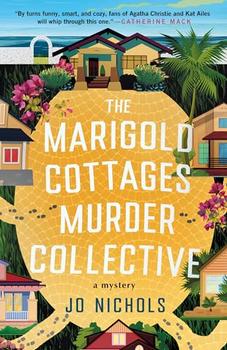
The Marigold Cottages Murder Collective (The Marigold Cottages Mysteries, 1)
by Jo Nichols
An entertaining and enjoyable cosy. (5/24/2026)
The Marigold Cottages Murder Collective is the first book in The Marigold Cottages Murders series by American writing duo Joel Ross and Lee Nichols writing as Jo Nichols. For forty years, Golda Bakofsky has looked after her tenants at the Marigold Cottages near State Street in Santa Barbara. They’re a weird bunch, eccentric, needy, broken, but they’re hers.
But one March Saturday morning, there’s a dead body in their midst, a man hit on the head with a blunt instrument, lying under the bushes. And DS Vernon Enible, typically wearing blinders, detains the man whom he sees as the most likely killer. His extensive tattoos making him look exactly like the convicted felon he is, Anthony Lambert was invited by Mrs B to rent the tiny studio behind Ocean’s cottage, after she met him at the bus stop.
To all her tenants, Mrs B insists that Anthony is innocent of the murder: there’s no evidence or motive, he didn’t know the victim; they need to find out who did it to get him released. One of their number sets up a group chat, calling it the Marigold Cottages Murder Collective, and they meet in Lawrence Hamilton’s cottage, mostly in consideration for his agoraphobia.
Each of them, except for Nicholas, who works in the local government planning department and avoids them all, has a different take on the situation: sculptor Ocean had worried about Anthony’s proximity to her children, but will do anything for Mrs B, the woman she sees as a surrogate mother; Lily-Ann, whose perfectionist workaholic tendencies broke her marriage, sees it as an exercise in lists and goals.
Hamilton’s habit of spouting non-sequitur facts may irritate, but he has a gaming friend in the police, and a novel way of getting information; and aspiring playwright Sophie notes it all down as potential material for a new work. But none really believes they can affect Anthony’s fate, until some evidence emerges that has Mrs B worried enough to present herself at the police station with a confession and a murder weapon. Now they really do need to do something!
Pre-book a chiropractic appointment before reading: this has twists and turns that even the most astute reader won’t see coming. The authors give the reader a wonderfully quirky set of characters and easily evoke the setting. This is an intriguing murder mystery with a generous helping of feel-good, and more of this cast will be most welcome. An entertaining and enjoyable cosy.
This unbiased review is from an uncorrected proof copy provided by NetGalley and Allison & Busby.
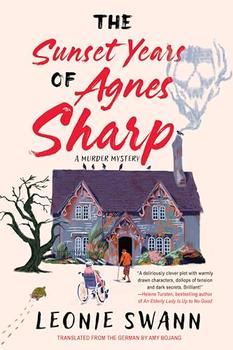
The Sunset Years of Agnes Sharp (Miss Sharp Investigates)
by Leonie Swann
a very entertaining read. (5/10/2026)
4.5
The Sunset Years Of Agnes Sharp is the first book in the Miss Sharp Investigates series by award-winning, bestselling German-born author, Leonie Swann. It is translated from German by Amy Bojang. The capacious house outside the village of Duck End was where Agnes Sharp grew up. Now it’s called Sunset Hall, a share house for like-minded elderly people who want to escape the restrictions that family and society want to put on them.
In the beginning, sparks flew, but once they got used to each other’s quirks, and set down a few rules, things have been fairly harmonious. But now, one of their number lies dead in the garden shed. So when PC Tom Wink comes to notify them of the death of their neighbor, shot by a burglar, it’s actually quite convenient: they can blame Lillith’s shooting on that burglar: problem solved!
But when Agnes goes to offer her condolences to the surviving twin at the mansion next door, she quickly realizes it was no burglar: Mildred Puck’s murder was personal. And to complicate things further, the distinctive WW2 pistol that went missing after Lillith was shot mysteriously turns up on the kitchen table.
The housemates may be elderly now, but outsiders tend to forget that they had careers, some of which might surprise. With unexpected expertise at their fingertips, the housemates try to work out who had the opportunity, and with what possible motive. Agnes comes up with some rather crazy theories about the murders, and has the wrong end of the stick most times.
Before matters are resolved: there are two more murders; an opportunistic thief is given lessons; a policeman is locked in the cellar; Agnes poses as a charity collector; Agnes sneaks into a secure Care Facility, then tries to escape; an identity is stolen; a boy is kidnapped; and a housefire is started.
With the Sunset Hall residents second guessing themselves and each other, worried about the mental state of their housemates, not to mention, sometimes, their own, the reader will be inclined to wonder if any of the narratives, except that of Hettie the tortoise, Brexit the wolfhound, and Nathan the grandson, are at all reliable. With shades of Richard Osman’s Thursday Murder Club and Tess Gerritsen’s Martini Club, this is a very entertaining read.







 Power Reviewer