
-
Your next favorite book
is waiting.
 "The less we know, the longer our explanations" – Ezra Pound
Ezra Pound (1885-1972) was a major figure in the early modernist poetry movement; in fact, some consider him to be the person most responsible for definining the modernist aesthetic in poetry.
Modernist poetry emerged in the early 20th century as a reaction to the flowery excess of Victorian poetry. The modernist poets saw themselves as extending a tradition from earlier periods and cultures such as classical Greek, Chinese and Japanese poetry, medieval Italian writers such as Dante, and English Metaphysical poets such as John Donne.
Pound was born in Idaho and graduated from Hamilton College, New York State. After teaching at Wabash College for two years, he traveled to Spain, Italy and then to England where he married and settled for a time, becoming the London editor of the Little Review in 1917.
In the mid 1920s, disillusioned by the loss of life in World War I and believing economic reform was the only way to prevent further war, he moved to Italy and became involved in Fascist politics. Between 1935 and 1945 he made frequent radio broadcasts from Rome to America, some paid for by the Italian government, criticizing the USA, Roosevelt, Jews and the global economy. He also engaged in a letter writing campaign to US politicians arguing that the war was the result of an international banking conspiracy and that the US should not get involved.
In May 1945 he was arrested and spent months in a US military camp in Pisa, Italy where he suffered a mental breakdown. Considered unfit to stand trial he was incarcerated in a psychiatric hospital in Washington DC for 12 years. He was discharged into his wife's care in 1958 with a diagnosis of permanent and incurable insanity. He returned to Italy where he died, a semi-recluse, in 1972.
He is best remembered for Ripostes (1912), Hugh Selwyn Mauberley (1920), and The Cantos, a 120 section poem written between about 1925 and 1964.
This quote & biography originally ran in an issue of BookBrowse's membership magazine. Full Membership Features & Benefits.
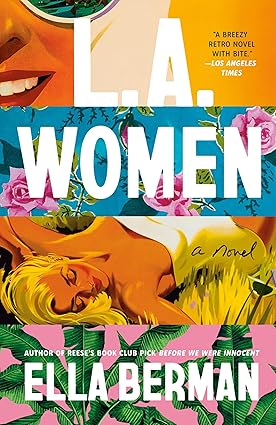
L.A. Women by Ella Berman
Two ambitious writers in 1960s LA face betrayal when one writes a novel based on the other's life.




Your guide toexceptional books
BookBrowse seeks out and recommends the best in contemporary fiction and nonfiction—books that not only engage and entertain but also deepen our understanding of ourselves and the world around us.

