
-
Your next favorite book
is waiting.
Summary | Excerpt | Reviews | Beyond the book | Read-Alikes | Genres & Themes | Author Bio

A Story of Siblinghood and Survival
by Trina Moyles Book Reviewed by:
Trina Moyles grew up the daughter of a wildlife biologist in Alberta, Canada, which has an estimated 40,000 black bears. One day in the spring of 1990 he brought home a bear cub that was orphaned when its mother was crushed in their den by logging machinery. The cub stayed with them overnight before being taken to live at Calgary Zoo. There's a photograph of the author, five years old, crouching next to the sleeping creature in their basement. It was the start of a lifelong fascination. Moyles's third nonfiction work is intimate in its focus on her relationships with her brother and with black bears, yet expansive as it surveys contemporary human–bear interactions and ponders fear, solitude, conflict, and loss.
As a child, Moyles idolized her big brother, Brendan. She loved cheering from the sidelines at his hockey games. As teenagers, they shared a penchant for alcohol and partying. His dream was to play professionally in the National Hockey League, but he failed his junior team tryouts. "A scout told him he was 'talented, but too small to make it.'" The shame of rejection lingered long after Brendan pivoted to join the oil and gas industry. As his alcohol and cocaine dependency worsened, he and Moyles became estranged. An intervention, Alcoholics Anonymous, and rehab helped for a time, but improvements were always followed by relapses. An additional factor in their separation was her commitment to environmentalism and social justice, which they both felt were at odds with his field of work.
The oil and gas business's volatility aggravated Brendan's mental ill health, and an explosive argument over values led to the siblings not speaking for a year. Moyles appreciated solitude for its own sake, too, and for several summers in a row, she barely saw another human being while working as a fire tower lookout. It was just her and her dogs. During this time, she also got the chance to observe black bears closely. At first, that was nerve-racking. Fatal bear attacks are rare but sensationalized by the media. Individual animals earn the name "nuisance bear" or "problem bear" when perceived to be interfering with human aims. (These "problems" are usually due to human actions, though, such as allowing bears to become habituated to anthropogenic food sources like garbage bins and unpicked fruit on trees.)
Over the author's first summer at Hawk Tower, she often saw one particular mother bear with two one-year-old cubs. Initially, she attempted a mutual avoidance policy, but the bears stayed near her cabin and tower. She set off an airhorn and fired rubber bullets at the adult's rump to scare the trio off. As a next-to-last resort, she called a helicopter to do a flyby. Nothing succeeded, and she began to wonder if the bears would have to be shot with real bullets.
But something magical happened at this point. By her second year at the tower, fear had turned to respect. Mutual tolerance was her new catchphrase. She started noticing a second matriarchal family unit and a few lone males. The evolution of her attitude towards the bears is evident from her language: in Year One, she wrote "its"; by Year Two, it was "her." She recognized individual animals and gave them names. The one mother bear who kept returning was "Osa"; a giant male was "Oscar" and one with cinnamon coloring was "Canelo." Respect ultimately turned to fondness. Documenting the bears' habits and behavior—including climbing or rubbing against trees, courtship rituals, and cubs nursing—was a source of delight. The bears felt like extra siblings to Moyles. "How could I say that I cared about Osa as though she were my sister? I would hesitate to say it out loud to someone, although it was true." Learning of Indigenous peoples' coexistence with and reverence for bears, as expressed through legends (see Beyond the Book), enhanced her gratitude.
At times, I thought the parallels between bear and human lives were overstated here, and that the connections drawn were too obvious and could have been left to the reader to make. There is some repetition to the multiple fire seasons and bear families that could have been reduced with a streamlined chronology. I also suspect that the content of Black Bear has rendered reading Moyles' 2021 memoir, Lookout, superfluous to a degree as it must cover some of the same material.
However, the book is full of fascinating information about bears as well as changes in government policies, shifts in relationships over time, and the march of history—for instance, the lockdown period of the Covid pandemic suited Moyles's stage of life but exacerbated conflicts with her brother, who chafed at safety measures and mocked the prime minister. Still, they'd reached a truce, and Brendan seemed to be in a good place—in recovery, with a partner and two children. His death by suicide in 2022 therefore comes as a real shock to the reader, as much as it did for the author.
Black Bear is so restrained and varied that I wouldn't define it only as a bereavement memoir. Its focus is wider; it's a clear-eyed nature book with a social conscience. Indeed, I most treasured Moyles's passion for the environment and explanations of how climate change will increase conflicts with wildlife. It's inspiring to see her determination to keep going despite personal and ecological setbacks. She also gives a beautiful picture of the potential for living peacefully alongside bears—and places value on trying to do the same with fellow humans, even when some hold ideologies that seem to make this relationship unsustainable. A neat coda to the author's story is that she now lives in the Yukon Territory and her partner is making a documentary about polar bears. It makes you think bears must be part of her destiny.
 This review
first ran in the February 11, 2026
issue of BookBrowse Recommends.
This review
first ran in the February 11, 2026
issue of BookBrowse Recommends.

If you liked Black Bear, try these:

by Maria Reva
Published 2026
Set in Ukraine, an eccentric scientist breeding rare snails crosses paths with sisters posing as members of the marriage industry to find their activist mother. As Russia invades, they embark on a wild journey with kidnapped bachelors and a last-of-its-kind snail. This darkly comic novel explores survival, love, and the impact of war.

by Miriam Toews
Published 2025
Internationally bestselling author Miriam Toews' memoir of the will to write-a work of disobedient memory, humor, and exquisite craft set against a content-hungry, prose-stuffed society.
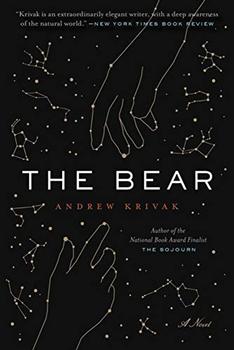
by Andrew Krivak
Published 2020
In an Edenic future, a girl and her father live close to the land in the shadow of a lone mountain.

L.A. Women by Ella Berman
Two ambitious writers in 1960s LA face betrayal when one writes a novel based on the other's life.






Your guide toexceptional books
BookBrowse seeks out and recommends the best in contemporary fiction and nonfiction—books that not only engage and entertain but also deepen our understanding of ourselves and the world around us.

