
-
Your next favorite book
is waiting.
Summary | Excerpt | Reading Guide | Reviews | Beyond the book | Read-Alikes | Genres & Themes | Author Bio

 Book Reviewed by:
Silvia Moreno-Garcia's The Bewitching follows the stories of three women living decades apart: one in 1904, one in 1934, and one in 1998. In this work by the author of Mexican Gothic, the women are whipsmart and curious, traits that draw them further into the mysteries surrounding them. All three stories center upon mysterious disappearances of loved ones—one in a Mexican farm town, and the other two at a small liberal arts college in Massachusetts. In every situation, the disappearance follows the victim's reporting of ominous activity, like being followed or finding a dead animal that seems to be a threat. Upon investigation, the disappearances begin to seem supernatural, putting the women in danger when they get too close.
I enjoyed this novel and found it to be readable and compelling while still complex enough to occupy my mind. The three women—Alba, Betty, and Minerva—are likable, and it's easy to care what happens to them. All three are independent women whose love lives are not top priority, which I always find refreshing. Alba, from 1904, helps on her family's farm in Mexico following her father's death. Betty, in 1934, is attending college when her roommate mysteriously vanishes. And in 1998, Minerva, who is Alba's great-granddaughter, is writing her thesis (on a novel written by Betty).
Of all the characters, I most identified with Minerva, first noting that she and I have some of the same books. As a fan of 90s alt-rock, I loved when the author mentioned what Minerva listened to on her Discman. She even visits Boston, where I once lived. A character walking through Copley Square listening to PJ Harvey on headphones and about to dive into the library might well have been me. I felt excited by how much I related to her and loved the specificity of the cultural details.
I also appreciated the seamlessness with which the plot unfurls. There was never a moment in which I thought a character acted unrealistically, never a too-convenient plot point, or sensationalized moment of terror. The supernatural elements enter gradually, starting as eerie sensations and shadows. Because of the subtle introductions and the realistic characters, I easily accepted even the plot points that might have otherwise been hard to believe. The pacing, too, is excellent, with the author building suspense but not drawing it out needlessly.
Aside from the three women, there are other strong characters that I liked, such as Alba's cosmopolitan but moody uncle Arturo and Minerva's fellow resident director Hideo. One of my favorite characters was Noah Yates, a man with generational wealth whose charm makes for some lively exchanges with Minerva. In a story like this, I knew some of the characters were likely to be exposed as evil, but I appreciated how multifaceted they all were.
In Betty's story, her roommate Ginny is a bohemian who readily announces her love of Spiritualism and learns everyone's astrological sign. While some of the wealthy students look down on Ginny, Betty develops romantic feelings for her. The descriptions of Ginny's smile and charm made me reflect on glamorous hippie women I have known, and I spent some pleasant time contemplating what makes some people so dazzling. (I did not find an answer.)
It was also a treat learning more about Mexican theories and practices of witchcraft. I've read a lot about the occult in various cultures, but these characters and stories were new, and I found the magic in the world of the novel fascinating. A healer gives Alba a protection spell involving a dead bird with seven pins in it; she is told to remove the pins one by one, prick her finger, and reinsert them. Alba also employs other occult tools, such as placing scissors in water beneath her bed to see if they rust overnight, which would indicate a curse. She holds a flower to a sleeping person's mouth to see if the petals droop right away, which can reveal that a person is into the dark arts. In addition to being informative, the stark visuals linger in my mind.
While The Bewitching contains plenty of horror and occult elements, I didn't find it to be a dark or cumbersome read, and there's minimal gore. I don't think it would be off-putting or alienating to those who lack prior knowledge of this kind of subject matter. (I'm even recommending it to my mom!) At the heart of the book are strong, relatable women grappling with situations they don't understand. We all know how that feels.
 This review
first ran in the July 30, 2025
issue of BookBrowse Recommends.
This review
first ran in the July 30, 2025
issue of BookBrowse Recommends.

If you liked The Bewitching, try these:

by Quan Barry
Published 2025
From the award-winning author of We Ride Upon Sticks and When I'm Gone, Look for Me in the East, a genre-bending novel of literary horror set in Antarctica that explores abandonment, guilt, and survival in the shadow of America's racial legacy.

by Ruben Reyes
Published 2025
From the author of There Is a Rio Grande in Heaven, a piercing debut novel following two families in alternative timelines of the Salvadoran civil war—a stunning exploration of the mechanisms of fate, the gravity of the past, and the endurance of love.

by Leigh Bardugo
Published 2025
From the #1 New York Times bestselling author Leigh Bardugo comes a spellbinding novel set in the Spanish Golden Age.
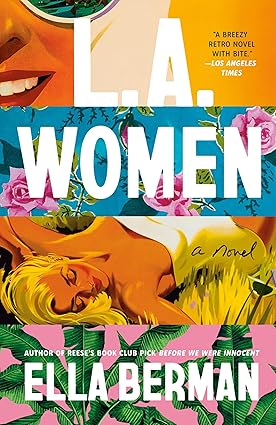
L.A. Women by Ella Berman
Two ambitious writers in 1960s LA face betrayal when one writes a novel based on the other's life.






Your guide toexceptional books
BookBrowse seeks out and recommends the best in contemporary fiction and nonfiction—books that not only engage and entertain but also deepen our understanding of ourselves and the world around us.

