
-
Your next favorite book
is waiting.
Summary | Excerpt | Reviews | Beyond the book | Read-Alikes | Genres & Themes | Author Bio

A Novel
by Ann Packer Book Reviewed by:
The title of Ann Packer's sixth work of fiction, an Oprah's Book Club selection, comes from a Christian Wiman poem in which a man sits at a woman's deathbed feeling time counting down. The speaker imagines the afterlife as "some bright nowhere / of broad fields and sunlight." That it's a "nowhere" rather than a "somewhere" makes it a sort of impossible utopia (which literally means "no place" in Ancient Greek). It also fits with the agnosticism of one of the central characters, Claire: she's not expecting there to be a heaven awaiting her when she dies. Eight years into a breast cancer journey, she has run out of treatment options, and doctors say she has three to six months left. Now she's determined to make her last days the best she can.
Emulating her late support group friend Susan, who gathered women friends and relatives around her for her final two months—creating an atmosphere of "female energy, chatter, tears, laughter"—Claire wants her two best friends, Holly and Michelle, to look after her until her death. Utopias rarely succeed, however: If Claire believes she can create a heaven on earth, or even what Holly dubs a "pretty death," she's wrong. Instead, her request leads to resentment and rivalry, especially for her husband of thirty-five years, Eliot.
The idea is that Holly and Michelle will move into Claire's suburban New Haven, Connecticut home, while Eliot will temporarily relocate to Holly's house nearby. Eliot tries to maintain a presence in his wife's life, bringing over fresh-baked blueberry scones and taking every excuse to pick up forgotten possessions. But each time, he gets the sense that he's intruding in his own home. This drives him to do uncharacteristic things such as hide in the garage to eavesdrop and hack into Holly's email to track the women down when they disappear to Maine for one last vacation at Claire's usual summer destination.
The novel is compact and intimate in its focus on relationship dynamics. Flashbacks to the central couple's therapy sessions reveal recurring issues in their marriage. Both partners were raised in repressive households but have put in the work to better express their feelings. In fact, in a poignant turn of events, their son Josh, who takes on odd jobs while trying to make it as a musician, announces that he wants to train as a therapist, suggesting that they have placed high value on emotional competence.
The close third-person narration sticks entirely to Eliot's point of view, so it's easy for readers to sympathize with his feelings of hurt and injustice—and to cheer for him as he moves from being what Josh calls an "amenable" and "benign blob" to an assertive husband who insists on fulfilling his till-death-do-us-part role. "He was going to be the one to usher Claire out of life," he decides. "It was his job, his burden, his privilege."
A downside to seeing events solely from one perspective, though, is that it's harder to see the other characters clearly, including Claire herself as she disappears into late-stage illness. There is negativity, even misogyny, in Eliot's depiction of Claire and her friends. He thinks of them as a "coven," following Holly's ex's reference to them as "three witches," and uses Claire's joking phrase "death spa" in a disparaging way. Perhaps because he's been socialized as a man, he can't relate to the women's experience of friendship, and so he takes offense and mocks their exclusivity. Claire and Eliot's daughter, Abby, encourages Eliot to think of Holly and Michelle more charitably, as being like death doulas.
Packer doesn't shy away from the physical realities of Claire's decline, including vomiting, a bad fall, and memory lapses and hallucinations due to brain metastases. The author also frankly depicts Eliot's anxiety and anger, which are tied to his lack of control, and his coping mechanisms, some of them healthier than others: running, drinking alcohol, and cooking elaborate dishes. His interest in food is encouraged by his dinner club of five men friends. The contrast between female and male friendship is an underlying theme in the book: Eliot feels awkward confiding in friends, doesn't understand the depth of Claire's connection with Holly and Michelle, and ultimately feels that he has no one he can rely on.
Although I wondered how the scope might have been expanded by switching between various points of view, I admired the out-of-the-ordinary approach to the terminal cancer plot. Death is an inexorable process, but Packer leaves matters beautifully open-ended. The final scene closes on a community of family and friends divvying up the labor of caregiving: "Everyone took turns administering morphine because they wanted to share the work." The hope offered here is not of heaven, nor of a perfectly orchestrated death, but of flawed humans doing the best they can and coming together to lighten each other's load of grief.
 This review
first ran in the January 14, 2026
issue of BookBrowse Recommends.
This review
first ran in the January 14, 2026
issue of BookBrowse Recommends.

If you liked Some Bright Nowhere, try these:
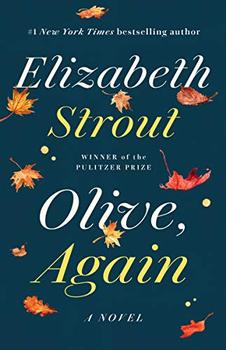
by Elizabeth Strout
Published 2020
Winner of the 2019 BookBrowse Fiction Award
Prickly, wry, resistant to change yet ruthlessly honest and deeply empathetic, Olive Kitteridge is "a compelling life force" (San Francisco Chronicle).
by Meg Wolitzer
Published 2014
The Interestings explores the meaning of talent; the nature of envy; the roles of class, art, money, and power; and how all of it can shift and tilt precipitously over the course of a friendship and a life.

by Helen Garner
Published 2010
A powerful, witty, and taut novel about a complex friendship between two women—one dying, the other called to care for her—from an internationally acclaimed and award-winning author.
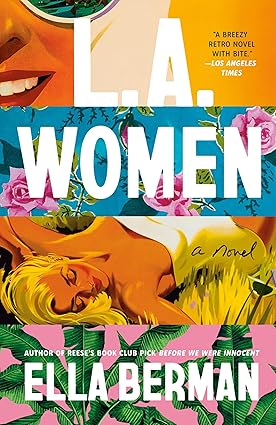
L.A. Women by Ella Berman
Two ambitious writers in 1960s LA face betrayal when one writes a novel based on the other's life.






Your guide toexceptional books
BookBrowse seeks out and recommends the best in contemporary fiction and nonfiction—books that not only engage and entertain but also deepen our understanding of ourselves and the world around us.

