
-
Your next favorite book
is waiting.
Summary | Excerpt | Reviews | Beyond the book | Read-Alikes | Genres & Themes | Author Bio

A Memoir
by Geraldine Brooks Book Reviewed by:
After she was widowed, author Geraldine Brooks busied herself with the unbearable duties of sudden death. She wasn't bereft so much as she was altered and rearranged. Married to the writer Tony Horwitz for thirty-four years, she had assumed their later life would be of the same weight as the previous decades. In May of 2019, Tony was in the midst of a grueling tour for his book Spying on the South. A break in the tour schedule had Tony at his brother's house to recharge. He was due at a dinner party in a few hours. But after a casual lunch in a café on Northampton Street in Washington, DC, he elegantly drifted to the ground with the poise of a fluttering leaf. And died there. He was sixty years old. It was Memorial Day.
The news that Tony had died was delivered to Brooks by an exhausted emergency room physician who left no room for empathy or compassion. It all felt acutely absurd. A Pulitzer Prize-winning reporter turned author, Tony had ducked snipers in Sarajevo and dodged rifle fire in Romania and hiked the outback of Australia. That he would perish on a city street in the middle of the day, rushed to the same hospital where both his father and grandfather had been surgeons, felt like an unsolvable riddle.
Brooks was given a plastic bag that held her husband's belongings: flip-flops, phone, glasses, a newspaper page, wallet. She nearly collapsed after she was told she couldn't see him. "It's DC, we get gunshot casualties, angry people…" The candor wasn't appreciated when all she wanted was to see her husband, to touch his face, to lean into his everything. Hovering over her was this terrible anxiety about her life and the sledgehammer that had dissolved it into shards. Now she was denied the only remaining thing a human wants in times like these: grace.
While trauma is a private assault, a widow's trauma lives on skin, metastasizing in light. Only she sees the damage. In those early days, Brooks acquiesced to the performance. She numbly walked through her lines as the forlorn spouse. She said the right things. Accepted tenderness and concern. She finished her novel Horse. She mothered her sons. She canonized Tony. But she didn't grieve. She didn't settle into her memories of Tony so much as she clung to her personal snapshots of him; yet it wasn't enough for her to be alive and breathing and in flux.
Not quite four years after Tony died, Brooks, Australian-born writer of both fiction and nonfiction, moved to the farthest end of Flinders Island in the Bass Strait for two specific reasons. She wanted to unpack every inch of buried grief. To do the unfinished work, as she often called it. To pay the promissory note that was long ago due. And she wanted to examine her compromise of leaving Australia and raising her children on Martha's Vineyard. Was this choice responsible for her current despair? Had she chosen Australia for her family, would Tony still be alive? Had she traded one beautiful thing for one terrible thing? Reflections like these make up her memoir Memorial Days.
"I am here all alone in this beautiful place." She rented a three-room shack that overlooked the sea and Mount Killiecrankie. "It's a gray, windy morning, and the sea is high. I have only a loose notion of how I will spend my time here. I will walk and reflect, taking whatever solace nature cares to offer me."
After Tony died, something happened that was unsettling, mostly because Brooks didn't believe in an afterlife or the dead speaking to the living. A cousin of Tony's emailed her to tell her a psychic had seen a vision of Tony post-death, surrounded by a mass of yellow and red flowers. Brooks thought nothing of it. And then a year later, in spring, tulips pushed through the earth. Tulips she never planted because the squirrels chew up the bulbs and make a mess of the garden. These flowers were yellow and red with glistening petals, exactly how the psychic had described. Where had they come from?
Books about death, whether sudden and unpredictable death like what happened to Tony, a protracted illness, or the product of impulsive rage, often center upon the existential question of adjustment. What happens when one person dies, what is to become of your life? Within this diminishment and raw mourning and dare I say confusion, the brain somehow, from its slippery fog, erases. Brooks remembered small things. "I've always loved his hands. Big, meaty, peasant hands. His touch, insistent with desire. The weight of his arm flung over me before we fell asleep."
Her mother had raised her to save her tears. Don't wallow. Keep moving ahead. What Brooks cherished about adulthood was the opposite, crying whenever she wanted. She tells of being in the West Bank and mistakenly driving past a school at the wrong hour. Her car was pelted with stones and chunks of concrete. After yelling at the boy perpetrators, adults came outside and ushered her in, offered her tea and comfort. She was hysterical and then embarrassed at her display. The people who were comforting her had experienced things she would never know. Their life was military occupation and extremist Israeli settlers. Nevertheless, long-suppressed tears were a dam waiting for the right circumstance to break; she couldn't stop herself from weeping like there was no tomorrow.
And then the hard truth. For Tony, those kinds of tears never came. It scared her. She remembered that day in Hebron in the West Bank and thought if she ever cried like that again her entire body would dissolve. She did what many grievers do to cope. She normalized the experience: "We will all die. We will all grieve. Women lose their husbands. Widows, widows everywhere."
During her self-imposed exile, a catastrophe occurred in Turkey and Syria. An earthquake trapped and killed thousands. The magnitude of the loss forced her to reexamine the width of her grief. She questioned if it was empathic to mourn a man in his sixties when the world was a calamitous place where thousands could perish at any moment. This is the rare passage where the author gives herself permission to think of something other than her own suffering, and although it only spans a page or two, it is a reminder of how solace is often interrupted by unfathomable crises in the world.
I want to mention a book I read several years ago by Nigerian author Chimamanda Ngozi Adichie, Notes on Grief. There is this beautiful description of what happens after death. For Adichie, it was her father she mourned. "Grief is a cruel kind of education. You learn how ungentle mourning can be…you learn how much grief is about language, the failure of language, the grasping for language."
For Brooks, language was her comfort; her thoughts of the last time she saw Tony in Nashville, to interview him. She replayed the last words he said to her in an aural loop. I can't believe it's ten days before I'll see you again. I can't believe it's ten days before I'll see you again. I can't believe it's ten days before I'll see you again.
More than one writer has noted that the popularity of grief memoirs has to do with how they practice grief. But that isn't quite it. It's not the practice of grief that they are providing, but the living through grief, the missing of someone and the surviving of it. We will all lose someone we love, if we have not already, and it's only human to admire those who have been dealt a horrible hand and can talk about it with clarity. It is what makes Memorial Days so striking as a remembrance. It's a story about sudden death and trauma and it's a story about being in love. In practical human terms, Geraldine Books explains what it is like to love someone with every inch of your life and then to have that life slip away from you on a Monday in May.
 This review
first ran in the December 10, 2025
issue of BookBrowse Recommends.
This review
first ran in the December 10, 2025
issue of BookBrowse Recommends.

If you liked Memorial Days, try these:
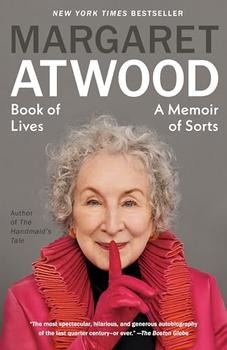
by Margaret Atwood
Published 2026
How does one of the greatest storytellers of our time write her own life? The long-awaited memoir from one of our most lauded and influential cultural figures.
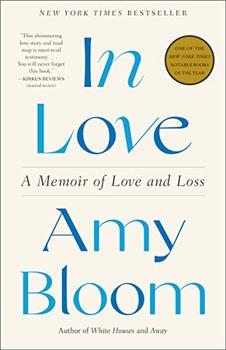
by Amy Bloom
Published 2023
Winner of the 2022 BookBrowse Nonfiction Award
This powerful memoir by New York Times bestselling author Amy Bloom is an illuminating story of two people whose love and shared life experiences led them to find a courageous way to part - and of a woman's struggle to go forward in the face of loss.
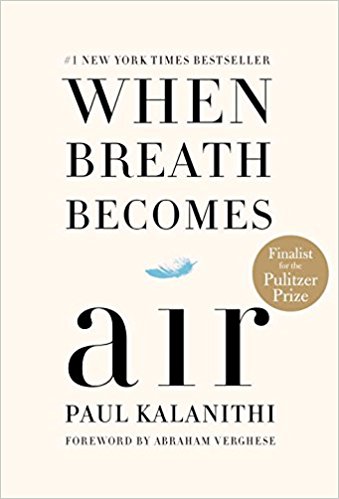
by Paul Kalanithi
Published 2016
Winner of the 2016 BookBrowse Nonfiction Award
For readers of Atul Gawande, Andrew Solomon, and Anne Lamott, a profoundly moving, exquisitely observed memoir by a young neurosurgeon faced with a terminal cancer diagnosis who attempts to answer the question What makes a life worth living?

L.A. Women by Ella Berman
Two ambitious writers in 1960s LA face betrayal when one writes a novel based on the other's life.




Your guide toexceptional books
BookBrowse seeks out and recommends the best in contemporary fiction and nonfiction—books that not only engage and entertain but also deepen our understanding of ourselves and the world around us.

