
-
Your next favorite book
is waiting.
Summary | Excerpt | Reviews | Beyond the book | Read-Alikes | Genres & Themes | Author Bio

An Oral History of the New York Commune, 2052–2072
by M.E. O'Brien, Eman Abdelhadi Book Reviewed by:
Everything for Everyone is a mock work of academic history structured like a series of interviews, established in its introduction as a history designed to give readers insight into events that took place from 2052 into the 2060s surrounding the creation and sustenance of what is called the New York Commune. The people conducting the interviews are the authors, M.E. O'Brien and Eman Abdelhadi, but their subjects, and the accounts they provide, are entirely fictional. In the universe of the book, the 2030s-2040s saw massive economic decline, catastrophic effects of climate change, the outbreak of another pandemic, and another war between the United States and Iraq. In the 2040s, as a result of such widespread human misery, people started to rise up, defeating the capitalist state and replacing it with localized self-governing and self-sustaining communes—first in the Andes, and then in China, in India, and eventually the United States by the 2050s. At the time the interviews take place, only Australia continues with the old, oppressive ways of life.
Absent a centralized US government, communes developed regionally, and the book centers around the development specifically of the New York Commune, which is home to residents of the five boroughs of New York City as well as parts of New Jersey. (A "commune" in this world is essentially an interconnected neighborhood; people generally have their own living spaces and are required to contribute only a handful of hours a week to commune maintenance. People then do what we consider "work" outside the commune about ten hours a week.) Over the course of the interviews, the reader pieces together the history of how this incredible institution has been created and maintained to feed, clothe, house, and help to thrive every resident of the area without traditional wage employment; without police, prisons, and military; without the cudgels of racism, xenophobia, homophobia, and misogyny that keep people's dreams and expectations small in our present world.
The first interview sets the stage by narrating the events of what could be perceived as the first battle in the revolutionary takeover of New York City: the Insurrection of Hunts Point. We meet Miss Kelley, a trans woman who has been engaged in skincraft (or what we now call sex work) in the Bronx since the 2040s. She recalls the rampant famine in the area at the time, resulting in increasing desperation that exploded one night at the Hunts Point produce market. Neighborhood residents descended on this last bastion of food (which was largely being distributed to the US military and the uber wealthy who could pay exorbitant inflation costs) and engaged in battle with the Army. The uprising was successful, and this victory represented a major turning point in what many people could imagine their lives to be. Miss Kelley's narration is electrifying.
In the chapters that follow, O'Brien and Abdelhadi present interviews that demonstrate the different ways of living that have developed in this future world where people no longer have to burn themselves out daily with unceasing labor to have their basic needs met. What emerges is a beautiful, carefully constructed ecosystem of communal care that highlights the greatest facets of the human condition. In the commune, people still have private living spaces, but multiple families or couples often choose to live together, raising children as a group so that no one person is responsible for taking care of all of a child's needs. When teenagers quarrel with their parents, they are permitted to move into a private living space with other teens and respectfully distanced adult supervision, so they can learn responsibility and conflict management. On a larger scale, the ivy tower has been toppled; knowledge and resources for space exploration, for instance, have been disseminated to the people.
While most of the events and aspects of life at the commune take place in the New York metropolitan area, there is an occasional dip into the international, as in the chapter "Hassan on Liberating the Levant," in which a Brooklyn resident recalls the successful uprising that freed Palestine from Israeli occupation in the 2040s. Given present-day events, this chapter is especially cathartic. (Abdelhadi is of Palestinian and Egyptian descent and known for her activism against the Israeli occupation.)
A non-linear plot is constructed out of these interviews that follows how things changed over the twenty-year period covered, but Everything for Everyone is a revolutionary novel in ways beyond just subject matter. It is a utopian vision with minimal conflict or dramatic tension (see Beyond the Book). Of course, some chapters feature an event like Hunts Point, and in some interviews we meet characters who are suffering from post-traumatic stress disorder or other mental health challenges as a result of things that happened to them during the revolution. But the majority of the book tells the vibrant, joyful story of people coming together to create something new, and better, and helping each other become better in the process. This is a different kind of storytelling to match a very different future world—with Everything for Everyone as a blueprint, we can start building that world today.
 This review
first ran in the November 5, 2025
issue of BookBrowse Recommends.
This review
first ran in the November 5, 2025
issue of BookBrowse Recommends.

If you liked Everything for Everyone, try these:

by Richard Powers
Published 2025
A magisterial new novel from the Pulitzer Prize–winning and New York Times best-selling author of The Overstory and Bewilderment.

There Is a Rio Grande in Heaven
by Ruben Reyes
Published 2025
An electrifying debut story collection about Central American identity that spans past, present, and future worlds to reveal what happens when your life is no longer your own.
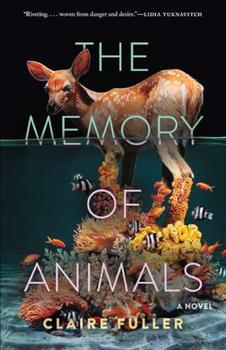
by Claire Fuller
Published 2024
From the award-winning author of Our Endless Numbered Days, Swimming Lessons, Bitter Orange, and Unsettled Ground comes a beautiful and searing novel of memory, love, survival—and octopuses.
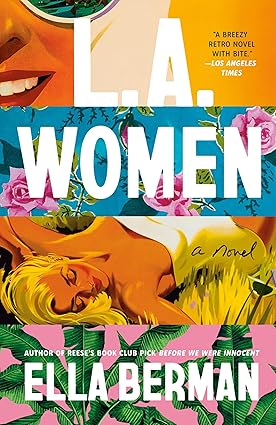
L.A. Women by Ella Berman
Two ambitious writers in 1960s LA face betrayal when one writes a novel based on the other's life.






Your guide toexceptional books
BookBrowse seeks out and recommends the best in contemporary fiction and nonfiction—books that not only engage and entertain but also deepen our understanding of ourselves and the world around us.

