
-
Your next favorite book
is waiting.
Summary | Excerpt | Reviews | Beyond the book | Read-Alikes | Genres & Themes | Author Bio

 Book Reviewed by:
Miriam Toews, author of seven novels including the international bestsellers Women Talking and All My Puny Sorrows, has written directly about her life for the first time in her memoir A Truce That Is Not Peace. The book is Toews' attempt to answer the question, "Why do I write?"
As a conceit, she invents a fictional event in Mexico City, where writers from around the world are asked to present stories or essays on a committee-chosen topic: why they write. Each section begins with Toews' progress in providing a response. In Part 2, her submission is deemed "not altogether what they are looking for." By Part 4, the committee director tells her that her work remains unsuitable and urges her to focus solely on the core question: "Please you must simply answer the question: Why Do I Write? What is your reason?" Throughout the book, she explores the core question through the inclusion of archival letters she wrote to her sister, stories about her family, and reflections on her desire to write. The final part opens with "Why do I write? Because she asked me to." Ultimately, she explains how her craft is intertwined with her attempts to understand her father and sister—their silences, and their deaths, both by suicide. A Truce That Is Not Peace is a tragic, darkly humorous, and contemplative exploration of grief, artistic ambition, what silence conveys, and how writing sustains life.
Toews creates a fragmented, non-linear narrative, which includes, in addition to the letters to her sister, lists of methods of suicide used by notable figures, plans for something called a wind museum she wishes to build, and descriptions of her roles as a caretaker for her mother and as a grandparent. She sprinkles in quotes from famous writers about grief and writing every few paragraphs, adding perspective and understanding about how difficult it is to answer the committee's seemingly simple, straightforward question. Anyone familiar with Toews' work will recognize her humor and details from her family life, from her upbringing in the Mennonite community to the deaths of her father and sister. Newcomers might take longer to find their footing. As someone familiar with her work, even I struggled—I found the structure somewhat disjointed, as she takes a piecemeal approach to exploring the core question. But once you accept the format, it becomes a more enjoyable reading experience. You become immersed in the author's mind, exploring the meandering and challenging process of investigating the act and purpose of writing. As Toews conveys, this process can lead you to answers that don't provide much clarity or resolution.
Toews wrestles profoundly with her grief over the deaths of her sister and father. They took their own lives in identical ways; her sister's death in 2010 was 12 years to the day after their father's. In both cases, there were long stretches of silence before their deaths.
"My sister's silence was a creative act – or was it? Had her suffering destroyed her language, or faith in language, and left her unable or unwilling to speak? Or was her silence a creative choice, an act of creation, an effort? Or was it language, or its futility, its shortcomings, that destroyed her first."
Toews notes that she initially started writing to fulfill a promise to her sister. This was in the 1980s, when she was traveling often with her boyfriend, while her sister, due to her declining mental health, remained at home. She struggles to pinpoint why she has continued writing many years later. Still, she views it as a means of better understanding her father and sister, hoping for clarity about their lives and, more acutely, their deaths.
"Was writing in the voice of my father an act of compassion? Or born of an urgent need to know why and how, a creative act from a deep, dark hole, a well of fear: Would I do it, too? If I could become my father, I would understand. And if I could understand why and how, I could understand why not and how not."
The book takes its title and epigraph from writer Christian Wiman, who is also quoted several times throughout: "...that those of us who have gone to war with our own mind there is yet hope for what Freud called 'normal unhappiness,' wherein we might remember the dead without being haunted by them, give to our lives a coherence that is not 'closure,' and learn to live with our memories, our families, and ourselves amid a truce that is not peace."
A Truce That Is Not Peace aims to answer unanswerable questions about grief, silence, and writing as a form of survival. It's ideal for readers who enjoy literary memoirs that eschew a linear narrative in favor of philosophical exploration.
 This review
first ran in the October 22, 2025
issue of BookBrowse Recommends.
This review
first ran in the October 22, 2025
issue of BookBrowse Recommends.

If you liked A Truce That Is Not Peace, try these:
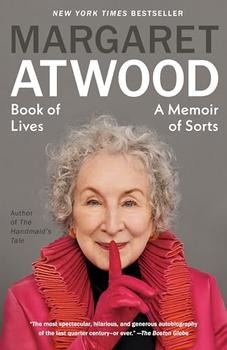
by Margaret Atwood
Published 2026
How does one of the greatest storytellers of our time write her own life? The long-awaited memoir from one of our most lauded and influential cultural figures.

by Trina Moyles
Published 2026
A dazzling memoir about one woman's coexistence with bears in the boreal forest and a singular meditation on sibling loss.
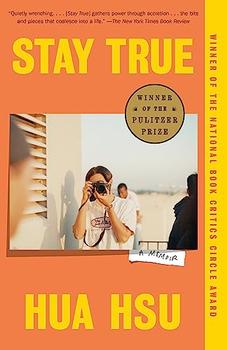
by Hua Hsu
Published 2023
From the New Yorker staff writer Hua Hsu, a gripping memoir on friendship, grief, the search for self, and the solace that can be found through art.

In order to become the master, the politician poses as the servant
Click Here to find out who said this, as well as discovering other famous literary quotes!

Can you name the title?
Test your book knowledge with our daily trivia challenge!
Your guide toexceptional books
BookBrowse seeks out and recommends the best in contemporary fiction and nonfiction—books that not only engage and entertain but also deepen our understanding of ourselves and the world around us.
